Summary of Final Guidance on Improving EPA Review of Appalachian Surface Coal Mining Operations Under the Clean Water Act, National Environmental Policy Act, and the Environmental Justice Executive Order
On July 21, 2011, EPA released final guidance to its Appalachian Regional offices to clarify EPA’s roles and expectations, in coordinating with Federal and State partners, to assure more consistent, effective, and timely review of Appalachian surface coal mining operations with respect to provisions of the Clean Water Act (CWA), the National Environmental Policy Act (NEPA), and the Environmental Justice Executive Order (E.O. 12898).
Clean Water Act Section 402
EPA’s final guidance reiterates the importance of protecting water quality through state-issued National Pollutant Discharge Elimination System (NPDES) permits for Appalachian surface coal mining operations. As EPA Regions exercise their Clean Water Act responsibility to oversee authorized state NPDES programs, Regions should work to ensure that permits comply with the Clean Water Act in the following ways:
• Ensure Adequate Effluent Characterization: The applicant should characterize the effluent from the proposed operation using facility-specific data, data from similar mining operations, or data submitted in support of permit applications under other laws.
• Conduct Adequate Reasonable Potential Analyses: The permitting authority should conduct an adequate analysis as to whether a discharge has the reasonable potential to cause a violation of both narrative and numeric water quality standards. States should meaningfully implement narrative standards and reflect best-available science, such as the 300 μS/cm value derived in EPA’s final conductivity benchmark report μS/cm described in Pond et al. 2008.
• Set Water Quality-Based Effluent Limits: For parameters that are shown to have reasonable potential, the permitting authority should set water quality-based effluent limits necessary to achieve water quality standards. With respect to conductivity, states can implement this requirement through a numeric limit for conductivity or a numeric effluent limitation for other parameters, presuming such a limitation is scientifically defensible and adequately protective.
• Incorporate WET Limits: Permits should also generally include a limit for Whole Effluent Toxicity (WET) where reasonable potential exists, but such limits alone are generally not protective unless coupled with other numeric effluent limits.
• Incorporate Other Permit Conditions: The permitting authority may also include other permit conditions to protect narrative standards, such as measurements of the in-stream biological community (bioassessment), Best Management Practices (BMPs) for reducing downstream water quality concerns, water quality offsets, and sequencing of valley fills (whereby a multiple-fill project is constructed one fill at a time so as to demonstrate water quality protection).
• Address Other Permitting Considerations: The permitting authority should effectively implement antidegradation analyses in support of any lowering of water quality. Regions should also work with states to ensure protective general permits, address watershed-level water quality impacts in addition to localized effects, and ensure adequate consideration of environmental justice issues and adequate community participation in the permitting process.
Clean Water Act Section 404
As Regions review permit applications for surface coal mining activities under Section 404 of the Clean Water Act, they should ensure that permits comply with the Section 404(b)(1) Guidelines and other applicable Clean Water Act regulations in the following ways:
• Analyze Less Damaging Practicable Alternatives: Regions should coordinate with state and federal agencies to find ways to reduce impacts to waters of the United States.
• Protect Against Water Quality Standards Violations: Regions should evaluate the extent to which a proposed project has the potential to violate water quality standards, consistent with best-available science. Regions should inform the U.S. Army Corps of Engineers (Corps) of EPA’s concerns if EPA believes that the project, considering permit conditions imposed under other authorities, is likely to violate such standards.
• Prevent Significant Degradation: Regions should be informed by the available science on the downstream water quality effects of surface coal mining operations, including the 300-500 μS/cm peer-reviewed conductivity science described above. To prevent significant degradation, Regions should, for example, recommend permit conditions that include numeric triggers for conductivity (or similar parameters), that are tied to adaptive management actions, and that incorporate offsets in already degraded watersheds (as appropriate) in order to promote watershed-level restoration.
• Minimize Impacts: Regions should recommend implementation of appropriate BMPs on a case-by-case basis to help prevent downstream water quality impacts from conductivity, selenium, and other parameters. Techniques could include materials handling plans, fill construction best practices, sediment pond impact reductions, and sequencing of multiple valley fills.
• Adequately Mitigate for Project Impacts: Regions should ensure that adequate structural and functional assessments are conducted and that mitigation timeframes, monitoring, and adaptive remedial action are adequately incorporated. Regions should carefully review proposals for stream creation and ditch conversion, which the scientific literature has shown may not compensate for lost stream functions.
Regions should also work to ensure that Section 404 permits require adequate water quality and biological monitoring and that the Regions evaluate and make recommendations for mitigating potential environmental justice concerns while ensuring effective public participation.
Clean Water Act Section 401
EPA Regions should work with states to ensure that they meaningfully utilize their Section 401 certification authority in order to protect state water quality standards.
National Environmental Policy Act (NEPA)
Regions should work with the Corps and the Office of Surface Mining (OSM), as appropriate, to:
• Ensure the public availability of key NEPA documents, such as draft environmental assessments;
• Engage with local communities, including low-income and minority populations, to identify potential adverse human health and environmental impacts and mitigation measures;
• Conduct appropriate watershed watershed-scale cumulative impact analysis;
• Review the use of mitigation measures to ensure that they will be effective at avoiding or compensating for significant impacts; and
• Recommend preparation of an Environmental Impact Statement (EIS) when impacts are not reduced to levels below significance.
Environmental Justice Executive Order (E.O. 12898)
Regions should work with States, the Corps and OSM to ensure that applicable provisions of the Clean Water Act and NEPA are recognized as opportunities to address environmental hazards in minority communities and low-income communities, to prevent disproportionate environmental and human health effects, and to provide transparency and meaningful participation by these communities in government decision-making regarding surface coal mining. (EPA)
The Center, founded in 1985, is an environmental organization dedicated to protecting the environment, enhancing human, animal and plant ecologies, promoting the efficient use of natural resources and expanding participation in the environmental movement.
Thursday, July 21, 2011
Tuesday, July 19, 2011
Mitt Romney Playing Both Sides of Climate Change Card (Again)
Mitt Romney, left, stated at a recent town hall meeting in Derry, New Hampshire that he does not think carbon pollution threatens human health and would not green-light EPA climate regulations if he were in the White House. The GOP presidential candidate signaled the reversal to one of the Obama administration's top environmental policies six weeks after he acknowledged during a campaign stop that global warming is real.
According to Romney,
So it appears that Romney believes that humans have contributed to climate change, but he believes that it does not pose a threat to human health.
As governor in Massachusetts, Romney took the opening steps toward joining a cap-and-trade compact for power plants known as the Regional Greenhouse Gas Initiative. But he pulled out of the program just before it formed in late 2005. (Politico, 7/18/2011)
According to Romney,
"My view is that the EPA in getting into carbon and regulating carbon has gone beyond the original intent of that legislation, and I would not take it there,"Romney last month ignited conservative complaints when he told a New Hampshire audience that he believed in the widespread scientific consensus that humans have contributed to a warming planet.
So it appears that Romney believes that humans have contributed to climate change, but he believes that it does not pose a threat to human health.
As governor in Massachusetts, Romney took the opening steps toward joining a cap-and-trade compact for power plants known as the Regional Greenhouse Gas Initiative. But he pulled out of the program just before it formed in late 2005. (Politico, 7/18/2011)
EPA Extends Comment Period For Cooling Water Systems
Cooling Water Intake Structures Proposed Rule
In response to requests from stakeholders and to encourage additional public comment, the U.S. Environmental Protection Agency (EPA) is extending the public comment period by 30 days for the cooling water intake structures proposed rule. This change will not affect EPA’s schedule for issuing a final rule by July 27, 2012.
This proposed rule, based on Section 316 (b) of the Clean Water Act, aims to protect billions of fish and other aquatic organisms drawn each year into cooling water systems at large power plants and factories.
The original 90-day public comment period was originally set to expire on July 19, 2011. EPA will publish a notice of this 30-day extension in the Federal Register.
More information
In response to requests from stakeholders and to encourage additional public comment, the U.S. Environmental Protection Agency (EPA) is extending the public comment period by 30 days for the cooling water intake structures proposed rule. This change will not affect EPA’s schedule for issuing a final rule by July 27, 2012.
This proposed rule, based on Section 316 (b) of the Clean Water Act, aims to protect billions of fish and other aquatic organisms drawn each year into cooling water systems at large power plants and factories.
The original 90-day public comment period was originally set to expire on July 19, 2011. EPA will publish a notice of this 30-day extension in the Federal Register.
More information
American Nuclear Power Companies Want India Market
The 1984 Bhopal gas disaster that claimed more than 15,000 lives has made India wary about trusting foreign firms with potentially volatile technologies. The recent Japan nuclear power plant disaster has only served to fortify India's wariness.
With its economy and its demand for energy growing rapidly, India wants to raise its nuclear power generating capacity from the current 5,000 megawatts a year to more than 60,000 megawatts by 2032.
An additional complication is that before India can buy American and French reactors, New Delhi has to sign a nuclear cooperation deal with Japan. Those reactors use Japanese parts and technology, which cannot be supplied until Japan changes its law to allow nuclear trade with India. Another complication occurred last month when the Nuclear Suppliers Group, which has about four dozen members, voted at a meeting in The Hague to bar access to sensitive uranium enrichment and reprocessing technology, which can be used to make atomic bombs, to countries that have not signed the Non-Proliferation Treaty.
The Center supports the U.S. effort to build nuclear power plants in India. And if the U.S. companies are confident in the safety of their technology, there should be no reason for them to adhere to India's self indemnification requirement. (Wash Post, 7/19/2011)
Monday, July 18, 2011
Power NY Act of 2011
Article 10 Reauthorization Law
The Power NY Act of 2011
The New York Legislature has passed and Govern Andrew Cuomo has signed the “Power NY Act of 2011.” Section 12 of the new law reauthorizes and modernizes Article X of the Public Service Law, which expired on January 1, 2003, governing the siting and approval of power plants in New York.
Like its predecessor, the new version of Article X aims to centralize and streamline the siting approval process, although the threshold for application of the law has been lowered from 80 to 25 megawatts. The law creates and vests permitting authority with the New York State Board on Electric Generation Siting and the Environment (“the Board”). The statute provides that two local residents will be part of the Board with the other five members being State officials for each proceeding. The law also provides for “intervenor funding” which will enable municipalities and other local parties to participate in all phases of the administrative review, including the mandated adjudicatory hearing.
The Board is given authority to override local laws and ordinances if they are “unreasonably burdensome.” Unless otherwise agreed to by an applicant or extended due to a “material and substantial amendment to the application” or “extraordinary circumstances,” Board decisions must be rendered within a year of the application being deemed complete.
Article X displaces the State Environmental Quality Review Act (SEQRA) process for covered projects, but mandates several environmental analyses of the facility’s impacts. These analyses include a “cumulative air quality analysis” of the combined effects from the proposed facility, other proposed sources and all existing sources; a description of the demographics of the surrounding community; and a description of “reasonable and available” alternative locations. It also requires the Board to find that the project minimizes or avoids disproportionate impacts on the surrounding community.
There are significant differences between the new version of Article X and the expired version. The lower 25 megawatt threshold will allow smaller projects to be covered by the law and may particularly benefit developers of wind projects, which in most cases would not have been covered by the expired version. The increased emphasis on environmental justice impacts addresses concerns stated by environmental groups. Current applicants for local and state permits for a power plant may elect to be covered by the new law. (Sive, Paget & Riesel, PC)
Governor Cuomo’s Memorandum on the Legislation
The Power NY Act of 2011
The New York Legislature has passed and Govern Andrew Cuomo has signed the “Power NY Act of 2011.” Section 12 of the new law reauthorizes and modernizes Article X of the Public Service Law, which expired on January 1, 2003, governing the siting and approval of power plants in New York.
Like its predecessor, the new version of Article X aims to centralize and streamline the siting approval process, although the threshold for application of the law has been lowered from 80 to 25 megawatts. The law creates and vests permitting authority with the New York State Board on Electric Generation Siting and the Environment (“the Board”). The statute provides that two local residents will be part of the Board with the other five members being State officials for each proceeding. The law also provides for “intervenor funding” which will enable municipalities and other local parties to participate in all phases of the administrative review, including the mandated adjudicatory hearing.
The Board is given authority to override local laws and ordinances if they are “unreasonably burdensome.” Unless otherwise agreed to by an applicant or extended due to a “material and substantial amendment to the application” or “extraordinary circumstances,” Board decisions must be rendered within a year of the application being deemed complete.
Article X displaces the State Environmental Quality Review Act (SEQRA) process for covered projects, but mandates several environmental analyses of the facility’s impacts. These analyses include a “cumulative air quality analysis” of the combined effects from the proposed facility, other proposed sources and all existing sources; a description of the demographics of the surrounding community; and a description of “reasonable and available” alternative locations. It also requires the Board to find that the project minimizes or avoids disproportionate impacts on the surrounding community.
There are significant differences between the new version of Article X and the expired version. The lower 25 megawatt threshold will allow smaller projects to be covered by the law and may particularly benefit developers of wind projects, which in most cases would not have been covered by the expired version. The increased emphasis on environmental justice impacts addresses concerns stated by environmental groups. Current applicants for local and state permits for a power plant may elect to be covered by the new law. (Sive, Paget & Riesel, PC)
Governor Cuomo’s Memorandum on the Legislation
Center Still Hopeful Blue Jobs Will Develop
The United States will need significant additional electricity capacity to meet future demand. There has been much debate about green jobs, including defining exactly what qualifies as such. America needs wind, solar, hydro, natural gas, coal, and nuclear to meet our future electricity needs. Unfortunately, America appears to be falling behind in building sufficient new capacity to support a reinvigorated economy.
The Center was out front in promoting a mix of energy sources to produce electricity. However, to effectively and efficiently provide electricity in bulk baseload to miilions of households, nuclear power should be the primary source to achieve this goal. We hoped that numerous blue jobs would be created with the so-called 'Nuclear Power Renaissance.' Alas, the renaissance stalled even before the Fukushima Daiichi disaster in Japan. Also, unfortunately, our support for nuclear power has not led to any job creation. Not one additional job was even created at the Center due to promotion of blue power. Considering that nuclear should still be a significant part of the electricity generation mix, we wonder if any new blue jobs will ever be created now.
Why blue jobs? Even though nuclear power in America has been green, we think that a unique designation is needed due to the unique technology. A bright blue glow surrounds 'swimming pool' reactors. The blue glow results from gamma rays knocking out electrons from whatever they hit, such as the hydrogen and oxygen in the water. The light produced appears as a blue glow underwater. The radiation is called Cerenkov radiation, after the Russian scientist whose experiments led to its explanation. Spent fuel pools also have the blue glow. Thus, the blue jobs designation, which sounds better than Cerenkov jobs. (Albert B. Reynold, "Bluebells and Nuclear Energy,")
The Center has pursued all kinds of blue jobs, from partial nuclear plant ownership to promotion of new technologies. We formed the Nuclear Fuels Reprocessing Coalition in 2003 to promote recycling nuclear fuel (see logo upper right). We believe that blue jobs cover the spectrum from electricians and pipe fitters to nuclear physicists to upper management. These jobs cover the rank and file and ownership opportunities. We hope this industry can rebound to create millions of new blue jobs. It would be ideal if some of those jobs originated at the Center.
The Center was out front in promoting a mix of energy sources to produce electricity. However, to effectively and efficiently provide electricity in bulk baseload to miilions of households, nuclear power should be the primary source to achieve this goal. We hoped that numerous blue jobs would be created with the so-called 'Nuclear Power Renaissance.' Alas, the renaissance stalled even before the Fukushima Daiichi disaster in Japan. Also, unfortunately, our support for nuclear power has not led to any job creation. Not one additional job was even created at the Center due to promotion of blue power. Considering that nuclear should still be a significant part of the electricity generation mix, we wonder if any new blue jobs will ever be created now.
Why blue jobs? Even though nuclear power in America has been green, we think that a unique designation is needed due to the unique technology. A bright blue glow surrounds 'swimming pool' reactors. The blue glow results from gamma rays knocking out electrons from whatever they hit, such as the hydrogen and oxygen in the water. The light produced appears as a blue glow underwater. The radiation is called Cerenkov radiation, after the Russian scientist whose experiments led to its explanation. Spent fuel pools also have the blue glow. Thus, the blue jobs designation, which sounds better than Cerenkov jobs. (Albert B. Reynold, "Bluebells and Nuclear Energy,")
The Center has pursued all kinds of blue jobs, from partial nuclear plant ownership to promotion of new technologies. We formed the Nuclear Fuels Reprocessing Coalition in 2003 to promote recycling nuclear fuel (see logo upper right). We believe that blue jobs cover the spectrum from electricians and pipe fitters to nuclear physicists to upper management. These jobs cover the rank and file and ownership opportunities. We hope this industry can rebound to create millions of new blue jobs. It would be ideal if some of those jobs originated at the Center.
NRC To Reconsider 'Cost Protection Rule'
Recommendations from an NRC task force formed after Japan's Fukushima Daiichi disaster in March represent the most significant changes to nuclear-industry safety since the 1979 Three Mile Island disaster in Pennsylvania.
The Nuclear Regulatory Commission (NRC) intends to decide within 90 days how to proceed with far-reaching safety changes recommended for the nuclear industry, including requiring plant owners to have greater levels of backup power and requiring possibly costly upgrades. Up to now, a cost-protection rule has essentially barred the NRC from requiring major plant improvements without first having to prove that the human-health benefits justify the cost. The NRC is considering changing the rule to accomodate the Task Force recommendations.
Task Force Report
Immediate actions:
Order nuclear plants to re-evaluate seismic and flooding risks. Update structures and components to provide more protection.
Order plants to have backup electricity for spent-fuel pools and better monitoring and cooling.
Update emergency plans to incorporate severe-accident guidelines that now are voluntary.
Order plants like those in Japan to have better ways to vent dangerous hydrogen gas and prevent explosions.
Order plants to prepare for disasters that damage more than one reactor
Longer-term actions:
Require plants to re-evaluate seismic and flooding risks every 10 years.
Require plants to have systems in place to ride out extended blackouts.
Improve emergency training for nuclear-plant
(WSJ, 7/18/2011)
| NRC |
Task Force Report
Immediate actions:
Order nuclear plants to re-evaluate seismic and flooding risks. Update structures and components to provide more protection.
Order plants to have backup electricity for spent-fuel pools and better monitoring and cooling.
Update emergency plans to incorporate severe-accident guidelines that now are voluntary.
Order plants like those in Japan to have better ways to vent dangerous hydrogen gas and prevent explosions.
Order plants to prepare for disasters that damage more than one reactor
Longer-term actions:
Require plants to re-evaluate seismic and flooding risks every 10 years.
Require plants to have systems in place to ride out extended blackouts.
Improve emergency training for nuclear-plant
(WSJ, 7/18/2011)
Japan Nuclear Plant Finally Taking Center Recommendation
| A trial fitting last month of a cover for Fukushima Daiichi's Unit 1 No. 1, meant to limit the release of radioactive material. |
Tepco is also attempting the treat the highly radioactive water strewn all over the facility. They are using a U.S.-French-designed water-treatment system. Tepco plans to protect the facility from additional damage by another earthquake and tsumani.
The Center has been recommending a sarcophagus over the facility for months. The site should also be hardened to prevent the escape of contaminated water. Such protective measures should include a cover or covers that completely prevents the release of additional radiation into the environment. (WSJ, 7/17/2011Photo courtesy Tepco/European Pressphoto Agency)
Saturday, July 16, 2011
Samuel Wynkoop Returns To PG Environmental Resources
| Samuel E. Wynkoop, Jr. |
Environmental resources is the county’s chief agency for basic resident services. It handles waste management and animal control, and fields complaints on everything from abandoned homes to building code infractions. DER workers are also responsible for all county licenses and for issuing building permits.
Wynkoop has over 40 years of federal, state, local government, and private sector experience. He is a former chief of staff for House Majority Leader Steny Hoyer, who represents Prince George's, and was also the director of the department of environmental resources for more than eight years. Wynkoop was vice president for operations for southern Maryland for the Hallowell Corporation, a Montgomery County land acquisition company that is expanding to Prince George's and Charles counties.
Mr. Wynkoop began his career in Prince George’s County as a teacher in 1967 and then worked in various County government positions including County Council Administrator from 1971-1988. Mr. Wynkoop also served as Chief of Staff to Congressman Steny Hoyer from 1991-1993, returning to Prince George’s County Government as Director of the Department of Environmental Resources from 1995-2003.
Wynkoop served as the chairman of the board of directors for Dimensions Healthcare System since 1993. Prior to his appointment as board chairman, Wynkoop was the vice chairman of the Dimensions board. He also served as chairman of the board of directors for Prince George's Hospital Center, a member institution of Dimensions Healthcare System.
Mr. Wynkoop has earned an undergraduate degree from Frostburg State University, earned a master's degree in social work from Catholic University of America and completed additional studies at Bowie State University and the University of Maryland. He is a lifelong resident of Prince George’s County, now residing in Upper Marlboro, Maryland. Mr. Wynkoop is married to Sunday Jay Wynkoop, and is the father of Daniel Wynkoop and Carrie Neuman and grandfather to Jari and Samantha. (PG County, Kalibooks, 5/18/2011, PG Gazette, 7/12/2011, Dimensions Health Care, photo courtesy Dimensions Health Care)
Thursday, July 14, 2011
U.S. Wind Capacity Takes Off After 2005
From 2005 to 2009, the annual growth in U.S. wind capacity averaged 40%. Since 2006, 36% of total electric power industry capacity additions have been wind generators. The economic downturn and an uncertain regulatory environment (particularly relating to the renewal of production and investment tax credits) contributed to a lower level of wind capacity additions in 2010.
Japan Prime Minister Calls For Phase Out of Nuclear Power
In a television address to the country, Japanese Prime Minister Naoto Kan said that Japan should decrease and eventually eliminate its reliance on nuclear energy. He said:
Kan also told lawmakers that Japan must scrap a plan that calls for the country to increase its use of nuclear power to 53 percent by 2030, up from the pre-quake levelof roughly 30 percent. And he took a stand Wednesday against the government’s long-peddled slogan about the safety of nuclear power — the “safety myth” that allowed for the construction of 54 reactors over four decades.
Kan’s energy plan faces obstacles, from within his own government and from the utility companies that act as regional monopolies.
The Center has called for Kan's resignation due to his inept handling of the aftermath of the Fukushima Daiichi disaster.
Since the March disaster, 35 of the country’s 54 reactors are offline, either damaged, halted by the earthquake and resulting tsunami, or down for routine repairs. Japan has been unable to restart any of its reactors, scuttled by local opposition and its own meandering policies. That alone has led to nationwide energy shortages.
But the energy shortages could become more severe in coming months as the reactors that are still operating come offline for scheduled tests. If Japan does not find a way to restart its reactors, the country could be entirely without nuclear energy by April. (Wash Post, 7/14/2011)
“We will aim to bring about a society that can exist without nuclear power. Through my experience of the March 11 accident, I came to realize the risk of nuclear energy is too high. It involves technology that cannot be controlled according to our conventional concept of safety”
| Naoto Kan |
Kan’s energy plan faces obstacles, from within his own government and from the utility companies that act as regional monopolies.
The Center has called for Kan's resignation due to his inept handling of the aftermath of the Fukushima Daiichi disaster.
Since the March disaster, 35 of the country’s 54 reactors are offline, either damaged, halted by the earthquake and resulting tsunami, or down for routine repairs. Japan has been unable to restart any of its reactors, scuttled by local opposition and its own meandering policies. That alone has led to nationwide energy shortages.
But the energy shortages could become more severe in coming months as the reactors that are still operating come offline for scheduled tests. If Japan does not find a way to restart its reactors, the country could be entirely without nuclear energy by April. (Wash Post, 7/14/2011)
Wednesday, July 13, 2011
EPA Considers Secondary Air Standards for NOx & SOx
EPA Opens Public Comment on Secondary Air Standards for Nitrogen and Sulfur Oxides
Agency announces pilot field study on environmental impacts
After a careful review of the best available science, the U.S. Environmental Protection Agency (EPA) is proposing secondary air quality standards to protect the environment from nitrogen oxides (NOx) and sulfur oxides (SOx). Today’s proposal builds on EPA efforts already underway to reduce NOx and SOx emissions.
EPA has made significant progress in developing a multi-pollutant standard that would protect vulnerable ecosystems, including streams and lakes. To ensure any updated standard is effective, EPA is planning to conduct a field pilot program to collect and analyze additional data and information.
In the meantime, EPA is proposing to set an additional secondary standard for each pollutant. The new standards would be identical to the public health standards that the agency strengthened last year. These standards reduce the amount of NOx and SOx in the air and the harmful effects that the pollutants have on sensitive lakes and streams. EPA is also proposing to retain the existing secondary standards for each pollutant.
EPA is already taking a number of steps to reduce NOx and SOx emissions, including the recently announced Cross-State Air Pollution Rule. This new rule will cut millions of tons of these pollutants from power plants each year.
Nitrogen oxides are emitted from an array of sources, including vehicles, power plants, off-road equipment, and agricultural sources. Sulfur oxides are emitted from fossil fuel combustion by power plants, large industries, and mobile sources, and from some industrial processes.
EPA will accept comments for 60 days after the proposed rule is published in the Federal Register and will issue a final rule by March 2012. (EPA)
More information
Agency announces pilot field study on environmental impacts
After a careful review of the best available science, the U.S. Environmental Protection Agency (EPA) is proposing secondary air quality standards to protect the environment from nitrogen oxides (NOx) and sulfur oxides (SOx). Today’s proposal builds on EPA efforts already underway to reduce NOx and SOx emissions.
EPA has made significant progress in developing a multi-pollutant standard that would protect vulnerable ecosystems, including streams and lakes. To ensure any updated standard is effective, EPA is planning to conduct a field pilot program to collect and analyze additional data and information.
In the meantime, EPA is proposing to set an additional secondary standard for each pollutant. The new standards would be identical to the public health standards that the agency strengthened last year. These standards reduce the amount of NOx and SOx in the air and the harmful effects that the pollutants have on sensitive lakes and streams. EPA is also proposing to retain the existing secondary standards for each pollutant.
EPA is already taking a number of steps to reduce NOx and SOx emissions, including the recently announced Cross-State Air Pollution Rule. This new rule will cut millions of tons of these pollutants from power plants each year.
Nitrogen oxides are emitted from an array of sources, including vehicles, power plants, off-road equipment, and agricultural sources. Sulfur oxides are emitted from fossil fuel combustion by power plants, large industries, and mobile sources, and from some industrial processes.
EPA will accept comments for 60 days after the proposed rule is published in the Federal Register and will issue a final rule by March 2012. (EPA)
More information
NRC’S JAPAN TASK FORCE RECOMMENDATIONS
NRC’S JAPAN TASK FORCE RECOMMENDS CHANGES TO DEFENSE IN DEPTH MEASURES AT NUCLEAR PLANTS; CITES STATION BLACKOUT, SEISMIC, FLOODING AND SPENT FUEL POOLS AS AREAS FOR IMPROVEMENT
The Nuclear Regulatory Commission’s Japan Task Force has proposed improvements in areas ranging from loss of power to earthquakes, flooding, spent fuel pools, venting and preparedness, and said a “patchwork of regulatory requirements” developed “piece-by-piece over the decades” should be replaced with a “logical, systematic and coherent regulatory framework” to further bolster reactor safety in the United States.
The report has been given to the five members of the Nuclear Regulatory Commission, who are responsible for making decisions regarding the Task Force’s recommendations.
While declaring that “a sequence of events like the Fukushima accident is unlikely to occur in the United States” and that plants can be operated safely, the Task Force also recognized that “an accident involving core damage and uncontrolled release of radioactivity to the environment, even one without significant health consequences, is inherently unacceptable.” Thus, the Task Force developed a comprehensive set of 12 recommendations – many with both short and long term elements – to increase safety and redefine what level of protection of public health is regarded as adequate. It also recommended additional study of some issues.
The report noted that the current NRC approach to regulation includes requirements for protection and mitigation of design-basis events, requirements for some “beyond-design-basis” events through regulations, and voluntary industry initiatives to address severe accident issues.
By recommending a more “coherent regulatory framework for adequate protection that appropriately balances defense-in-depth and risk considerations,” the report recommends:
Requiring plants to reevaluate and upgrade as necessary their design-basis seismic and flooding protection of structures, systems and components for each operating reactor and reconfirm that design basis every 10 years;
Strengthening Station Black Out (SBO) mitigation capability for existing and new reactors for design-basis and beyond-design-basis natural events – such as floods, hurricanes, earthquakes, tornadoes or tsunamis – with a rule to set minimum coping time without offsite or onsite AC power at 8 hours;
Establishing equipment, procedures and training to keep the core and spent fuel pool cool at least 72 hours; and preplanning and pre-staging offsite resources to be delivered to the site to support uninterrupted core and pool cooling and coolant system and containment integrity as needed;
Requiring that facility emergency plans address prolonged station blackouts and events involving multiple reactors;
Requiring additional instrumentation and seismically protected systems to provide additional cooling water to spent fuel pools if necessary; and requiring at least one system of electrical power to operate spent fuel pool instrumentation and pumps at all times.
The Task Force noted it will take some time for a full understanding of the sequence of events and condition of the spent fuel pools. The report said based on information available to date the two most cogent insights related to the availability of pool instrumentation and the plant’s capability for cooling and water inventory management;
Requiring reliable hardened vent designs in boiling water reactors (BWRs) with Mark I and Mark II containments;
Strengthening and integrating onsite emergency response capabilities such as emergency operating procedures, severe accident management guidelines and extensive damage mitigation guidelines;
Identifying, as part of the longer term review, insights about hydrogen control and mitigation inside containment or in other buildings as more is learned about the Fukushima accident;
Evaluating, as part of the longer term review, potential enhancements to prevent or mitigate seismically induced fires or floods;
Pursuing, as part of the longer term review, additional emergency preparedness topics related to SBO and multiunit events;
Pursuing, as part of the longer term review, emergency preparedness topics on decision making, radiation monitoring and public education;
Strengthened regulatory oversight of plant safety performance – the NRC’s Reactor Oversight Process by which plants are monitored on a daily basis – by focusing more attention on defense-in-depth requirements.
The report also acknowledged work on flooding and seismic issues under way at the NRC before the March 11 Fukushima event. The short-term review will be followed by a longer term review with a report with recommendations for the Commission’s consideration within six months. (NRC)
The Nuclear Regulatory Commission’s Japan Task Force has proposed improvements in areas ranging from loss of power to earthquakes, flooding, spent fuel pools, venting and preparedness, and said a “patchwork of regulatory requirements” developed “piece-by-piece over the decades” should be replaced with a “logical, systematic and coherent regulatory framework” to further bolster reactor safety in the United States.
The report has been given to the five members of the Nuclear Regulatory Commission, who are responsible for making decisions regarding the Task Force’s recommendations.
While declaring that “a sequence of events like the Fukushima accident is unlikely to occur in the United States” and that plants can be operated safely, the Task Force also recognized that “an accident involving core damage and uncontrolled release of radioactivity to the environment, even one without significant health consequences, is inherently unacceptable.” Thus, the Task Force developed a comprehensive set of 12 recommendations – many with both short and long term elements – to increase safety and redefine what level of protection of public health is regarded as adequate. It also recommended additional study of some issues.
The report noted that the current NRC approach to regulation includes requirements for protection and mitigation of design-basis events, requirements for some “beyond-design-basis” events through regulations, and voluntary industry initiatives to address severe accident issues.
By recommending a more “coherent regulatory framework for adequate protection that appropriately balances defense-in-depth and risk considerations,” the report recommends:
Requiring plants to reevaluate and upgrade as necessary their design-basis seismic and flooding protection of structures, systems and components for each operating reactor and reconfirm that design basis every 10 years;
Strengthening Station Black Out (SBO) mitigation capability for existing and new reactors for design-basis and beyond-design-basis natural events – such as floods, hurricanes, earthquakes, tornadoes or tsunamis – with a rule to set minimum coping time without offsite or onsite AC power at 8 hours;
Establishing equipment, procedures and training to keep the core and spent fuel pool cool at least 72 hours; and preplanning and pre-staging offsite resources to be delivered to the site to support uninterrupted core and pool cooling and coolant system and containment integrity as needed;
Requiring that facility emergency plans address prolonged station blackouts and events involving multiple reactors;
Requiring additional instrumentation and seismically protected systems to provide additional cooling water to spent fuel pools if necessary; and requiring at least one system of electrical power to operate spent fuel pool instrumentation and pumps at all times.
The Task Force noted it will take some time for a full understanding of the sequence of events and condition of the spent fuel pools. The report said based on information available to date the two most cogent insights related to the availability of pool instrumentation and the plant’s capability for cooling and water inventory management;
Requiring reliable hardened vent designs in boiling water reactors (BWRs) with Mark I and Mark II containments;
Strengthening and integrating onsite emergency response capabilities such as emergency operating procedures, severe accident management guidelines and extensive damage mitigation guidelines;
Identifying, as part of the longer term review, insights about hydrogen control and mitigation inside containment or in other buildings as more is learned about the Fukushima accident;
Evaluating, as part of the longer term review, potential enhancements to prevent or mitigate seismically induced fires or floods;
Pursuing, as part of the longer term review, additional emergency preparedness topics related to SBO and multiunit events;
Pursuing, as part of the longer term review, emergency preparedness topics on decision making, radiation monitoring and public education;
Strengthened regulatory oversight of plant safety performance – the NRC’s Reactor Oversight Process by which plants are monitored on a daily basis – by focusing more attention on defense-in-depth requirements.
The report also acknowledged work on flooding and seismic issues under way at the NRC before the March 11 Fukushima event. The short-term review will be followed by a longer term review with a report with recommendations for the Commission’s consideration within six months. (NRC)
Tuesday, July 12, 2011
White House Position On House Clean Water Act Bill
EXECUTIVE OFFICE OF THE PRESIDENT
OFFICE OF MANAGEMENT AND BUDGET
WASHINGTON, D.C. 20503
July 12, 2011
STATEMENT OF ADMINISTRATION POLICY
H.R. 2018 - Clean Water Cooperative Federalism Act
(Rep. Mica, R-FL, and 39 cosponsors)
---------------------------------------------
UPDATE: Yesterday (7-13-2011), the House of Representatives passed HR 2018, the so-called Clean Water Cooperative Federalism Act of 2011, by a vote of 239-184.
The Center opposes the bill.
----------------------------------------------
The Administration strongly opposes H.R 2018 because it would significantly undermine the Clean Water Act (CWA) and could adversely affect public health, the economy, and the environment.
Under the CWA, one of the Nation’s most successful and effective environmental laws, the Federal Government acts to ensure safe levels of water quality across the country through the Environmental Protection Agency (EPA). Since the enactment of the CWA in 1972, the Federal Government has protected the waterways our citizens depend on by using its checks and balances authority to review and adjust key State water pollution control decisions, where necessary, to assure that they reflect up to date science, comply with the law, and protect downstream water users in other States. H.R. 2018 would roll back the key provisions of the CWA that have been the underpinning of 40 years of progress in making the Nation’s waters fishable, swimmable, and drinkable.
H.R. 2018 could limit efforts to safeguard communities by removing the Federal Government’s authority to take action when State water quality standards are not protective of public health. In addition, it would restrict EPA’s authority to take action when it finds that a State’s CWA permit or permit program is inadequate and would shorten EPA’s review and collaboration with the Army Corps of Engineers on permits for dredged or fill material. All of these changes could result in adverse impacts to human health, the economy, and the environment through increased pollution and degradation of water bodies that serve as venues for recreation and tourism, and that provide drinking water sources and habitat for fish and wildlife.
H.R. 2018 would disrupt the carefully constructed complementary CWA roles for EPA, the Army Corps of Engineers, and States in protecting water quality. It also could eliminate EPA’s ability to protect water quality and public health in downstream States from actions in upstream States, and could increase the number of lawsuits challenging State permits. In sum, H.R. 2018 would upset the CWA’s balanced approach to improve water quality across the Nation, risking the public health and economic benefits of cleaner waters.
If the President is presented with this legislation, his senior advisors would recommend that he veto the bill.
OFFICE OF MANAGEMENT AND BUDGET
WASHINGTON, D.C. 20503
July 12, 2011
STATEMENT OF ADMINISTRATION POLICY
H.R. 2018 - Clean Water Cooperative Federalism Act
(Rep. Mica, R-FL, and 39 cosponsors)
---------------------------------------------
UPDATE: Yesterday (7-13-2011), the House of Representatives passed HR 2018, the so-called Clean Water Cooperative Federalism Act of 2011, by a vote of 239-184.
The Center opposes the bill.
----------------------------------------------
The Administration strongly opposes H.R 2018 because it would significantly undermine the Clean Water Act (CWA) and could adversely affect public health, the economy, and the environment.
Under the CWA, one of the Nation’s most successful and effective environmental laws, the Federal Government acts to ensure safe levels of water quality across the country through the Environmental Protection Agency (EPA). Since the enactment of the CWA in 1972, the Federal Government has protected the waterways our citizens depend on by using its checks and balances authority to review and adjust key State water pollution control decisions, where necessary, to assure that they reflect up to date science, comply with the law, and protect downstream water users in other States. H.R. 2018 would roll back the key provisions of the CWA that have been the underpinning of 40 years of progress in making the Nation’s waters fishable, swimmable, and drinkable.
H.R. 2018 could limit efforts to safeguard communities by removing the Federal Government’s authority to take action when State water quality standards are not protective of public health. In addition, it would restrict EPA’s authority to take action when it finds that a State’s CWA permit or permit program is inadequate and would shorten EPA’s review and collaboration with the Army Corps of Engineers on permits for dredged or fill material. All of these changes could result in adverse impacts to human health, the economy, and the environment through increased pollution and degradation of water bodies that serve as venues for recreation and tourism, and that provide drinking water sources and habitat for fish and wildlife.
H.R. 2018 would disrupt the carefully constructed complementary CWA roles for EPA, the Army Corps of Engineers, and States in protecting water quality. It also could eliminate EPA’s ability to protect water quality and public health in downstream States from actions in upstream States, and could increase the number of lawsuits challenging State permits. In sum, H.R. 2018 would upset the CWA’s balanced approach to improve water quality across the Nation, risking the public health and economic benefits of cleaner waters.
If the President is presented with this legislation, his senior advisors would recommend that he veto the bill.
DC PSC Tightens Performance Standards on PEPCO
District of Columbia Public Service Commission (DCPSC) tightened performance standards for Pepco, threatening to fine the beleaguered power company unless it improves reliability within two years and matches the performance of the nation’s most dependable power providers within a decade. Under the new performance measures, Pepco must reduce the frequency of outages by 9 percent each year, beginning in 2013. It must reduce the length of outages by 3.4 percent annually.
On Friday, Pepco applied for a 5.3 percent rate increase that would cover the costs for the performance standards, cover the cost a typical District residential customer $5 a month and provide the company with an additional $42 million a year.
The provisions do not mandate a penalty if Pepco falls short, but current law allows the commission to fine the company $10,000 per offense for failure to perform reliably. The commission and the D.C. Council have asked Congress to raise the maximum penalty to $100,000. The commission has never used the authority it has to fine Pepco because Pepco had always exceeded weaker reliability standards that have been in place.
Pepco has about 778,000 residential and commercial customers in Washington and in Montgomery and Prince George’s counties. Neither the performance standards nor the rate increase would apply to Maryland customers, although regulators there are finalizing tougher regulations, and Pepco is expected to seek a rate hike in Maryland. Maryland legislators passed a bill in April that imposes a $25,000-a-day fine on electric utilities for each violation of reliability standards. The standards are to be enforced by July 2013.
The push for higher reliability standards comes after an investigation by The Washington Post that found Pepco ranked near the bottom nationally among electricity companies in terms of keeping the power on and bringing the lights back once the electricity goes out. The Post found that the average Pepco customer experienced 70 percent more outages than customers of other big-city utilities. And the lights stayed out, on average, more than twice as long. The newspaper’s study concluded that Pepco’s reliability began faltering five years ago and that company officials failed to stem the decline. Reliability in Maryland was substantially
worse than in the District, where many lines are underground.
After the articles, Pepco executives acknowledged they had failed to provide reliable power and vowed to improve. They said planned upgrades would cost an average residential customer an additional $1 a month. The proposed D.C. rate increase would pay for those improvements, along with maintenance and new equipment. (Wash Post, 7/12/2011)
On Friday, Pepco applied for a 5.3 percent rate increase that would cover the costs for the performance standards, cover the cost a typical District residential customer $5 a month and provide the company with an additional $42 million a year.
The provisions do not mandate a penalty if Pepco falls short, but current law allows the commission to fine the company $10,000 per offense for failure to perform reliably. The commission and the D.C. Council have asked Congress to raise the maximum penalty to $100,000. The commission has never used the authority it has to fine Pepco because Pepco had always exceeded weaker reliability standards that have been in place.
Pepco has about 778,000 residential and commercial customers in Washington and in Montgomery and Prince George’s counties. Neither the performance standards nor the rate increase would apply to Maryland customers, although regulators there are finalizing tougher regulations, and Pepco is expected to seek a rate hike in Maryland. Maryland legislators passed a bill in April that imposes a $25,000-a-day fine on electric utilities for each violation of reliability standards. The standards are to be enforced by July 2013.
The push for higher reliability standards comes after an investigation by The Washington Post that found Pepco ranked near the bottom nationally among electricity companies in terms of keeping the power on and bringing the lights back once the electricity goes out. The Post found that the average Pepco customer experienced 70 percent more outages than customers of other big-city utilities. And the lights stayed out, on average, more than twice as long. The newspaper’s study concluded that Pepco’s reliability began faltering five years ago and that company officials failed to stem the decline. Reliability in Maryland was substantially
worse than in the District, where many lines are underground.
After the articles, Pepco executives acknowledged they had failed to provide reliable power and vowed to improve. They said planned upgrades would cost an average residential customer an additional $1 a month. The proposed D.C. rate increase would pay for those improvements, along with maintenance and new equipment. (Wash Post, 7/12/2011)
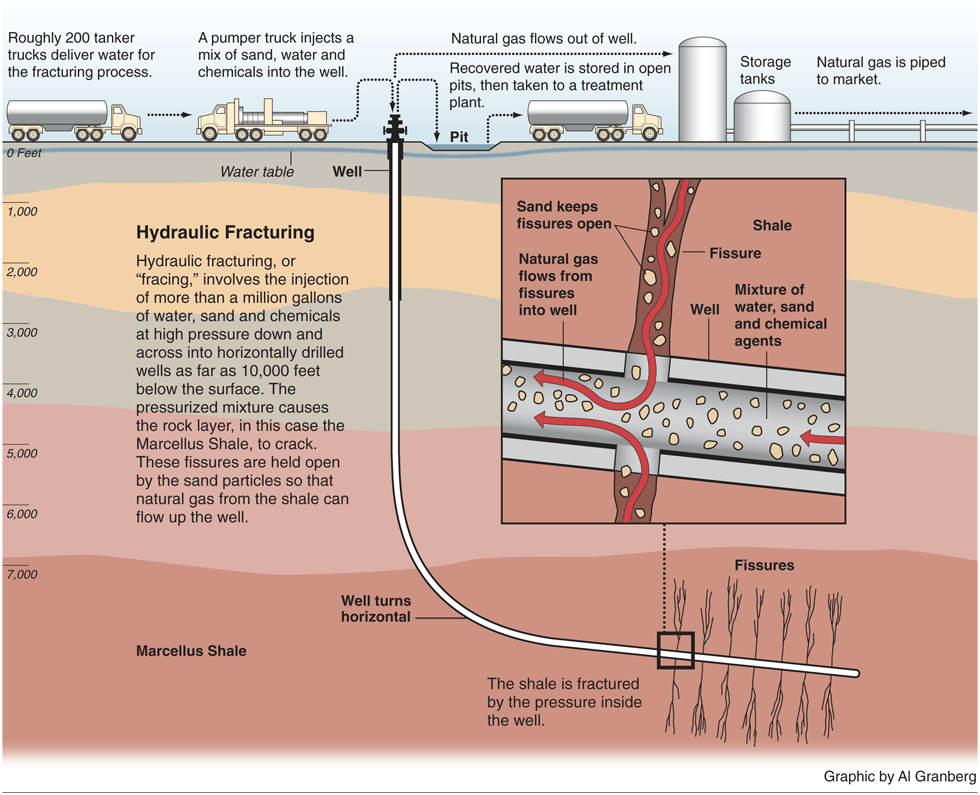
NY DEC Issues Fracking Proposal
The New York Department of Environmental Conservation posted its 700-plus-page blueprint for hydraulic fracturing, known as fracking, in the lucrative Marcellus Shale region on its website Friday, allowing industry and environmental groups to start dissecting the proposed plan to allow gas drilling in an area where it’s been on hold since 2008. The proposal to places large areas off-limits to gas drilling, which industry representatives belive is overly restrictive, while environmentalists believe the proposed watershed protections do not go far enough.
The proposed New York rules include a section describing several gas-drilling operation accidents in Pennsylvania and outlining New York’s measures designed to mitigate such incidents. A coalition of 47 health and environmental groups has called for a statewide ban on hydraulic fracturing for natural gas, saying it poses unacceptable risks. The Center New York has established Criteria For Evaluating Hydraulic Fracturing Projects.
In the proposal, the watersheds and state lands where gas-drilling would be prohibited amount to about 15 percent of the land in New York’s part of the Marcellus Shale, the nation’s largest-known natural gas reservoir. The formation underlies southern New York, much of Pennsylvania, and parts of Ohio, West Virginia and Western Maryland.
Some believe the proposal to place the watersheds off-limits to drilling doesn’t go far enough because it doesn’t include a sufficient buffer around the ancient underground tunnels that carry water to New York City from its upstate reservoirs.
The first wave of Marcellus development in New York would likely run along Interstate 86 from Binghamton through Tioga and Chemung counties, near the Millennium Pipeline. Lawsuits could occur in areas where there are attempts by municipal governments to use zoning or local ordinances to regulate natural gas activities. (The Daily Record, 7/11/2011)
The proposed New York rules include a section describing several gas-drilling operation accidents in Pennsylvania and outlining New York’s measures designed to mitigate such incidents. A coalition of 47 health and environmental groups has called for a statewide ban on hydraulic fracturing for natural gas, saying it poses unacceptable risks. The Center New York has established Criteria For Evaluating Hydraulic Fracturing Projects.
| Chesapeake Bay Watershed |
Some believe the proposal to place the watersheds off-limits to drilling doesn’t go far enough because it doesn’t include a sufficient buffer around the ancient underground tunnels that carry water to New York City from its upstate reservoirs.
The first wave of Marcellus development in New York would likely run along Interstate 86 from Binghamton through Tioga and Chemung counties, near the Millennium Pipeline. Lawsuits could occur in areas where there are attempts by municipal governments to use zoning or local ordinances to regulate natural gas activities. (The Daily Record, 7/11/2011)
Monday, July 11, 2011
2011 International Green Energy Economy Conference
July 28-29, 2011
Washington, DC
The National Council for Science and the Environment invites you to hear speakers from more than a dozen countries:
• Hoesung Lee, Vice Chair, Intergovernmental Panel on Climate Change (IPCC)
• Dan Kammen, University of California, Berkeley; Chief Technical Specialist for Renewable Energy and Energy Efficiency, The World Bank
• Peter Lund, Director, New Energy Technologies Group, Aalto University, Finland
• Governor Bill Richardson, former Congressman, Ambassador to the UN, and Secretary of Energy
• Eduardo Pereira Guimaraes, Secretary of International Relations, Curitiba City Government, Brazil
• Johanna Gregory Partin, Director of Climate Protection Initiatives, Mayor's Office, City of San Francisco
• Jong-dall Kim, President, International Solar Cities Initiative, Kyungpook National University, Korea
• David Jhirad, Professor and Director, Energy, Resources, and Environment Program; HRH Prince Sultan bin Abdul Aziz Professor in Environmental Policy, Johns Hopkins University School of Advanced International Studies
• Mark Levine, Founder and Group Leader, China Energy Group, Lawrence Berkeley National Laboratory
• Johan Eliasch, CEO of Head, former Climate Change Advisor to UK Prime Minister Tony Blair
• Allen Barnett, School of Photovoltaic and Renewable Energy Engineering, University of New South Wales, Australia
• Gary Guzy, Deputy Director, White House Council on Environmental Quality
The conference will focus on the interplay between clean-energy strategies and policies to secure significant technological innovation, workforce development to promulgate green jobs, and sustainability principles to guide economies and societies toward sustainability.
Registration is still available (click HERE to register now). The registration fee of $220 includes a banquet featuring remarks from Governor Richardson, two luncheons, and a reception, along with the full conference program.
The conference is organized by the National Council for Science and the Environment (NCSE), the Center for Energy and Environmental Policy (CEEP) at the University of Delaware, the Council of Energy Research and Education Leaders (CEREL), in collaboration with the Korea Energy Economics Institute (KEEI).
More information, including the conference agenda and a registration link, is available through the conference website . You can also contact David Blockstein, NCSE/CEREL or 202-207-0004.
Washington, DC
The National Council for Science and the Environment invites you to hear speakers from more than a dozen countries:
• Hoesung Lee, Vice Chair, Intergovernmental Panel on Climate Change (IPCC)
• Dan Kammen, University of California, Berkeley; Chief Technical Specialist for Renewable Energy and Energy Efficiency, The World Bank
• Peter Lund, Director, New Energy Technologies Group, Aalto University, Finland
• Governor Bill Richardson, former Congressman, Ambassador to the UN, and Secretary of Energy
• Eduardo Pereira Guimaraes, Secretary of International Relations, Curitiba City Government, Brazil
• Johanna Gregory Partin, Director of Climate Protection Initiatives, Mayor's Office, City of San Francisco
• Jong-dall Kim, President, International Solar Cities Initiative, Kyungpook National University, Korea
• David Jhirad, Professor and Director, Energy, Resources, and Environment Program; HRH Prince Sultan bin Abdul Aziz Professor in Environmental Policy, Johns Hopkins University School of Advanced International Studies
• Mark Levine, Founder and Group Leader, China Energy Group, Lawrence Berkeley National Laboratory
• Johan Eliasch, CEO of Head, former Climate Change Advisor to UK Prime Minister Tony Blair
• Allen Barnett, School of Photovoltaic and Renewable Energy Engineering, University of New South Wales, Australia
• Gary Guzy, Deputy Director, White House Council on Environmental Quality
The conference will focus on the interplay between clean-energy strategies and policies to secure significant technological innovation, workforce development to promulgate green jobs, and sustainability principles to guide economies and societies toward sustainability.
Registration is still available (click HERE to register now). The registration fee of $220 includes a banquet featuring remarks from Governor Richardson, two luncheons, and a reception, along with the full conference program.
The conference is organized by the National Council for Science and the Environment (NCSE), the Center for Energy and Environmental Policy (CEEP) at the University of Delaware, the Council of Energy Research and Education Leaders (CEREL), in collaboration with the Korea Energy Economics Institute (KEEI).
More information, including the conference agenda and a registration link, is available through the conference website . You can also contact David Blockstein, NCSE/CEREL or 202-207-0004.
Thursday, July 07, 2011
Cross-State Air Pollution Rule Finalized by EPA
Today, the U.S. Environmental Protection Agency (EPA) finalized a rule that protects the health of millions of Americans by helping states reduce air pollution and meet Clean Air Act standards. The Cross-State Air Pollution Rule requires 27 states in the eastern half of the United States to significantly improve air quality by reducing power plant emissions that cross state lines and contribute to ground-level ozone and fine particle pollution in other states.
To see or download a copy of the final rule.
Resources For States
The rule allows air quality-assured allowance trading among power plants, utilizing an allowance market infrastructure based on existing, successful allowance trading programs.
EPA designed the Cross-State Air Pollution Rule to make it as easy as possible for states to use SIPs to implement any or all Cross-State Air Pollution Rule programs at any time.
– A state may develop a state plan to achieve the required reductions and may choose which types of sources to control and how to administer the programs.
– States also can choose only to allocate allowances for any or all programs, starting as early as 2013.
To meet the requirements of this rule, EPA anticipates power plants will:
– Maximize use of installed SO2and NOXpollution control equipment, including running clean units more than would otherwise occur;
– Use lower sulfur coal, switch fuels; or
– Install or upgrade pollution control equipment, such as low NOXburners or scrubbers (Flue Gas Desulfurization).
• CAIR will be implemented through 2011 compliance periods –CAIR then replaced by Cross-State Air Pollution Rule
• Cross-State Air Pollution Rule establishes new allowances for all programs
– There is no carryover of Acid Rain Program, NOXSIP Call/NBP, or CAIR allowances
The final rule yields $120 to $280 billion in annual health benefits in 2014. The emission reductions will have significant and immediate public health benefits and in three years will annually prevent:
· 13,000 to 34,000 premature deaths;
· 19,000 cases of acute bronchitis;
· 19,000 hospital and emergency room visits;
· 1.8 million days when people miss work or school; and
· 420,000 cases of upper and lower respiratory symptoms.
Ensuring flexibility, EPA will work with states to help develop the most appropriate path forward to deliver significant reductions in harmful emissions while minimizing costs for utilities and consumers.
Carried long distances across the country by wind and weather, power plant emissions of sulfur dioxide (SO2) and nitrogen oxide (NOx) continually travel across state lines. As the pollution is transported, it reacts in the atmosphere and contributes to harmful levels of smog (ground-level ozone) and soot (fine particles), which are scientifically linked to widespread illnesses and premature deaths and prevent many cities and communities from enjoying healthy air quality.
The rule will improve air quality by cutting SO2 and NOx emissions that contribute to pollution problems in other states. By 2014, the rule and other state and EPA actions will reduce SO2 emissions by 73 percent from 2005 levels. NOx emissions will drop by 54 percent. Following the Clean Air Act’s “Good Neighbor” mandate to limit interstate air pollution, the rule will help states that are struggling to protect air quality from pollution emitted outside their borders, and it uses an approach that can be applied in the future to help areas continue to meet and maintain air quality health standards.
The Cross-State Air Pollution Rule replaces and strengthens the 2005 Clean Air Interstate Rule (CAIR), which the U.S. Court of Appeals for the D.C. Circuit ordered EPA to revise in 2008. The court allowed CAIR to remain in place temporarily while EPA worked to finalize today’s replacement rule.
The rule will also help improve visibility in state and national parks while better protecting sensitive ecosystems, including Appalachian streams, Adirondack lakes, estuaries, coastal waters, and forests. In a supplemental rulemaking based on further review and analysis of air quality information, EPA is also proposing to require sources in Iowa, Kansas, Michigan, Missouri, Oklahoma, and Wisconsin to reduce NOX emissions during the summertime ozone season. The proposal would increase the total number of states covered by the rule from 27 to 28. Five of these six states are covered for other pollutants under the rule. The proposal is open for public review and comment for 45 days after publication in the Federal Register. (EPA)
More information
To see or download a copy of the final rule.
Resources For States
The rule allows air quality-assured allowance trading among power plants, utilizing an allowance market infrastructure based on existing, successful allowance trading programs.
EPA designed the Cross-State Air Pollution Rule to make it as easy as possible for states to use SIPs to implement any or all Cross-State Air Pollution Rule programs at any time.
– A state may develop a state plan to achieve the required reductions and may choose which types of sources to control and how to administer the programs.
– States also can choose only to allocate allowances for any or all programs, starting as early as 2013.
To meet the requirements of this rule, EPA anticipates power plants will:
– Maximize use of installed SO2and NOXpollution control equipment, including running clean units more than would otherwise occur;
– Use lower sulfur coal, switch fuels; or
– Install or upgrade pollution control equipment, such as low NOXburners or scrubbers (Flue Gas Desulfurization).
• CAIR will be implemented through 2011 compliance periods –CAIR then replaced by Cross-State Air Pollution Rule
• Cross-State Air Pollution Rule establishes new allowances for all programs
– There is no carryover of Acid Rain Program, NOXSIP Call/NBP, or CAIR allowances
The final rule yields $120 to $280 billion in annual health benefits in 2014. The emission reductions will have significant and immediate public health benefits and in three years will annually prevent:
· 13,000 to 34,000 premature deaths;
· 19,000 cases of acute bronchitis;
· 19,000 hospital and emergency room visits;
· 1.8 million days when people miss work or school; and
· 420,000 cases of upper and lower respiratory symptoms.
Ensuring flexibility, EPA will work with states to help develop the most appropriate path forward to deliver significant reductions in harmful emissions while minimizing costs for utilities and consumers.
| Map of Transport Rule States. |
The rule will improve air quality by cutting SO2 and NOx emissions that contribute to pollution problems in other states. By 2014, the rule and other state and EPA actions will reduce SO2 emissions by 73 percent from 2005 levels. NOx emissions will drop by 54 percent. Following the Clean Air Act’s “Good Neighbor” mandate to limit interstate air pollution, the rule will help states that are struggling to protect air quality from pollution emitted outside their borders, and it uses an approach that can be applied in the future to help areas continue to meet and maintain air quality health standards.
The Cross-State Air Pollution Rule replaces and strengthens the 2005 Clean Air Interstate Rule (CAIR), which the U.S. Court of Appeals for the D.C. Circuit ordered EPA to revise in 2008. The court allowed CAIR to remain in place temporarily while EPA worked to finalize today’s replacement rule.
The rule will also help improve visibility in state and national parks while better protecting sensitive ecosystems, including Appalachian streams, Adirondack lakes, estuaries, coastal waters, and forests. In a supplemental rulemaking based on further review and analysis of air quality information, EPA is also proposing to require sources in Iowa, Kansas, Michigan, Missouri, Oklahoma, and Wisconsin to reduce NOX emissions during the summertime ozone season. The proposal would increase the total number of states covered by the rule from 27 to 28. Five of these six states are covered for other pollutants under the rule. The proposal is open for public review and comment for 45 days after publication in the Federal Register. (EPA)
More information
Wednesday, July 06, 2011
Most Electric Generating Capacity Additions in the Last Decade Were Natural Gas-Fired
About 65% of the existing natural gas capacity added after 1980 is combined-cycle units. As a whole, average utilization of the nation's fleet of natural gas combined-cycle gas has been increasing over the past six years. Other recent natural gas capacity additions are primarily combustion turbines, typically used as peaking units. Most of the natural gas-fired capacity additions from the 1950s through the 1970s were steam turbines—some of these were dual-fired units capable of burning natural gas and oil. However, air pollution restrictions and the current price differences between gas and oil mean that these units are primarily burning gas. Although these gas-fired steam units were built as baseload generators, they now operate as load-following or peaking generators, that are dispatched only when higher efficiency, combined-cycle units are fully utilized or are otherwise unavailable to serve load requirements. (U.S. Energy Information Administartion-EIA)
EPA Seeks to Adopt Emission Standards for Aircraft
The U.S. Environmental Protection Agency (EPA) is proposing to adopt new air pollution standards for engines used primarily in large commercial aircraft, including 737s, 747s, and 767s. The proposal seeks to reduce ground-level nitrogen oxide emissions by an estimated 100,000 tons nationwide by 2030. Exposure to nitrogen oxide emissions can cause and aggravate lung diseases and increase susceptibility to respiratory infection.
The standards were previously agreed to by the United Nation’s International Civil Aviation Organization (ICAO). Due to the global nature of air travel, EPA works with international agencies to ensure significant and cost effective emissions reductions. If adopted in the United States, the standards would be phased in over the next two years, applying to all new engines in 2013.
Comments will be accepted for 60 days after the date that the proposal is published in the Federal Register. (EPA)
The Obama administration opposes the European Union's plans to regulate greenhouse gas emissions from airplanes. The 27-country bloc's plan to regulate airline emissions at talks in Oslo under EU law, requires any airline operating to or from an EU airport after January 1 to participate in the bloc's cap-and-trade system.
The Obama administration opposes the plan on grounds of jurisdiction, imprecision in the program's rules
and other issues. (Read More)
More information
The standards were previously agreed to by the United Nation’s International Civil Aviation Organization (ICAO). Due to the global nature of air travel, EPA works with international agencies to ensure significant and cost effective emissions reductions. If adopted in the United States, the standards would be phased in over the next two years, applying to all new engines in 2013.
Comments will be accepted for 60 days after the date that the proposal is published in the Federal Register. (EPA)
The Obama administration opposes the European Union's plans to regulate greenhouse gas emissions from airplanes. The 27-country bloc's plan to regulate airline emissions at talks in Oslo under EU law, requires any airline operating to or from an EU airport after January 1 to participate in the bloc's cap-and-trade system.
The Obama administration opposes the plan on grounds of jurisdiction, imprecision in the program's rules
and other issues. (Read More)
More information
DOT To ExxonMobil: Fix Oil Leak Damage & Submit Restart Plan
The Department of Transportation's Pipeline and Hazardous Materials Safety Administration (PHMSA) has ordered Exxon Mobil Corporation to rebury the Silvertip pipeline underneath the Yellowstone River's bed to protect the line from damage. PHMSA also said the company will need to submit a restart plan before it can resume operation of the pipeline. In its order, the PHMSA told Exxon to use horizontal drilling methods to rebury the pipeline at the river crossing to protect the pipeline from external damage. The company also must devise a plan to operate and monitor the pipeline during flooding conditions, including increasing patrols and surveillance. PHMSA regulates pipeline companies to ensure that energy is delivered safely to U.S. households and businesses.
Approximately 750 and 1,000 barrels of oil spilled into the Yellowstone River near Billings, Montana, after the 12-inch pipeline ruptured late Friday amid high waters, according to preliminary findings issued by the PHMSA. The agency said spilled oil in the river has traveled as far as 240 miles downstream to Terry, Montana. Exxon reported in June that at the river crossing, the pipe lay at least 12 feet below the surface.
The 69-mile pipeline delivers oil to Exxon's Billings refinery, which sits adjacent to the Yellowstone River. The facility processes crude oil from Wyoming and Alberta into gasoline and ultralow-sulfur diesel fuel, according to Exxon's website. The section of the pipeline that crosses the river, near the site of the accident, was built in 1991, although original portions of the pipeline were built between 1949 and 1954, the PHMSA said.
Exxon doesn't yet have a repair plan in place for the Silvertip pipeline. The company doesn't know when the crude-oil pipeline, which usually moves about 40,000 barrels of oil a day, could be back online, nor how much it will cost to clean up the spill.
The PHMSA has been working with the U.S. Environmental Protection Agency and the U.S. Coast Guard to investigate the incident and determine the cause of the pipeline rupture. (WSJ, 7/6/2011)
Approximately 750 and 1,000 barrels of oil spilled into the Yellowstone River near Billings, Montana, after the 12-inch pipeline ruptured late Friday amid high waters, according to preliminary findings issued by the PHMSA. The agency said spilled oil in the river has traveled as far as 240 miles downstream to Terry, Montana. Exxon reported in June that at the river crossing, the pipe lay at least 12 feet below the surface.
The 69-mile pipeline delivers oil to Exxon's Billings refinery, which sits adjacent to the Yellowstone River. The facility processes crude oil from Wyoming and Alberta into gasoline and ultralow-sulfur diesel fuel, according to Exxon's website. The section of the pipeline that crosses the river, near the site of the accident, was built in 1991, although original portions of the pipeline were built between 1949 and 1954, the PHMSA said.
Exxon doesn't yet have a repair plan in place for the Silvertip pipeline. The company doesn't know when the crude-oil pipeline, which usually moves about 40,000 barrels of oil a day, could be back online, nor how much it will cost to clean up the spill.
The PHMSA has been working with the U.S. Environmental Protection Agency and the U.S. Coast Guard to investigate the incident and determine the cause of the pipeline rupture. (WSJ, 7/6/2011)
Tuesday, July 05, 2011
New Jersey Legislature Votes to Ban Hydraulic Fracturing
The New Jersey Legislature passed a bill on Wednesday that would place a statewide ban on hydraulic fracturing. The bill passed the state Senate by 32-1 and the state Assembly by 56-11. New Jersey Gov. Chris Christie has not said if he would sign the bill into law. New Jersey is the first state to consider a ban on fracking.
The language in the New Jersey legislation echoes the concerns of fracking critics and accuses the industry of being unwilling to reveal the contents of fracking liquids. Some companies have voluntarily reported the contents of their fracking liquids to an online database and some drillers report using chemicals like formaldehyde, hydrochloric acid and 2-butoxyethanol.
Fracking is the process of injecting millions of gallons of water, sand and chemicals - some of them toxic - into underground formations to split up rock and release natural gas. Fracking operations require millions of gallons of water. Fracking proponents say the practice is safe and will create jobs while producing cheap, clean-burning domestic fuel.
New Jersey shares watersheds with New York and Pennsylvania, where a vast, gas-rich underground formation called the Marcellus Shale has become ground zero for the fracking debate in the eastern United States. The Marcellus Shale underlies 36 percent of the Delaware River basin, which provides water to 15 million people in New York, Pennsylvania, New Jersey and Delaware. (Truth Out, 6/30/2011)
Fracking is the process of injecting millions of gallons of water, sand and chemicals - some of them toxic - into underground formations to split up rock and release natural gas. Fracking operations require millions of gallons of water. Fracking proponents say the practice is safe and will create jobs while producing cheap, clean-burning domestic fuel.
New Jersey shares watersheds with New York and Pennsylvania, where a vast, gas-rich underground formation called the Marcellus Shale has become ground zero for the fracking debate in the eastern United States. The Marcellus Shale underlies 36 percent of the Delaware River basin, which provides water to 15 million people in New York, Pennsylvania, New Jersey and Delaware. (Truth Out, 6/30/2011)
Exxon Mobil Silvertip Pipeline Oil Leak on the Yellowstone River
| Section of Silvertip Pipeline |
The leak from the 12-inch pipeline caused the temporary evacuation of some area residents. Local officials have said that flooding has hampered the cleanup work, and that some of the leaked oil could reach the Missouri River, of which the Yellowstone is a tributary.
The U.S. Department of Transportation, which oversees pipelines, notified Exxon Mobil in July 2010 of seven potential safety violations and other problems along the pipeline. Two of the warnings faulted the company for its emergency response and pipeline corrosion training. The company also was cited for “probable violations” in a February letter. Those included inadequate pipeline markers in a housing development, a section of pipeline over a ditch covered with potentially damaging material and debris, vegetation in a housing area that covered a portion of line and prevented aerial inspections, and a line over a canal not properly protected against corrosion.
More than 280 people were involved in the response and cleanup and more than 9 miles of absorbent booms are being deployed. (Wash Post, 7/4/2011, NY Post, 7/4/2011))
Monday, July 04, 2011
Saturday, July 02, 2011
Strategic Petroleum Reserve Auction Nets $3.28 Billion
The auction of oil from the Strategic Petroleum Reserve brought in $3.28 billion of bids, an average of $107.19 a barrel, according to a list of the winning bidders. The price of New YorkMercantile Exchange’s benchmark crude, West Texas Intermediate, fell 48 cents to $94.94 a barrel Friday. On Thursday,WTI closed a penny above the level it was the day before Obama’s announcement. The price of the more widely used Brent grade of crude oil in London fell 71 cents to $111.77 a barrel on Thursday.
The Center opposed the drawdown from the SPR because it was to influence the price of gasoline at the pump instead of addressing a national oil disruption emergency. Moreover, crude oil prices on futures markets had already begun to drop to levels that preceded President Obama’s announcement of a drawdown from reserves. We also do not believe that the drawdown will influence prices. The U.S. uses about 20 billion barrels of oil every day and about half of that comes from imports. So the U.S. release represents about one and a half days of total oil use.
According to an Energy Department table, Valero, the nation’s biggest independent oil refiner, won the largest chunk in the auction, purchasing 6.9 million barrels, or 22.5 percent of the total. Other winning bids went to major oil refiners and oil trading firms, including Shell’s U.S. trading arm and Geneva-based Vitol. Barclays and J.P. Morgan Chase also submitted winning bids.
Obama ordered the release of 30 million barrels of oil from the reserves, an amount to be matched by other members of the International Energy Agency in an effort to tamp down prices and offset production lost as a result of fighting in Libya. But the IEA has since announced that 20 million barrels will be “released” by lowering requirements for commercial stockpiles. The total sales from government inventories would be at most 39 million barrels. (Wash Post, 7/2/2011)
The Center opposed the drawdown from the SPR because it was to influence the price of gasoline at the pump instead of addressing a national oil disruption emergency. Moreover, crude oil prices on futures markets had already begun to drop to levels that preceded President Obama’s announcement of a drawdown from reserves. We also do not believe that the drawdown will influence prices. The U.S. uses about 20 billion barrels of oil every day and about half of that comes from imports. So the U.S. release represents about one and a half days of total oil use.
According to an Energy Department table, Valero, the nation’s biggest independent oil refiner, won the largest chunk in the auction, purchasing 6.9 million barrels, or 22.5 percent of the total. Other winning bids went to major oil refiners and oil trading firms, including Shell’s U.S. trading arm and Geneva-based Vitol. Barclays and J.P. Morgan Chase also submitted winning bids.
Obama ordered the release of 30 million barrels of oil from the reserves, an amount to be matched by other members of the International Energy Agency in an effort to tamp down prices and offset production lost as a result of fighting in Libya. But the IEA has since announced that 20 million barrels will be “released” by lowering requirements for commercial stockpiles. The total sales from government inventories would be at most 39 million barrels. (Wash Post, 7/2/2011)
Friday, July 01, 2011
Utility Air Pollution Control Technology
See also Utility Air Pollution Regulations
Control technologies capable of capturing SO2 include dry scrubbers, wet scrubbers and semi-dry scrubbers.
In the case of a typical wet scrubber, flue gas coming from the boiler is saturated with a slurry containing limestone reagent. This type of SO2 control is characterized by high capital cost, low operating cost and high performance.
Dry scrubber processes inject particles of alkaline sorbent into the flue gas, producing a dry solid by-product. The flue gas leaving the absorber is not saturated in this process. Dry scrubber systems can be grouped into three categories: spray dryers, circulating spray dryers and dry injection systems. The circulating dry scrubber (CDS) technology operates at similar temperatures, but is based on separately feeding dry hydrated lime and water into a fluidized bed reactor. Here the SO2 removal takes place in a bed of moistened powder.
Another scrubber option known as dry sorbent injection (DSI) involves injecting a reagent in dry powdered form (hydrated lime, sodium bicarbonate or Trona) into the flue gas upstream of existing particulate control equipment. DSI is praised for its simplicity and low capital costs, but is limited in performance and requires reagent injection rates above stoichiometry that are often necessary for removal efficiencies.
One semi-dry FGD process uses a circulating fluid bed (CFB) dry scrubber or a lime spray dryer. Lime spray dryer technology operates by spraying a slurry of slaked lime reagent into the flue gas. The flue gas is cooled to 30 to 40 degrees above its saturation temperature as the slurry droplets are dried. As a result, when flue gases come out of the spray dryer, they are present as a dry powder product that is collected in a bag house. Semi-dry FGD technologies are characterized by capital costs that are about half that of wet FGD. They have higher operating costs than wet FGD, but lower operating costs than DSI. (Power Engineering, 6/1/2011)
Control technologies capable of capturing SO2 include dry scrubbers, wet scrubbers and semi-dry scrubbers.
In the case of a typical wet scrubber, flue gas coming from the boiler is saturated with a slurry containing limestone reagent. This type of SO2 control is characterized by high capital cost, low operating cost and high performance.
Dry scrubber processes inject particles of alkaline sorbent into the flue gas, producing a dry solid by-product. The flue gas leaving the absorber is not saturated in this process. Dry scrubber systems can be grouped into three categories: spray dryers, circulating spray dryers and dry injection systems. The circulating dry scrubber (CDS) technology operates at similar temperatures, but is based on separately feeding dry hydrated lime and water into a fluidized bed reactor. Here the SO2 removal takes place in a bed of moistened powder.
| Eco Power Solutions’ Comply 2000 is a multi-pollutant removal system. Photo courtesy Eco Power Solutions. |
One semi-dry FGD process uses a circulating fluid bed (CFB) dry scrubber or a lime spray dryer. Lime spray dryer technology operates by spraying a slurry of slaked lime reagent into the flue gas. The flue gas is cooled to 30 to 40 degrees above its saturation temperature as the slurry droplets are dried. As a result, when flue gases come out of the spray dryer, they are present as a dry powder product that is collected in a bag house. Semi-dry FGD technologies are characterized by capital costs that are about half that of wet FGD. They have higher operating costs than wet FGD, but lower operating costs than DSI. (Power Engineering, 6/1/2011)
Utility Air Pollution Regulations
See also Utility Air Pollution Control Technology
The U.S. Environmental Protection Agency (EPA) is implementing a number of regulations that are currently targeting or soon are set to target SO2 emissions, including the Clean Air Transport Rule (CATR) and the SO2 National Ambient Air Quality Standards (NAAQS). In addition, Hazardous air pollutants (HAPs), are poised for regulation under the Air Toxics Rule for utilities via the proposed Maximum Achievable Control Technologies (MACT) standard.
According to the EPA, power plants are responsible for 66 percent of worldwide SO2 emissions, with the majority—more than 98 percent—coming from coal-fired power plants. According to the Edison Electric InstituteWet FGD, semi-dry FGD, dry sorbent injection (DSI) and other technologies have been responsible for cutting SO2 emissions by 57 percent between 1980 and 2008.
The Clean Air Transport Rule (CATR)—proposed by the EPA in July 2010—was created to reduce the interstate transport of emissions from power plants in the eastern U.S. as required by the Clean Air Act. EPA is expected to finalize the CATR by the end of 2011. The Transport Rule replaces the Clean Air Interstate Rule (CAIR) that EPA issued in March 2005. “Good neighbor” provisions of the Act require states to prohibit emissions that contribute significantly to a downwind state’s air quality problems. One example is West Virginia, where the EPA found that power plants significantly affect air quality statuses of counties in Ohio, Indiana, Kentucky, Pennsylvania and Michigan, preventing these states from achieving federal air quality standards.
The Transport Rule will go into effect under two phases: the Phase 1 compliance date of 2012 and the Phase 2 compliance date of 2014. The Transport Rule also establishes two independent trading programs for SO2: Group 1 states and Group 2 states (See figures 1 and 2). SO2 emissions from Group 1 states would be capped at 3.1 million tons per year beginning in 2012 and 1.7 million tons per year beginning in 2014. The 2012 cap represents a 13 percent reduction below 2009 emissions levels. SO2 emissions from Group 2 states would be capped at 0.8 million tons beginning in 2012. The 2012 cap for Group 2 states represents a 29 percent reduction below 2009 emissions levels. The rule will affect fossil fuel-fired power plants 25 MW and larger in 31 states and Washington D.C., encompassing both SO2 and NOx reductions.
The Air Toxics Rule is EPA’s replacement for the Clean Air Mercury Rule (CAMR), an interstate cap-and-trade program issued in 2005. On March 8, 2008, a federal court ruled that EPA violated the Clean Air Act when it sought to regulate mercury-emitting power plants through CAMR. EPA estimates the proposed Air Toxics Rule will reduce mercury emissions from covered power plants by 91 percent, acid gas emissions by 91 percent and SO2 by 55 percent. This is the first time federal limits have been established for hazardous air pollutants (HAPs) and mercury control. A consent degree with public health and environmental groups requires EPA to finalize the standards by Nov. 16, 2011. Compliance to the MACT ruling is expected by around 2015.
The SO2 NAAQS are another concern for utilities. The Clean Air Act requires EPA to set national air quality standards for SO2 and five other emissions types. On June 2, 2010, the primary SO2 NAAQS was revised to set the SO2 standard at 75 parts per billion (ppb), which is attained when the three-year average of the 99th percentile of one-hour daily maximum concentrations does not exceed 75 parts per billion (ppb). SO2 emissions must now be recorded at a one-hour measurement, which raises a new set of challenges for utilities. The Clean Air Act directs states to submit their SO2 designation recommendation by June 3, 2011.
On March 16, 2011, EPA proposed new source performance standards and Maximum Achievable Control Technologies (MACT) standards for fossil fuel-fired units under the Air Toxics Rule. This ushers in the first-ever national standards for mercury, arsenic and other hazardous air pollutants (HAPs). Since SO2 is a surrogate for HAPs, the Utility MACT standard could also introduce or reinforce a push toward SO2 control installation.
Best Available Retrofit Technology (BART) guidelines under the Clean Air Visibility Rule will also take a toll on SO2 emissions (as well as NOx, ammonia and certain volatile organic compounds), affecting facilities built or reconstructed between Aug. 7, 1962, and Aug. 7, 1977, that have the potential to emit more than 250 tons a year of emissions and fall into one of 26 different categories. These include utility and industrial boilers and large industrial plants such as pulp mills, refineries and smelters. The EPA’s presumptive BART emission limit for SO2 is 0.15 lb/mmBtu, or 95 percent removal.
Instead of undergoing extensive retrofits, a percentage of coal-fired generation—an estimated 50 to 60 GW by 2020—will likely be retired, according to a 2010 Credit Suisse report. (Power Engineering, 6/1/2011)
The U.S. Environmental Protection Agency (EPA) is implementing a number of regulations that are currently targeting or soon are set to target SO2 emissions, including the Clean Air Transport Rule (CATR) and the SO2 National Ambient Air Quality Standards (NAAQS). In addition, Hazardous air pollutants (HAPs), are poised for regulation under the Air Toxics Rule for utilities via the proposed Maximum Achievable Control Technologies (MACT) standard.
According to the EPA, power plants are responsible for 66 percent of worldwide SO2 emissions, with the majority—more than 98 percent—coming from coal-fired power plants. According to the Edison Electric InstituteWet FGD, semi-dry FGD, dry sorbent injection (DSI) and other technologies have been responsible for cutting SO2 emissions by 57 percent between 1980 and 2008.
| McGill Air Clean’s spray dry scrubber and fabric filter operating on a Bubbling Fluidized Bed boiler. Photo courtesy McGill Air Clean. |
The Transport Rule will go into effect under two phases: the Phase 1 compliance date of 2012 and the Phase 2 compliance date of 2014. The Transport Rule also establishes two independent trading programs for SO2: Group 1 states and Group 2 states (See figures 1 and 2). SO2 emissions from Group 1 states would be capped at 3.1 million tons per year beginning in 2012 and 1.7 million tons per year beginning in 2014. The 2012 cap represents a 13 percent reduction below 2009 emissions levels. SO2 emissions from Group 2 states would be capped at 0.8 million tons beginning in 2012. The 2012 cap for Group 2 states represents a 29 percent reduction below 2009 emissions levels. The rule will affect fossil fuel-fired power plants 25 MW and larger in 31 states and Washington D.C., encompassing both SO2 and NOx reductions.
The Air Toxics Rule is EPA’s replacement for the Clean Air Mercury Rule (CAMR), an interstate cap-and-trade program issued in 2005. On March 8, 2008, a federal court ruled that EPA violated the Clean Air Act when it sought to regulate mercury-emitting power plants through CAMR. EPA estimates the proposed Air Toxics Rule will reduce mercury emissions from covered power plants by 91 percent, acid gas emissions by 91 percent and SO2 by 55 percent. This is the first time federal limits have been established for hazardous air pollutants (HAPs) and mercury control. A consent degree with public health and environmental groups requires EPA to finalize the standards by Nov. 16, 2011. Compliance to the MACT ruling is expected by around 2015.
The SO2 NAAQS are another concern for utilities. The Clean Air Act requires EPA to set national air quality standards for SO2 and five other emissions types. On June 2, 2010, the primary SO2 NAAQS was revised to set the SO2 standard at 75 parts per billion (ppb), which is attained when the three-year average of the 99th percentile of one-hour daily maximum concentrations does not exceed 75 parts per billion (ppb). SO2 emissions must now be recorded at a one-hour measurement, which raises a new set of challenges for utilities. The Clean Air Act directs states to submit their SO2 designation recommendation by June 3, 2011.
On March 16, 2011, EPA proposed new source performance standards and Maximum Achievable Control Technologies (MACT) standards for fossil fuel-fired units under the Air Toxics Rule. This ushers in the first-ever national standards for mercury, arsenic and other hazardous air pollutants (HAPs). Since SO2 is a surrogate for HAPs, the Utility MACT standard could also introduce or reinforce a push toward SO2 control installation.
Best Available Retrofit Technology (BART) guidelines under the Clean Air Visibility Rule will also take a toll on SO2 emissions (as well as NOx, ammonia and certain volatile organic compounds), affecting facilities built or reconstructed between Aug. 7, 1962, and Aug. 7, 1977, that have the potential to emit more than 250 tons a year of emissions and fall into one of 26 different categories. These include utility and industrial boilers and large industrial plants such as pulp mills, refineries and smelters. The EPA’s presumptive BART emission limit for SO2 is 0.15 lb/mmBtu, or 95 percent removal.
Instead of undergoing extensive retrofits, a percentage of coal-fired generation—an estimated 50 to 60 GW by 2020—will likely be retired, according to a 2010 Credit Suisse report. (Power Engineering, 6/1/2011)
Electrical Switching Equipment Design Flaw Doomed Nuke Plant
Japan Fukushima Daiichi Backup Generators Could Not Get Electricity
When electrcitiy from the grid was knock out by the tsumani, even if the swamped and inoperable backup generators would have been working, it would have done no good because the equipment used to switch the power from the diesel geneators to the reactors cooling systems was inoperable due to being flooded. Nuclear-power plants must continuously cool their hot, radioactive fuel. Those cooling systems run on electricity, which the plants ordinarily pulled from the nation's power grid. If the grid fails, on-site diesel generators kick on to keep the cooling systems running. If they don't, that plant is in danger of melting down.
The company used two different designs for safeguarding its 10 reactors at its two Fukushima sites. When the devastating quake struck on March 11, the five reactors at Fukushima Daini with the newer design withstood the resulting 45-foot tsunami without their vital cooling systems failing. Those reactors shut down safely. But the cooling systems failed at four reactors at Fukushima Daiichi with the older design. Backup diesel generators and electrical-switching equipment were swamped by seawater. As a result, fuel melted down at three reactors and there were explosions at four reactor buildings.
The placement of a single electric-switching station in a poorly protected outbuilding led to those switches being knocked out by the tsunami and rendering operating generators useless. This design flaw was a relic of the original design. General Electric Company designed the older Fukushima reactors. All the Fukushima plants, including the newer ones, were based on GE designs. GE has expressed that any flaws at the Fukushima reactors weren't its fault because Tepco was in charge of design changes. The location of emergency diesel generators at the Fukushima Daiichi plant were reviewed and approved by Tepco and regulatory authorities.
The early reactors used GE's Mark 1 design. To keep the reactor compact and economical, the reactor buildings were made small. Because Tepco's first reactor buildings were small, the generators had to go somewhere else. Engineers put them into neighboring structures that house turbines. The reactor buildings were fortress-like, with thick concrete walls and dual sets of sturdy doors. The turbine buildings were far less sturdy, especially their doors. Backup power generators are critical safety equipment, and it should've been a no-brainer to put them inside the reactor buildings.
Tepco the Mark II design in the No. 6 reactor building, which had enough space for the backup generators to go inside. By 1987, Tepco had opened its tenth and final reactor in Fukushima prefecture. Nos. 1 through 5 at Fukushima Daiichi had the old design. The other five at Daini had the newer design.
In 1998, to comply with new regulatory requirements, Tepco decided to give each reactor at Fukushima Daiichi at least two dedicated backup diesel generators, something that not all of them had. New backup generators for reactors Nos. 2 and 4 were placed in new buildings located higher on the mountainside next to the reactors. All six reactors were given access to generators housed outside of the vulnerable turbine buildings.
The switching stations for reactors Nos. 1 through 5 were in the poorly protected turbine buildings and that's where they stayed. (Because of its more-advanced original design, No. 6's switching station was already in the reactor building.)
Explosions at Nos. 1 and 3 severely damaged those reactor buildings. Hydrogen leaking from No. 3 is thought to have triggered a blast at the No. 4 reactor building, and No. 2 probably had an explosion, too. The multiple blasts released radiation into the outside air.
In contrast, reactors No. 5 and 6, and all four reactors at nearby Fukushima Daini, safely reached cold shutdown. At No. 6, the newest generator housed in a separate building kept working and supplying power through its undamaged switching station, secure inside the reactor building. Tepco was able to use that power to keep equipment at neighboring No. 5 running. (WSJ, 7/1/2011, photo and graphic courtesy WSJ)
When electrcitiy from the grid was knock out by the tsumani, even if the swamped and inoperable backup generators would have been working, it would have done no good because the equipment used to switch the power from the diesel geneators to the reactors cooling systems was inoperable due to being flooded. Nuclear-power plants must continuously cool their hot, radioactive fuel. Those cooling systems run on electricity, which the plants ordinarily pulled from the nation's power grid. If the grid fails, on-site diesel generators kick on to keep the cooling systems running. If they don't, that plant is in danger of melting down.
The company used two different designs for safeguarding its 10 reactors at its two Fukushima sites. When the devastating quake struck on March 11, the five reactors at Fukushima Daini with the newer design withstood the resulting 45-foot tsunami without their vital cooling systems failing. Those reactors shut down safely. But the cooling systems failed at four reactors at Fukushima Daiichi with the older design. Backup diesel generators and electrical-switching equipment were swamped by seawater. As a result, fuel melted down at three reactors and there were explosions at four reactor buildings.
The placement of a single electric-switching station in a poorly protected outbuilding led to those switches being knocked out by the tsunami and rendering operating generators useless. This design flaw was a relic of the original design. General Electric Company designed the older Fukushima reactors. All the Fukushima plants, including the newer ones, were based on GE designs. GE has expressed that any flaws at the Fukushima reactors weren't its fault because Tepco was in charge of design changes. The location of emergency diesel generators at the Fukushima Daiichi plant were reviewed and approved by Tepco and regulatory authorities.
The early reactors used GE's Mark 1 design. To keep the reactor compact and economical, the reactor buildings were made small. Because Tepco's first reactor buildings were small, the generators had to go somewhere else. Engineers put them into neighboring structures that house turbines. The reactor buildings were fortress-like, with thick concrete walls and dual sets of sturdy doors. The turbine buildings were far less sturdy, especially their doors. Backup power generators are critical safety equipment, and it should've been a no-brainer to put them inside the reactor buildings.
Tepco the Mark II design in the No. 6 reactor building, which had enough space for the backup generators to go inside. By 1987, Tepco had opened its tenth and final reactor in Fukushima prefecture. Nos. 1 through 5 at Fukushima Daiichi had the old design. The other five at Daini had the newer design.
In 1998, to comply with new regulatory requirements, Tepco decided to give each reactor at Fukushima Daiichi at least two dedicated backup diesel generators, something that not all of them had. New backup generators for reactors Nos. 2 and 4 were placed in new buildings located higher on the mountainside next to the reactors. All six reactors were given access to generators housed outside of the vulnerable turbine buildings.
The switching stations for reactors Nos. 1 through 5 were in the poorly protected turbine buildings and that's where they stayed. (Because of its more-advanced original design, No. 6's switching station was already in the reactor building.)
Explosions at Nos. 1 and 3 severely damaged those reactor buildings. Hydrogen leaking from No. 3 is thought to have triggered a blast at the No. 4 reactor building, and No. 2 probably had an explosion, too. The multiple blasts released radiation into the outside air.
In contrast, reactors No. 5 and 6, and all four reactors at nearby Fukushima Daini, safely reached cold shutdown. At No. 6, the newest generator housed in a separate building kept working and supplying power through its undamaged switching station, secure inside the reactor building. Tepco was able to use that power to keep equipment at neighboring No. 5 running. (WSJ, 7/1/2011, photo and graphic courtesy WSJ)
Subscribe to:
Posts (Atom)