Wednesday, March 25, 2015

Crude Oil Storage at Cushing, but not Storage Capacity Utilization Rate, at Record Level

graph of weekly crude oil inventory and storage capacities at Cushing, Oklahoma, as explained in the article text
Source: U.S. Energy Information Administration, Weekly Petroleum Status Report and Working and Net Available Shell Storage Capacity

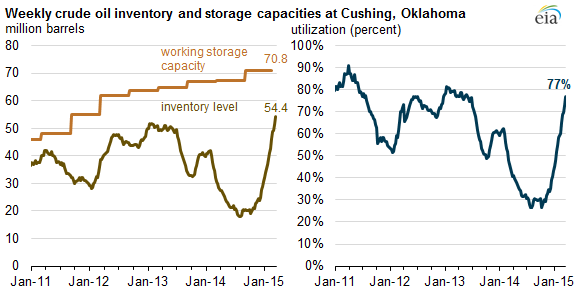
After increasing for 15 consecutive weeks, crude oil storage at Cushing, Oklahoma, reached 54.4 million barrels on March 13, according to EIA's Weekly Petroleum Status Report. This volume is the highest on record, but not the highest percent of storage utilization, as working storage capacity at Cushing has also increased over time.
Storage levels at Cushing are significant, because Cushing serves as the delivery point for the United Statescrude oil benchmark, West Texas Intermediate. Sited in central Oklahoma, Cushing is home to both a network of crude oil pipelines and storage capacity. The 70.8 million barrels of storage capacity in Cushing represent more than 60% of all crude oil working storage capacity in the Midwest (as defined by Petroleum Administration for Defense District 2) and about 19% of all commercial crude oil storage in the United States.
Although inventory levels at Cushing are at their record high, storage utilization (inventories as a percent of working storage capacity) are not at record levels. Capacity utilization at Cushing is now 77%, a large increase from a recent low of 27% in October 2014. However, utilization reached 91% in March 2011, soon after EIA begansurveying storage capacity twice a year, starting in September 2010.  (DOE-EIA)

Nuclear Matters & Center Support For Nuclear Power Plants

Nuclear Matters announced today that 15 organizations have joined the campaign as Partners, coalescing in their support for existing nuclear energy plants and the need to ensure they are preserved. The diverse cross-section of voices includes environmental, consumer and academic groups, among others. They will work alongside Nuclear Matters’ Leadership Council to raise awareness around the value of the existing nuclear fleet for their benefits in terms of reliability, carbon-free generation, and economic impact.
“In my role as co-chair of Nuclear Matters, I’ve heard first-hand from a range of organizations and individuals who are in strong support of our existing nuclear fleet,” said former Senator Evan Bayh. “The fact that many of these organizations have joined Nuclear Matters as Partners is representative of the serious and growing desire that exists across the country to do everything we can to ensure that these plants are preserved.”
“As an organization whose mission it is to apply practical environmental solutions to ensure a cleaner energy future, our partnership with Nuclear Matters is well-suited,” said Norris McDonald, President of the African American Environmentalist Association. “Given that our existing nuclear energy fleet provides 63 percent of the nation’s carbon-free energy, it plays a key role in helping to address environmental challenges, including meeting proposed rules laid out by the Environmental Protection Agency to reduce carbon emissions.”
Below is a complete list of the organizations that have partnered with Nuclear Matters and will join the campaign in various events and initiatives across the country:
  • African American Environmentalist Association
  • Carolinas Nuclear Cluster (CNC)
  • Center for Environment, Commerce and Energy
  • Citizens for Nuclear Technology Awareness
  • Consumer Energy Alliance (CEA)
  • Energy for Carolinas (E4C)
  • Energy Information Center
  • Environmentalists for Nuclear Energy - USA
  • Go Nuclear
  • Illinois Clean Energy Coalition
  • National Museum of Nuclear Science and History
  • North American Young Generation in Nuclear (NAYGN)
  • Nuclear Advocacy Network
  • Nuclear Fuels Reprocessing Coalition
  • U.S. Women in Nuclear
About Nuclear Matters
The mission of Nuclear Matters is to inform the public about the clear benefits that nuclear energy provides to our nation, to raise awareness of the economic challenges to nuclear energy that threaten those benefits, and to work with stakeholders to explore possible policy solutions that properly value nuclear energy as a reliable, affordable and carbon-free electricity resource that is essential to America’s energy future.
Supporters of Nuclear Matters include a range of companies and organizations in the energy industry, including Ameren Missouri, American Nuclear Insurers, Arizona Public Service Company, AREVA, Black & Veatch, POWER Burns and Roe, Centrus Energy Corp. Dominion, Duke Energy, Energy Future Holdings Corporation, Energy Northwest, Entergy Corporation, Exelon Corporation, FirstEnergy Corporation, GE Hitachi Nuclear Energy, Lightbridge Corporation, Nebraska Public Power District, NextEra Energy Inc., Omaha Public Power District, Pacific Gas and Electric Company, South Texas Project Nuclear Operating Company, Southern Company, Tennessee Valley Authority, and Westinghouse Electric Corporation.
Media Contacts
For Nuclear Matters:
Alexandra Meredith
(212) 446-1887
AMeredith@SloanePR.com
Joe Germani
(212) 446-1899
JGermani@SloanePR.com

Thursday, March 19, 2015

The White House Announces Greenhouse Gas Reduction Initiative

Today President Obama signed an Executive Order to cut the Federal Government’s greenhouse gas (GHG) emissions by 40 percent from 2008 levels. The President’s initiative also increases the share of electricity that the federal government uses from renewable sources to 30 percent by 2025.
Following the signing at the White House, the President traveled to the Department of Energy to tour the building’s rooftop solar panels and to host a meeting with executives from some of the largest Federal suppliers to discuss how their new and existing GHG reduction targets are helping address climate change, while at the same time helping their company’s bottom line by reducing energy costs.

The President is following through with the commitment he made in China last year to reduce economy-wide emissions 26-28 percent by 2025. 
For more information, please see the White House Fact Sheet and Blog. (The White House)

Friday, March 13, 2015

LISTING OF DOE/FE Natural Gas AUTHORIZATIONS ISSUED IN 2014

Listing

The chart in the listing at the link above contains all Orders issued by the Office of Natural Gas Regulatory Activities in 2014 through December 31st. The orders include all new or renewed authority to Import and Export Natural Gas and/or Liquefied Natural Gas, as well as all procedural orders; i.e., vacates, name changes. To download applications, click here and select the "View (blankets), PDF (exports)" tab. 

Wednesday, March 11, 2015

New California Groundwater Law

Sustainable Groundwater Management Act (“SGMA”)

As of January 1, 2015, the Sustainable Groundwater Management Act (“SGMA”), an ambitious attempt that Governor Jerry Brown signed last September in order to regulate the use of groundwater on a more universal scale, has now gone into effect.   

Local Control

In enacting the SGMA, the California legislature sought to “manage groundwater basins through the actions of local governmental agencies to the greatest extent feasible.”   For the most part, any local agency with water supply, water management or land use responsibilities in a given groundwater basin (or a combination of such agencies) can become the groundwater sustainability agency for that basin.
The SGMA gives sustainability agencies a number of powers and authorities in addition to those they already may possess. Agencies are authorized, among other things, to conduct investigations; require registration of facilities that extract groundwater; require said facilities to measure the amount of water they extract; acquire property including water rights; regulate, limit or allocate groundwater extraction; and authorize transfers of groundwater allocations.  They also have the power to “impose fees, including . . . permit fees and fees on groundwater extraction” to support their activities, and to bring enforcement actions seeking civil penalties for violations relating to rules implemented pursuant to the SGMA. 
The SGMA’s use of local planning and management – as opposed to purely centralized state control – is intended to provide valuable opportunities for informed and proactive water users to have a say in groundwater sustainability planning from the start.
State Oversight and Intervention
While the SGMA generally emphasizes local management of groundwater resources, it does provide for state involvement on a number of levels. For example, DWR must develop and publish best management practices for sustainable groundwater management, and it is responsible for reviewing sustainability plans every five years to ensure compliance with the SGMA.   In addition, the State Water Resources Control Board (“SWRCB” or “State Board”) can “designate a basin as a probationary basin” for failure to develop a groundwater sustainability plan where one is needed, or for implementation of an insufficient plan.  If a local agency fails to remedy the problem that led to a designation, the State Board may adopt its own interim sustainability plan for the basin.
DWR is also tasked with establishing the initial priority for the state’s groundwater basins, a job of considerable consequence given that many of the SGMA’s requirements apply only to those basins designated as high or medium priority.  DWR has announced that the basin designations it finalized under the California Statewide Groundwater Elevation Monitoring program will serve as the initial prioritization required by the SGMA. [More at Marten Law]

Calif State Can't Protect Groundwater & L.A. DWP Can't Collect Bills

The agencies charged with overseeing oil production and protecting California's water sources from the industry's pollution all fell down on the job. The California Department of Conservation, the department's Division of Oil, Gas and Geothermal Resources and the state Water Resources Control Board promised  a top-down overhaul of their regulation of the disposal of oil field wastewater.

Some state legislators have characterized agency practices as corrupt and inept.  Agency officials have attributed the errors to haphazard record-keeping and antiquated data collection. And they have said that initial tests on nine drinking water supply wells found no benzene or other contaminants. The federal Environmental Protection Agency has called the state's errors "shocking" and said California's oil field wastewater injection program does not comply with the federal Safe Drinking Water Act.

State legislators believed it was not a lack of regulation (new laws). but a lack of enforcement of existing regulations.  State regulatory officials have noted that the oil industry's technology had outpaced the state's regulations, many of which have remained unchanged for decades.

Meanwhile, the botched rollout of a new billing system at the Los Angeles Department of Water and Power disrupted the utility's ability to collect unpaid bills, helping to drive the total to $681 million late last year, a state audit of the system has found.

Customer confusion over late and estimated bills after a new "Customer Care & Billing" system went live in September 2013 produced a flood of calls to DWP's customer service lines. As officials diverted the workforce to answering phone calls and issuing corrected bills, collections fell further behind, the audit found.

Before the system went live, the DWP carried about $436 million in uncollected bills. The billing problem added another $245 million to the debt. The total shortfall includes both residential and commercial billings.

The L.A. City Attorney filed a lawsuit alleging that PricewaterhouseCoopers intentionally misled DWP managers about its ability to help the utility implement the system. The global accounting firm responded that it did its job well and that the DWP was trying to make the vendor a scapegoat.  (L.A.Timeshttp://www.latimes.com/local/california/la-me-fracking-water-20150311-story.html, 3/10/2015, L.A. Times, 3/10/2015)

Thursday, March 05, 2015

House Bill Introduced To Keep Ethanol From Ruining Boat Motors

The Renewable Fuel Standard (RFS) Reform Act of 2015 was introduced Feb. 4 by Rep. Bob Goodlatte (R-Virginia) and co-sponsors Jim Costa (D-California), Peter Welsh (D-Vermont) and Steve Womack (R-Arkansas) to reform the RFS. Costa, Goodlatte, Welsh and Womack’s bill proposes to eliminate corn-based ethanol blending and cap ethanol blending into conventional at 10 percent, commonly referred to as ethanol 10 or E10. The sponsors believe ethanol is ruining the engines of boats, chainsaws and snowmobiles across the country. This bill will remove the remaining consumer subsidy of the ethanol industry, the mandated blending of ethanol into gasoline.

In February 2013, the EPA approved a new blender pump configuration for gas stations seeking to use a common hose and nozzle to dispense E10 and E15 fuels. The combination of E10 and E15 at the same gas pump could result in boaters being confused and filling their boats with E15 instead of E10. According to BoatUS, boaters are prohibited from using E15 in their vessels.


More than 60 percent of BoatUS members fill their boat’s fuel tanks at roadside gas stations where the higher blend ethanol fuels are often the cheapest fuel at the pump. This creates a huge potential for misfueling and puts boaters at risk,

According to The Hill, the Renewable Fuel Association (RFA), an ethanol lobby, opposes the proposed bill. The lobby reportedly issued a study last week at the National Ethanol Conference in Texas presenting the economic benefits of ethanol. Specifically, the study reported 14.3 billion gallons of ethanol was produced in 2014, potentially offsetting 515 million barrels of foreign oil.

RFA has promoted increased use of ethanol blends. The RFS became law in 2005 and required
biofuels such as corn-based ethanol to be blended with gasoline. Several years later, the EPA permitted gas stations to use E15 blends in an attempt to keep pace with the standard’s mandates. The EPA reportedly approved E15 blends to reduce greenhouse gas emissions. However, the American Automobile Association challenged the EPA’s claim in 2012, issuing a statement that E15 potentially damaged fuel lines. An investigative report published by the Associated Press (AP) in November 2013 corroborated claims of the harms caused by fuels with corn-based ethanol.

 “The government’s predictions of the benefits have proven so inaccurate that independent scientists question whether it will ever achieve its central environmental goal: reducing greenhouse gases,” the AP report stated. “The numbers behind the ethanol mandate have become so unworkable that, for the first time, the EPA is soon expected to reduce the amount of ethanol required to be added to the gasoline supply.”

When the bill was introduced Feb. 4, the EPA reportedly did not set blend mandates for 2015 and 2016.  [See more]  (The Log, 2/26/2015)

Senate Fails To Override President Obama's Veto of Keystone XL Pipeline

The Senate failed on Wednesday to override President Obama’s veto of legislation approving the Keystone XL oil sands pipeline, falling five votes short of the two-thirds majority needed in a 62-37 vote.
It’s the first time Congress has voted on whether to override a veto from Obama and could be a sign of things to come, with Republicans in charge of the House and Senate.

Eight Democrats voted with Republicans to override Obama: Sens. Joe Manchin (W.Va.), Heidi Heitkamp (N.D.), Mark Warner (Va.), Claire McCaskill (Mo.), Bob Casey Jr. (Pa.), Michael Bennet (Colo.), Tom Carper (Del.) and Jon Tester (Mont.).
Sen. Joe Donnelly (D-Ind.), who backs the pipeline, missed the vote.  
The eight Democrats also voted to approve the $8 billion oil sands project in January. Sixty-seven votes are needed to override a presidential veto.

Keystone proponents vowed to continue the fight for the pipeline despite the failure.
Obama’s rejection of the Keystone bill came within hours of Republicans sending it to the White House. It was the third veto of his presidency but his first major veto.
It’s also the first time Obama has vetoed legislation sent to his desk by the new Republican majorities in both chambers.  (The Hill, 3/4/2015)

Wednesday, March 04, 2015

How Did L.A./Long Beach Shutdown Affect Air Quality?

Dozens of ships backed up off the Los Angeles and Long Beach ports in February, unable to unload cargo because of a protracted labor dispute. Work resumed at the ports after a few days, but the slowdown in shipping traffic raised concerns that emissions from waiting vessels would degrade Southern California air quality.

Ports and air pollution

The backup, largely a result of stalled negotiations between the dockworkers union and employers, boosted emissions from cargo ships. Normally, the vessels would be docked and plugged into shore power. Instead, more than 30 ships at a time were anchored off the ports, burning diesel fuel and releasing exhaust. But because the cargo wasn't getting off the ships, the onshore activity of cargo handling equipment, trucks and trains also slowed down and may have reduced pollution from land-based sources.  That could cancel out the increased emissions from ships offshore.

Have the waiting ships worsened pollution in harbor communities? No, according to port official. Air quality monitoring stations in the Port of Los Angeles and neighboring Wilmington and San Pedro have measured pollution levels similar to or lower than they were at the same time last year.

Emissions from the ships are still contributing to smog across the region. The impact could have been more evident if sea breezes that blow pollution inland replace Santa Ana winds, which  sweep pollution toward to the ocean.


How big a pollution source are the ports? The San Pedro Bay ports are the largest single source of air pollution in Southern California, generating about 10% of the region's smog-forming emissions, according to the South Coast air district. The seaports are major hubs of freight activity, attracting thousands of ships, trucks and locomotives that transport goods but also pollute the air. Container ships, with their enormous diesel engines, are the largest air pollution source at the complex.

Diesel emissions from the ports have the greatest health consequences for harbor-area neighborhoods like San Pedro, Wilmington and West Long Beach, where studies have shown that residents have higher rates of asthma and face the region's highest cancer risk from air pollution. The ports also contribute to dirty air across Southern California. Ships, trucks and trains that carry goods through the port, across the country and overseas spew pollutants that blow inland and drive up basin-wide levels of smog and soot.

Norris McDonald at L.A./Long Beach Port Area During Strike

The ports of Los Angeles and Long Beach have slashed emissions since adopting their 2006 Clean Air Action Plan. The rules include a ban on old, dirty diesel trucks and requirements that docked vessels to turn off their engines and plug into the electrical grid. Near the shore, ocean vessels are also required to burn low-sulfur fuel that reduces the amount of pollution they release.  (L.A. Times, 2/17/2015)

Gulf of Mexico Oil Production Expected To Increase

graph of monthly oil production from the U.S. Gulf of Mexico, as explained in the article text

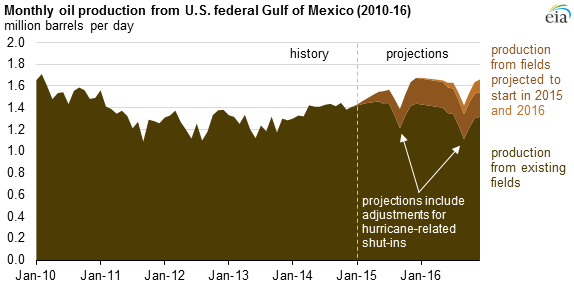
Because of the long timelines associated with Gulf of Mexico (GOM) projects, the recent downturn in oil prices is expected to have minimal direct impact on GOM crude oil production through 2016. EIA projects GOM production to reach 1.52 million barrels per day (bbl/d) in 2015 and 1.61 million bbl/d in 2016, or about 16% and 17% of total U.S. crude oil production in those two years, respectively.
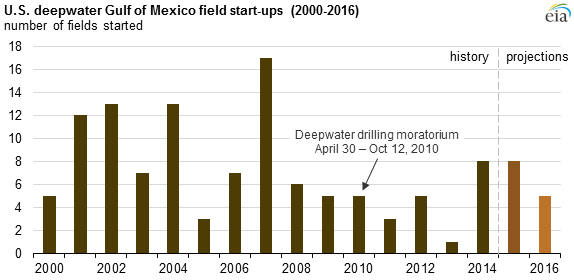
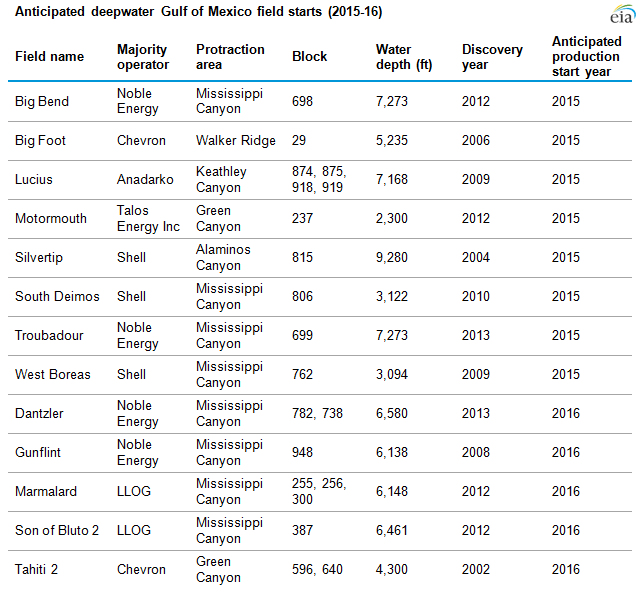
The forecasted production growth is driven both by new projects and the redevelopment and expansion of older producing fields. Five deepwater projects began in the last three months of 2014: Stone Energy-operated Cardamom Deep and Cardona projects, Chevron-operated Jack/St. Malo fields, Murphy Oil-operated Dalmatian, and Hess-operated Tubular Bells. Also occurring at the end of 2014 was the redevelopment of Mars (Mars B) and Na Kika (Na Kika Phase 3), both of which are mature fields. Cardamom Deep, Jack/St. Malo, and Tubular Bells were slated for a late 2014 start-up, as well. Although industry press releases have indicated they have started producing, their production data have not yet been reported to the Bureau of Safety and Environmental Enforcement (BSEE) under the U.S. Department of the Interior.
graph of daily U.S. deepwater Gulf of Mexico field start-ups, as explained in the article text


The relatively high number of fields that came online in 2014 and are scheduled for 2015 and 2016 production start-ups reflects the revival of interest and activity in the GOM following the moratorium on deepwater drilling after the 2010 Deepwater Horizon incident. While the moratorium officially lasted from April 30 to October 12, 2010, there were relatively few field start-ups in 2011 through 2013.
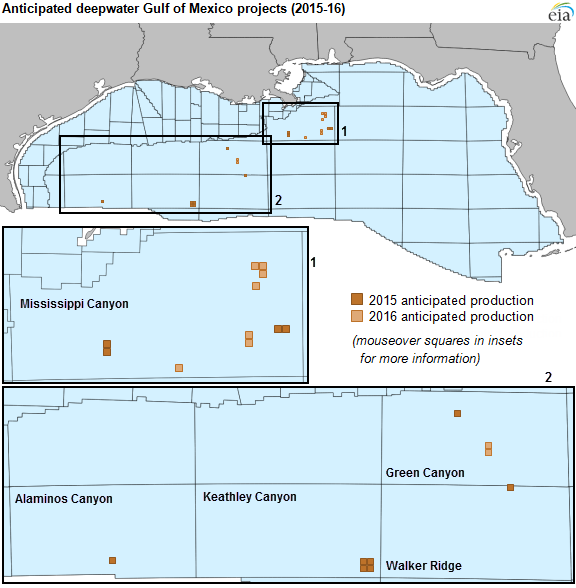
Thirteen fields are expected to start up in the next two years, eight in 2015 and five in 2016. Development of offshore fields requires both surface and subsea production equipment. The high cost of surface structures limits their application to large fields. Those fields with reserves not large enough to justify the necessary capital expenditure use subsea infrastructure to connect to nearby existing platforms. This approach, known as a subsea tieback, can reduce project costs and start-up times. More than half of the projects starting up in 2015 and 2016 will be subsea tiebacks to existing production platforms. These new projects, combined with continuing production from the developments brought online in late 2014, are forecast to add 265,000 bbl/d by the end of 2015. The production estimates for 2015 and 2016 (see first graph) include adjustments to account for seasonal shut-ins from hurricanes.


The current low oil price adds uncertainty to the timelines of deepwater GOM projects, with projects in early development stages exposed to the greatest risk of delay. In an effort to reduce this risk, producers are collaborating to develop projects more cost-effectively, to shorten the time to final investment decision and first production, and by sharing development costs. For instance, Chevron, BP, and ConocoPhillips recently announced a collaborative effort to explore and appraise 24 jointly held offshore leases in the northwest portion of the Gulf of Mexico's Keathley Canyon. (DOE-EIA)

FERC Authorizes Algonquin Pipeline Retrofits

(Issued March 3, 2015)

FULL RULING

On February 28, 2014, Algonquin Gas Transmission, LLC (Algonquin) filed an application in Docket No. CP14-96-000 pursuant to section 7(c) of the Natural Gas Act (NGA) and Part 157 of the Commission’s regulations for authorization to construct and operate its Algonquin Incremental Market Project (AIM Project) in New York, Connecticut, Rhode Island, and Massachusetts. Algonquin also requests NGA section 7(b) authorization to abandon a meter and regulating station in New London County, Connecticut, which will be replaced as part of the project, as well as to remove and replace certain aboveground facilities.

Algonquin states that the project will enable it to provide 342,000 dekatherms (Dth) per day of firm transportation service from its existing recipient points in Ramapo, New York, to various city gate delivery points in Connecticut, Rhode Island, and Massachusetts.

For the reasons stated below, we (FERC) will grant the requested authorizations, subject to certain conditions.


I. Background and Proposals

Algonquin is a limited liability company organized and existing under Delaware law and an indirect, wholly-owned subsidiary of Spectra Energy Partners, LP. Algonquin is a natural gas company as defined in the NGA, engaged in the transportation of natural 1 15 U.S.C. § 717f(c) (2012). 2 18 C.F.R. Pt. 157 (2014).Docket No. CP14-96-000 - 2 - gas in interstate commerce subject to the Commission’s jurisdiction. Algonquin’s natural gas pipeline system extends from points near Lambertville and Hanover, New Jersey, through the states of New Jersey, New York, Connecticut, Rhode Island, and Massachusetts, to points near the Boston area. A.

Project Proposal

Algonquin proposes to construct, install, operate, and maintain approximately 37.4 miles of pipeline and related facilities in New York, Connecticut, and Massachusetts. Specifically, Algonquin proposes the following activities:

• replace approximately 20.1 miles, in three segments, of 26-inch-diameter pipeline with 42-inch-diameter pipeline in Putnam, Rockland, and Westchester Counties, New York, and Fairfield County, Connecticut;

• install approximately 2.0 miles of 36-inch-diameter pipeline looping in Middlesex and Hartford Counties, Connecticut (Line 36A Loop Extension);

• replace approximately 9.1 miles of 6-inch-diameter pipeline with 16-inchdiameter pipeline on the E-1 System Lateral in New London County, Connecticut (E-1 System Lateral Take-up and Relay);

• install approximately 1.3 miles of 12-inch-diameter pipeline looping in New London County, Connecticut (E-1 System Lateral Loop); and

• install approximately 4.1 miles of 16-inch-diameter pipeline and approximately 0.8 miles of 24-inch-diameter pipeline off its existing I-4 System Lateral in Norfolk and Suffolk Counties, Massachusetts (West Roxbury Lateral).  In addition, Algonquin proposes to add 81,620 horsepower (hp) of compression at six compressor stations in New York, Connecticut, and Rhode Island with the following modifications:

• install two new 15,900 hp natural gas-fired compressor units, restage one existing compressor unit, install gas cooling for the new compressor units, and modify station piping at the Stony Point Compressor Station in Rockland County, New York;

• install one new 10,320 hp natural gas-fired compressor unit, restage one existing compressor unit, replace the compressor body of one existing compressor unit, install gas cooling for the new compressor unit, and modify station piping at the Southeast Compressor Station in Putnam County, New York;Docket No. CP14-96-000 - 3 -

• restage one existing compressor unit at the Oxford Compressor Station in New Haven County, Connecticut; • install one new 15,900 hp natural gas-fired compressor unit, install gas cooling for the new compressor unit and two existing turbine-driven compressor units, and modify station piping at the Cromwell Compressor Station in Middlesex County, Connecticut;

• install one new 7,700 hp natural gas-fired compressor unit, restage two existing compressor units, install gas cooling for the new compressor unit and two existing compressor units, and modify station piping at the Chaplin Compressor Station in Windham County, Connecticut; and

• install one new 15,900 hp natural gas-fired compressor unit, restage one existing compressor unit, install gas cooling for the new compressor unit, and modify station piping at the Burrillville Compressor Station in Providence County, Rhode Island.  (FERC)

Friday, February 27, 2015

Senator Inhofe Throws Snowball On Senate Floor

FCC Net Neutrality Rulemaking

The Federal Communications Commission approved the policy known as net neutrality by a 3-2 vote at its meeting today, with FCC Chairman Tom Wheeler saying the policy will ensure "that no one — whether government or corporate — should control free open access to the Internet."


The Open Internet Order helps to decide an essential question about how the Internet works, requiring service providers to be a neutral gateway instead of handling different types of Internet traffic in different ways — and at different costs.

Republicans who warned that the FCC was overstepping its authority and interfering in commerce to solve a problem that doesn't exist. They also complained that the measure's 300-plus pages weren't publicly released or openly debated. The new policy would replace a prior version adopted in 2010 — but that was put on hold following a legal challenge by Verizon. The U.S. Court of Appeals for the D.C. Circuit ruled last year that the FCC did not have sufficient regulatory power over broadband.

After that ruling, the FCC looked at ways to reclassify broadband to gain broader regulatory powers. It will now treat Internet service providers as carriers under Title II of the Telecommunications Act, which regulates services as public utilities.

The ACLU noted that it was a victory for free speech. Americans use the Internet not just to work and play, but to discuss politics and learn about the world around them. The FCC has a critical role to play in protecting citizens' ability to see what they want and say what they want online, without interference. Title II provides the firmest possible foundation for such protections.

Opponents say: "The FCC's decision to impose obsolete telephone-era regulations on the high-speed Internet is one giant step backwards for America's broadband networks and everyone who depends upon them. These 'Title II' rules go far beyond protecting the Open Internet, launching a costly and destructive era of government micromanagement that will discourage private investment in new networks and slow down the breakneck innovation that is the soul of the Internet today."

The new FCC policy will "ban blocking, ban throttling, and ban paid-prioritization fast lanes." For the first time, open Internet rules will be fully applicable to mobile. By a 3-2 vote, the FCC voted to adopt net neutrality rules to "protect the open Internet.  (NPR)


Wednesday, February 25, 2015

Jewell, McCarthy & Moniz Head To Capitol Hill on Budget

Sally Jewell
Jewell Heads to Senate Energy – The Senate Committee on Energy and Natural Resources will convene a hearing tomorrow  to examine the President's proposed budget request for fiscal year 2016 for the Department of the Interior.  Interior Secretary Sally Jewell will testify.


Gina McCarthy
McCarthy Heads to House Energy and Appropriations Committees – EPA Head Gina McCarthy will visit the House Energy and Commerce Committee on Wednesday to examine the President's proposed budget request for fiscal year 2016 for EPA. 

Then on Thursday, U.S. EPA Administrator Gina McCarthy and David Bloom, U.S. EPA Acting Chief Financial Officer, will testify before the House Appropriations Subcommittee on Energy on Interior, Environment and Related Agencies on FY 2016 Budget. EPA’s proposed budget provides resources to ensure that the agency can make the investments needed to meet its mission to protect public health and the environment.


Ernest Moniz
U.S. Secretary of Energy Ernest Moniz Heads to House Energy Appropriations – The House Energy and Water Appropriations panel will examine the President's proposed budget request for fiscal year 2016 for DOE on Thursday with Energy Secretary Ernest Moniz testifying.

(Frank Maisano)

Tuesday, February 24, 2015

President Obama Vetoes Keystone XL Pipeline Legislation

President Obama vetoed legislation authorizing construction of the Keystone XL pipeline today, rebuffing the new Republican Congress amid a battle over Homeland Security funding. 
The veto — just the third of Obama’s presidency — was made in private and without fanfare, reflecting the tensions in the Democratic Party over whether the pipeline should be approved.
"Through this bill the United States Congress attempts to circumvent longstanding and proven processes for determining whether or not building and operating a cross-border pipeline serves the national interest," Obama said in his veto statement.

"The presidential power to veto is one I take seriously ... and because this act of Congress conflicts with established executive branch procedures and cuts short thorough consideration of issues that could bear on our national interest — including our security, safety and environment — it has earned by veto."
Speaker John Boehner (R-Ohio) ripped Obama's veto, calling it a "national embarrassment."

First proposed more than six years ago, the Keystone XL pipeline project has sat in limbo ever since, awaiting a permit required by the federal government because it would cross an international boundary. The pipeline would connect Canada's tar sands with refineries on the Texas Gulf Coast that specialize in processing heavy crude oil.

Republicans and the energy industry say the $8 billion project would create jobs, spur growth and increase America's independence from Mideast energy sources. Democrats and environmental groups have sought to make the pipeline a poster child for the type of dirty energy sources they say are exacerbating global warming.

President Obama's administration, through the State Department, is still weighing the pipeline's merits, and he has repeatedly threatened to veto any attempts by lawmakers to make the decision for him.  (The White House, The Hill, ABC News/AP, 2/24/2015)

Center Partners With Nuclear Matters

CfECE has joined Nuclear Matters as a partner.  CfECE's long history [China - France] of supporting nuclear power makes this a natural fit.  We expect this partnership to be dynamic and to enhance the maintenance of our current fleet of reactors.

The mission of Nuclear Matters is to inform the public about the clear benefits that nuclear energy provides to our nation, raise awareness of the economic challenges to nuclear energy that threaten those benefits, and to work with stakeholders to explore possible policy solutions that properly value nuclear energy as a reliable, affordable and carbon-free electricity resource that is essential to America’s energy future.

In furtherance of this mission, Nuclear Matters has reached out to stakeholders around the country to hear directly from them about the importance of nuclear energy to their states and communities and find the solutions that will help to preserve this essential energy resource.  Nuclear Matters reached out to CfECE and we enthusiastically reacted in the affirmative.  We look forward to a productive partnership.

Evan Bayh
Judd Gregg
Co-Chairs for Nuclear Matters are former Indiana United States Senator and former Indiana Governor Evan Bayh and former New Hampshire United States Senator and former New Hampshire Governor Judd Gregg.

Nuclear Matters is supported by a cross-section of individuals, organizations, and businesses united in their view that nuclear power plays a critical role in our energy portfolio, and that existing nuclear power plants should be preserved.

Nuclear Matters is currently recruiting partners and CfECE is proud to be among some of the original individuals, organizations, and businesses that are aligning with this dynamic pro-nuclear campaign.

Saturday, February 21, 2015

Exxon Mobil Refinery Explosion in Torrance, California

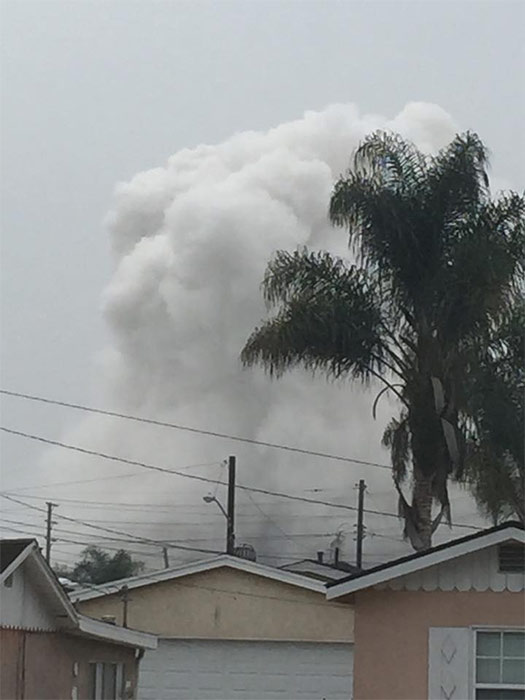
An explosion at the Exxon Mobil refinery caused structural damage and was felt for miles around Torrance on Wednesday, but there were no major injuries. The blast happened in a processing unit at the refinery in the 3700 block of 190th Street at 8:50 a.m.

A structure was damaged in an explosion at the ExxonMobil refinery in Torrance, California

The explosion was followed by a ground fire, which was quickly knocked down. The explosion was so strong that it registered as a 1.7-magnitude earthquake on a nearby seismometer operated by Caltech and USGS.

Smoke is seen after an explosion at the Exxon Mobil refinery in Torrance in this photo from ABC7 viewer Jeffery Smith. <span class=meta>ABC7 viewer Jeffery Smith</span>

Exxon Mobil said in a statement that four contractors were transported to Long Beach Medical Center for minor injuries, and everyone was accounted for. Some area residents reported feeling an earthquake-like jolt. Then, they saw ash falling in the neighborhood following the blast. The Torrance Fire Department says the white ash-like substance is non-toxic, but may pose inhalation risk as all airborne particles do.

View image on Twitter

The blast was strong enough to break a window at an apartment complex across the street from the refinery and damage a cinder block wall. Torrance police said air quality readings were normal, but area residents were advised to shelter in place temporarily. The shelter-in-place order has since been lifted. The Torrance Unified School District advised schools to shelter in their students. A total of 13 schools were affected, and parents were notified. Torrance fire officials say the situation was stabilized by noon.

The cause of the blast was not known. For more information, residents can call the Exxon Mobil hotline at (310) 505-3158.  (ABC 7Eye Witness News, Los Angeles, 2/18/2015)

Friday, February 20, 2015

L.A. Long Beach Port Strike

The International Longshore and Warehouse Union (ILWU) represents 20,000 dockworkers, who spend years earning full membership and whose current contract pays $26 to $41 an hour, with free healthcare for members, want more money. Some earn six figures with overtime.  The Pacific Maritime Association (PMA), which represents shipping companies, does not want to pay more and sees little need to back down.  Thus, the L.A./Long Beach Port is shut down.  And this is affecting the entire country with billions of dollars in commerce on the line.


The two parties are at the negotiating table, where U.S. Labor Secretary Thomas Perez is now trying to broker a deal.  Both parties say they want to avoid repeating the 10-day lockout of 2002, which then-President George W. Bush stepped in to end. They have reportedly agreed on many major elements of a new contract but remain at odds over finer points.  The same forces that have pulverized private sector unions in other industries — overseas manufacturing, lower transportation costs, global markets — have strengthened the hand of the ILWU. Every day, ship owners have to pay a lot of money for a ship. The cranes are very expensive, and if they're not being used, that's wasted money.  Containerization made the shipping industry very capital-intensive, and that effectively gave power to the union.

Center President Norris McDonald observing the cargo ships outside the port


So did two decisions by ILWU's founder and longtime president, Harry Bridges.  The first was negotiating a single contract covering every port from San Diego to Bellingham, Washington. That prevents shippers from playing one West Coast port against another, as sometimes happens on the East Coast.  The other was a 1960 agreement that embraced the arrival of containerization, essentially agreeing to shed thousands of jobs manually hauling crates and bags from ships' holds in order to save thousands in the higher-tech — and higher-paid — work of operating forklifts and giant cranes.


As container traffic boomed in the decades since, that tough choice paid off.  But the industry faces a new round of changes. Ever-larger ships are dumping more cargo at once on the docks, creating more congestion even when the work is going smoothly. That's increasing the demand for automation.  Ports in Europe and Asia increasingly use robotics to move goods that union longshoremen handle today on the West Coast. Another threat is the widening of the Panama Canal, scheduled for completion next year. That will enable some larger ships to pass more quickly to the East and Gulf Coast, though experts disagree on how much that could hurt Southern California.

The employers and the union both have a common interest in the success of L.A.-Long Beach and in keeping the port as efficient as possible. As the dispute drags on, the union's solidarity could be a key factor. The ILWU is known as an aggressive union — forged in violent strikes on San Francisco's Embarcadero in the 1930s, booted from national labor groups in the McCarthy-era 1950s for being "too red," and willing to shut down the docks several times in recent years in solidarity with smaller unions. That's what happened in 2012, when clerical workers at the L.A.-Long Beach docks went on strike and clogged the ports for several days.


In the port towns, everyone has a friend, a brother, a cousin, a niece who works in this industry and benefits from the power of the union. Many would like to join. Membership is typically earned only after years of so-called "casual" work, which involves showing up in the early morning at the cracked parking lot next to a junkyard in Wilmington, where day labor jobs are doled out — if there's work to go around — at the lower end of the pay scale. Log enough hours, and eventually you qualify for full membership, with better hours and full benefits. When they open the rolls to new casuals, the lines are thousands of people long.

Last year, it was the Justice for Port Truck Drivers work stoppage over “unfair labor practices” at Green Fleet Systems, Total Transportation Services and Pacific 9 Transportation that temporarily hemorrhaged the port system. The Teamsters affiliated group has backed three previous strikes in the last two years, each lasting less than 48 hours, at these carriers serving Southern California ports.  The Teamsters charge the three carriers violated labor laws and interfered with unionization efforts. (L.A. Times, 2/17/2015, CCJ Digital, 7/8/2014)

Tuesday, February 17, 2015

New York Mayor DeBlasio Releases 2015 Climate Report

Today, Mayor Bill de Blasio announced the release of the New York City Panel on Climate Change’s 2015 report, Building the Knowledge Base for Climate Resiliency, focused on increasing the current and future resiliency of communities, citywide systems, and infrastructure around New York City and the broader metropolitan region.
The New York City Panel on Climate Change (NPCC) is an independent body that advises the City on climate risks and resiliency. As the best available data, NPCC science informs the City’s comprehensive climate policies, including its multilayered, citywide resiliency plan and sweeping sustainability initiatives—in line with President Obama’s recent Executive Order. The NPCC worked in partnership with the City, including with the Mayor’s Office of Recovery and Resiliency, the Mayor’s Office of Sustainability, the Mayor’s Office of Operations, and the Department of Health and Mental Hygiene.
Today’s NPCC report provides climate projections through 2100 for the first time, for temperature, precipitation, and sea level rise, representing advancement in the science. New topics covered in the report also include public health, with a focus on extreme heat events and coastal storms and enhanced dynamic coastal flood modeling, which incorporate the effects of sea level rise. 
The full report—Building the Knowledge Base for Climate Resiliency: New York City Panel on Climate Change 2015 Report.
The City is announcing today new progress as it implements a comprehensive resiliency plan based on the NPCC’s science, including the kickoff of scoping and preliminary design work on the Lower East Side integrated flood protection system, the launch of the first-ever comprehensive regional analysis of New York City’s food supply chain resiliency, key steps forward to combat the urban heat island effect, and the start of an approximately $100 million shoreline investment program to protect the most vulnerable waterfront communities.
Additionally, Mayor de Blasio will launch NPCC3, which will build on today’s report, and, in particular, look at climate risks through the lens of inequality at a neighborhood scale in a report due early next year. NPCC3 will also focus on ways to enhance coordination of mitigation and resiliency across the entire New York metropolitan region.
In addition to providing climate projections through 2100, NPCC2’s new content today includes:
  • New coastal flood risk maps to the end of the century for the current 100-year (1 percent annual chance of occurrence) and 500-year (0.2 percent annual chance of occurrence) coastal flood events.
  • Enhanced dynamic flood inundation modeling of future coastal flooding that includes the effects of sea level rise. 
  • A review of key issues related to climate change health risks relevant to the citizens of New York City. 
  • A process for enhancing a New York City Climate Resiliency Indicators and Monitoring System. 

Key Recommendations and City Action
The City is announcing new progress on a number of key projects, including:
  • The launch of scoping and preliminary design work on the Lower East Side to implement a $335 million integrated, neighborhood-sensitive flood protection system to mitigate risk and help connect the community with the waterfront. This project, which is funded by the U.S. Department of Housing and Urban Development’s Rebuild by Design competition, runs from East 23rd Street to Montgomery Street and is intended to be just the first phase of a larger project that will ultimately provide coastal resiliency for all of Lower Manhattan. To that end, the City has already allocated additional funds to advance planning and preliminary design south of Montgomery Street.
  • The Office of Recovery and Resiliency (ORR), partnering with the New York City Economic Development Corporation (NYCEDC), has also launched the first-ever, comprehensive regional resiliency analysis of New York City’s food supply chain network. The study will examine key distribution assets both locally and in surrounding jurisdictions, examine regional transportation routes, and work with the city’s food community to help ensure continuity of operations during a disaster.
  • To combat the urban heat island effect, as of the end of 2014, NYC Cool Roofs has coated over six million square feet of building roofs with reflective paint to address the climate change risks associated with urban heat. The City’s recent green buildings plan commits to coating at least one million square feet a year more to continue mitigating the urban heat island effect and provide energy savings in affordable housing, public buildings, and non-profit organizations. ORR has also convened urban heat island experts to advance research and understanding on this issue, and continues to focus its heat response protocols on vulnerable populations.
  • ORR and NYCEDC have also launched an approximately $100 million shoreline investment program to protect the most vulnerable waterfront communities, including Coney Island Creek and Staten Island’s South Shore, and other low-lying parts of the city that will be evaluated as part of the first phase of work. This will include a nine-month first phase to identify and prioritize approximately 43 miles of at-risk shoreline, following by design and construction of site-specific resiliency measures that might include bulkhead upgrades, revetment installation, and living shoreline treatments.
The City has already implemented short-term measures to immediately reduce risk. For example:
  • 4.15 million cubic yards of sand placed on city beaches.
  • 26,000 linear feet of dunes on Staten Island alone, with additional dunes on the Rockaway peninsula.
  • 10,500 linear feet of bulkhead repairs around the city.
  • Updated building and zoning codes, including 16 new local laws to improve residential and commercial resiliency.
  • $1 billion in resiliency investments being made by ConEd to harden critical assets like substations and other critical distribution equipment.
  • Reforms to FEMA’s national flood insurance program, critical flood insurance affordability studies, and education efforts for homeowners across the city.
Additional longer-term measures are being advanced all across the entire city, including but not limited to:
  • Over $450 million to construct new armored levees and other infrastructure along Midland Beach and Staten Island’s East Shore, to substantially reduce risk in the future, in partnership with the U.S. Army Corps of Engineers and the State.
  • Substantial investment in the next phase of coastal protection in the Rockaways and the communities surrounding Jamaica Bay, in partnership with the Army Corps and State.
  • T-groins and beach nourishment in Sea Gate, on which ground was broken on Saturday, in partnership with the Army Corps and the State.
  • Dunes and other coastal protection in Breezy Point.
  • Integrated flood protection system measures in Red Hook.
  • Over $15 million in natural infrastructure resiliency projects funded by the Department of Interior in Jamaica Bay, the Bronx River, and elsewhere.
  • Additional coastal protection projects funded by the federal Rebuild by Design program (in addition to the Lower East Side flood protection system), including:
    • Hunts Point Lifelines—food distribution center investments in coastal protection, waterfront access, and energy resiliency.
    • Living Breakwaters—natural infrastructure investments in wave attenuation off of Staten Island’s South Shore, being implemented by the State.
  • Major investments in the Staten Island Bluebelt and other stormwater infrastructure across the city to better accommodate increasing precipitation.
  • Key resiliency upgrades at critical facilities, such as hospitals like Staten Island University Hospital, Coney Island Hospital, Bellevue, and more.
  • NYCHA recovery and resiliency funds to elevate boilers and install emergency generators and flood protection systems.
  • Agency recovery and resiliency funds to restore and protect critical City agency services like schools, parks, and other facilities.
  • Major flood and coastal protection studies, including at Coney Island Creek, Gowanus Canal, Southern Manhattan, and Newtown Creek, to evaluate the feasibility of additional tidal barrier and surge barrier investments.
  • Department of City Planning Resilient Neighborhoods studies to advance land use measures to support the vitality and resiliency of individual communities in the flood zones.
  • Small business resiliency support, including new resiliency technologies to be applied through the NYC: RISE competition and assistance through Business PREP, a new program to provide small businesses with education and technical support to enhance their resiliency.
The City is also taking dramatic steps to reduce its contributions to climate change, including becoming the largest city in the world to commit to an 80 percent reduction in greenhouse gas emissions by 2050. That commitment kicks off with Mayor de Blasio’s sweeping 10-year green buildings plan, One City: Built to Last, to retrofit public and private buildings, while creating green jobs and generating operational savings. (Office of the Mayor of New York)

Thursday, February 05, 2015

EPA Announces Fiscal Year 2016 Budget Proposal

The Obama Administration Fiscal Year 2016 budget for the U.S. Environmental Protection Agency (EPA) is $8.6 billion.  The request is $452 million above the agency’s enacted level for FY 2015.  (More at EPA)