Wednesday, May 16, 2012

EPA Launches College Stormwater Management Competition

The U.S. Environmental Protection Agency (EPA) is launching a new design competition called the Campus RainWorks Challenge to encourage student teams on college and university campuses across the country to develop innovative approaches to stormwater management. Stormwater is a major cause of water pollution in urban areas in the U.S., impacting the health of people across the country as well as tens of thousands of miles of rivers, streams, and coastal shorelines, and hundreds of thousands of acres of lakes, reservoirs, and ponds. The competition will help raise awareness of green design and planning approaches at colleges and universities, and train the next generation of landscape architects, planners, and engineers in green infrastructure principles and design.

Student teams, working with a faculty advisor, will submit design plans for a proposed green infrastructure project for their campus. Registration for the Campus RainWorks Challenge opens September 4, and entries must be submitted by December 14, 2012 for consideration. Winning entries will be selected by EPA and announced in April 2013. Winning teams will earn a cash prize of $1,500 - $2,500, as well as $8,000 - $11,000 in funds for their faculty advisor to conduct research on green infrastructure. In 2013, EPA plans to expand Campus RainWorks by inviting students to design and complete a demonstration project assessing innovative green infrastructure approaches on their campus.

EPA is encouraging the use of green infrastructure as a solution to help manage stormwater runoff. Green Infrastructure uses vegetation, soils, and natural processes to manage stormwater runoff at its source and provide other community benefits, including economic development.. Green infrastructure is increasingly being used to supplement or substitute for single-purpose “gray” infrastructure investments such as pipes, and ponds. The Campus RainWorks Challenge will help encourage the use of green infrastructure projects on college and university campuses to manage stormwater discharges. (EPA)

More information on the Campus RainWorks Challenge

Lisa Jackson Senate Appropriations 2013 Budget Testimony

Appropriations Committee Subcommittee on Department of the Interior, Environment, and Related Agencies
EPA’s budget request of $8.344 billion focuses on fulfilling EPA’s core mission of protecting public health and the environment, while making the sacrifices and tough decisions that Americans across the country are making every day.

Specifically, this budget proposes that $1.2 billion - nearly 15 percent of EPA’s overall request - be allocated back to the States and tribes, through categorical grants. This includes funding for State and Local Air Quality Management grants, Pollution Control grants and the tribal general assistance program.

The budget also proposes that a combined $2 billion - another 25 percent of EPA’s budget request - also goes directly to the States for the Clean Water and Drinking Water State Revolving Funds. This funding will help support efficient system wide investments and development of water infrastructure in our communities. We are working collaboratively to identify opportunities to fund green infrastructure - projects that can reduce pollution efficiently and less expensively than traditional grey infrastructure.

Additionally, EPA’s budget request would fund the protection of the nation’s land and water in local communities, including important waters such as the Narragansett Bay. Reflecting the President’s commitment to restoring and protecting the Great Lakes, this budget requests that Congress maintain the current funding level of $300 million for the Great Lakes Restoration Initiative. This support will continue to be used for collaborative work with partners at the State, local and tribal level, and also with non-profit and municipal groups. The budget also requests support for protection of the Chesapeake Bay, and several other treasured and economically significant water bodies. The budget reflects the importance of cleaning up contaminated land sites in our communities by requesting $755 million for continued support of the Superfund cleanup programs and maintains the Agency’s emergency preparedness and response capabilities.

EPA’s budget request makes major investments in its science and technology
account of $807 million, or almost 10 percent of the total request. This request includes $576M for research, including $81 million in research grants and fellowships to scientists and universities throughout the country for targeted research as part of the Science to Achieve Results - or STAR – program, including children’s health, endocrine disruption, and air monitoring research. Also, as part of this request, EPA includes funding increases into key areas that include green infrastructure and hydraulic fracturing.
As I’ve mentioned before, natural gas is an important resource which is abundant in the United States, but we must make sure that the ways we extract it do not risk the safety of public water supplies.
This budget continues EPA’s ongoing congressionally directed hydraulic fracturing study, which we have taken great steps to ensure is independent, peer reviewed and based on strong and scientifically defensible data. Building on these ongoing efforts, this budget requests $14 million in total to work collaboratively with the United States Geological Survey, the Department of Energy and other partners to assess questions regarding hydraulic fracturing. Strong science means finding the answers to tough questions, and EPA’s request does that.

Taken together, the Administration’s standards for cars and light trucks are projected to result in $1.7 trillion dollars of fuel savings, and 12 billion fewer barrels of oil consumed. This funding will also help support implementation of the first ever carbon pollution and fuel economy standards for heavy duty trucks.

Mister Chairman, thank you for the opportunity to testify today. While my testimony reflects only some of the highlights of EPA’s budget request, I look forward answering your questions. (EPA-Shortened by the Center)

Palm Oil Biofuels Under the Renewable Fuels Standard

March 29, 2012

The Honorable Lisa Jackson
Administrator
Environmental Protection Agency
1200 Pennsylvania Avenue, N.W.
Washington, DC 20460

Re: The Treatment of Palm Oil Biofuels under the Renewable Fuels Standard from the Center for Environment, Commerce & Energy (Center); Docket ID No. EPA–HQ–OAR–2011–0542

Dear Ms. Jackson:

The Center for Environment, Commerce & Energy (Center) is a national environmental organization  dedicated to protecting the environment, enhancing human, animal and plant ecologies and increasing participation in the environmental movement.  We focus on regulations, taxes, trade policies, monetary policies, and environmental issues as they relate to energy policy.

The Center is a strong advocate for U.S. energy prosperity and our organization raises awareness of the costs and consequences of policy changes for consumers. We believe it is important to ensure that minority communities are not burdened by artificially high energy costs. We also believe communities should be free to exercise a full range of choices in the marketplace, unburdened by short-sighted regulation or market manipulation.

To that end we stand in firm opposition to the EPA’s recent decision to penalize palm oil under the Agency’s management of the Renewable Fuels Standard. Palm oil is by far the lowest-cost biodiesel fuel source on the international market. By not allowing the lowest cost vegetable oil into the U.S. biofuel market, the EPA is ensuring that the RFS2 will lead to significantly higher prices at the pump as blenders rely on more costly vegetable oil feedstocks, like soybean oil and canola.

Blocking its trade in the United States will unduly burden poor communities.  We have already seen the baleful effects of higher energy costs in recent months as prices paid at the gas pump have risen steadily. These price increases have meant minority households have had less money at their disposal for food, clothing, shelter, education, health care, savings and investment, and more. The EPA’s decision will make an unfortunate situation worse.

More choices means more options when prices of one fuel rise. More choices means greater predictability and security when it comes to planning for the future. Restricting choices means minority groups are acutely vulnerable to price shocks in other sectors of the energy market.

Businesses and their workers are also keenly interested in policies regarding energy availability and affordability. For example, truckers and independent rail and transportation owner operators are significant consumers of diesel energy, including biodiesel. Many of these workers are minorities, and many of the businesses are minority owned and managed. Indeed, the transportation sector has been important to ensuring upward mobility and economic growth for minority communities.

As such, denying these communities the widest range of options in the energy market reduces their flexibility and their earnings prospects. It makes it more difficult to plan for growth, to hire workers and to expand operations that create opportunities and jobs for others.

The advance of sophisticated biodiesel systems is one of the most promising technological developments in recent memory. It promises to lower costs and generate long-run efficiencies that will benefit all stakeholders. But the full promise of biodiesel will not be realized without ample global competition and diversity of supply. As such, the EPA would be wise to avoid manipulating the market for biodiesel and let competition and consumer choice determine the ultimate shape and contours of market.

While we appreciate the EPA’s interest in ensuring a healthy domestic environment, we believe its rush to penalize foreign biofuel will do little to help America’s ecology and a great deal of harm to America’s minority communities. The EPA should reconsider its decision.

Sincerely yours,

Norris McDonald

Norris McDonald
President

Friday, May 11, 2012

EPA To Remove Vapor Capture Boot

Rubber Boot To Be Removed From Gas Pump Handles

The Obama administration and the Environmental Protection Agency announced Thursday they intend to phase out the rubber boots on gas pump handles now used to capture harmful gasoline vapors while refueling cars. The EPA says the vapor-capturing fuel pumps are redundant because more than 70% of all cars on the road today are equipped with on-board systems that capture the harmful vapors.

According to the EPA, 31,000 affected gas stations in mostly urban areas where smog is a problem will each save $3,000 apiece once the ruling is fully implemented.

Since 1994, gas stations that did not meet air quality standards have been required to use gas vapor recovery systems.

The most obvious gas vapor recovery system for drivers is the rubber boot at the end of the fuel pump nozzle that fits directly over the gas tank opening. When drivers refuel, gas vapors can escape and contribute to smog and harmful air pollution. To combat the release of these vapors, most gas stations have installed special gas pump nozzles that include the rubber boot to block vapors from escaping.

The EPA says the rubber fittings will be phased out as part of the new rule. The White House decision is the latest government-wide review of federal regulations. (CNN, 5/10/2012)

Thursday, May 10, 2012

Third Annual Industry Day at Cardozo Senior High School

Center President Norris McDonald participated as a panelist at the Cardozo Senior High School Third Annual Industry Day.  The Industry Day is sponsored by TransTech in collaboration with the Academy of Construction and Design and hosted by the National Association of Black Women in Construction (NABWIC) and Lockheed Martin.  Specialists addressed four broad areas: 1) Aviation, 2) Construction, 3) Engineering and 4) Transportation.  Cardozo Senior High School students attended the sessions with a general theme: "Preparing Students For College and Workforce-Linking Industry Leaders To The Classroom."

Industry Day presenters included representatives from a broad range of industries, including: aerospace, construction, engineering, environmental, transportation, consultants, government, architecture, and media, among others.

The afternoon Construction Session was facilitated by Sherry Snipes, American Institute of Architects and included panelists: Edward M. Johnson, Edward Johnson & Associates PC, and Jacque Ross, R & D Develpment, Inc.

Sherry Snipes, Edward M. Johnson, Jacque Ross, Norris McDonald

The sessions were held at the Cardozo High School Academy of Construction and Design.  The Academy of Construction of Design was created by the District of Columbia Public Schools Office of Career and Technology Education and the District of Columbia Students Construction Trades Foundation to develop student skills in carpentry, electricity and plumbing.  The students are equipped with necessary skills to move successfully from high school to an industry seeking competent workers.  Students engage in a core academic course that includes: basic safety, construction mathematics, introduction to blueprints, hand and power tools and more.  Students also participate in hands-on programs and field experiences.  Each student is also received certification in first aid, cardiopulmonary resuscitation (CPR) and OSHA 10 hour safety course.

Wednesday, May 09, 2012

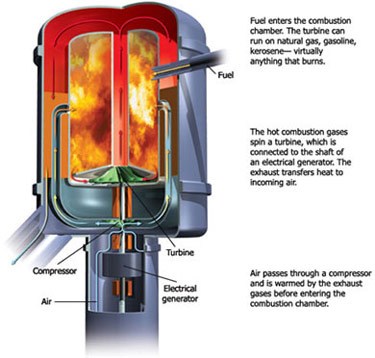
Microturbines


Microturbines are small combustion turbines that produce between 25 kW and 500 kW of power. Microturbines were derived from turbocharger technologies found in large trucks or the turbines in aircraft auxiliary power units (APUs).

Most microturbines are single-stage, radial flow devices with high rotating speeds of 90,000 to 120,000 revolutions per minute.


Fuel
Natural gas, hydrogen, propane, diesel
Efficiency
20 – 30% (Recuperated)
Environmental
Low (< 9 – 50 ppm) NOx


Microturbines are a relatively new distributed generation technology being used for stationary energy generation applications. They are a type of combustion turbine that produces both heat and electricity on a relatively small scale. Microturbines offer several potential advantages compared to other technologies for small-scale power generation, including: a small number of moving parts, compact size, lightweight, greater efficiency, lower emissions, lower electricity costs, and opportunities to utilize waste fuels. Waste heat recovery can also be used with these systems to achieve efficiencies greater than 80%.

Because of their small size, relatively low capital costs, expected low operations and maintenance costs, and automatic electronic control, microturbines are expected to capture a significant share of the distributed generation market.

(Ca. gov, Whole Building Design Guide (WBDG)-National Institute of Building Sciences)

Weak Link? Wind Turbine Step-Up Transformers

The key wind turbine generator (WTG) step-up transformer design issues that wind farm owners and developers should pay attention to include transformer loading, harmonics and non-sinusoidal loads, transformer sizing and voltage variation and special requirements to withstand faults.  The role of the WTG step-up transformers is critical and its design must be carefully and thoughtfully analyzed and reevaluated.

Wind turbines are highly dependent upon local wind and other climatic conditions, and their yearly average load factors can be as low as 35 percent.

Harmonics and Non-Sinusoidal Loads

WTG transformers are switched with solid state controls to limit the inrush currents. While potentially aiding in the initial energization, these same electronic controls contribute damaging harmonic voltages that, when coupled with the non-sinusoidal wave forms from the turbines, cannot be ignored from a heating point of view.

Normal voltage is alternating at 60 cycles per second. If the transformer operates at other voltages, the voltage peaks will not line up and you will not get the amplification you would achieve when frequencies line up. The transformer tries to pass the voltage it sees through the circuit and causes extra loading. All the electronics used today send spikes on the line and each time a frequency disturbance goes back to the transformer, the transformer must be able to handle the higher loading it sees.

When a rectifier/chopper system (the electronic controller used in wind turbines) is used, the WTG transformer must be designed for harmonics similar to rectifier transformers. These are "dirty" from a harmonics point of view, meaning they may contain high frequencies that the wind farm owner does not want to pass onto the utility power's grid, because it will affect other equipment.

If this happens, it can result in a protective equipment fault, causing transmission grid equipment to protect itself against faults by shutting down. The WTG must be able to take the additional loading into consideration and provide electrostatic shields to prevent the transfer of harmonic frequencies between the primary and secondary windings. It must be able to handle the energy and not transmit it to the grid.

Cost Risk

When purchasing a WTG step-up transformer, make sure you factor in how reliability affects the total cost of ownership. Wind farm turbines are unique because they are ganged together and dependent upon each other. For example, say one transformer fails, with a loss of revenue of about $1,000 per day. It may take two or even three days to replace the transformer, and in the meantime, the faulty generator may take down 10 to 14 other generators, not allowing them to produce. So that loss of $1,000 of revenue could turn into $30,000 in lost revenue, plus the cost of another transformer, construction labor and crane expenses. (Power Engineering, April 2012)

The Air Rule Puzzle Continues

The Clean Air Interstate Rule (CAIR) was finalized in 2005 and overturned by DC Circuit Court in 2008. Two years later it was re-proposed and rechristened as the Clean Air Transport Rule (CATR) and last year it was finalized as the Cross State Air Pollution Rule (CSAPR).

Utilities affected by the rule have been presented with five different sets of allowance allocations since July 2010. Some states have been "in" the group covered by the rule, then out, or vice versa. Allowances aren't the only aspect that has changed. Assurance provisions, which limit the amount of trading a state can do without being heavily penalized, have also gone through several iterations.

Additionally, since the CSAPR is based on helping downwind states comply with ozone and Pm2.5 National Ambient Air Quality Standards (NAAQS), as the NAAQS limits are lowered, it is likely that the CSAPR allowance allocations will be reduced as well.

The CSAPR was scheduled to replace CAIR starting Jan. 1, 2012. However, on Dec. 30, 2011, the U.S. Court of Appeals for the D.C. Circuit issued a ruling to stay the CSAPR pending judicial review.

The Greenhouse Gas Tailoring Rule is currently in litigation. While it is doubtful that the underlying endangerment finding will be revoked, if the court decides EPA overstepped its authority by eliminating smaller sources from regulation, the resulting universal applicability will overwhelm both state agencies and industry.

The Mercury and Air Toxics Standards (MATS) are likewise still facing legal challenges. And, no one knows quite where regulations for coal combustion residues and cooling water intake and discharge systems [316(a) and (b)] are going to end up. (Power Engineering, April 2012)

NRC Approves COLs for SCE&G, Santee Cooper Nuclear Units

South Carolina Electric & Gas Company SCE&G), principal subsidiary of SCANA Corporation (NYSE:SCG), and Santee Cooper, South Carolina’s state-owned electric and water utility, have received approval for combined construction and operating licenses (COLs) from the Nuclear Regulatory Commission (NRC) for two new nuclear units at V. C. Summer Station in Jenkinsville, S.C.

SCANA received approval for licenses to construct and operate units 2 and 3 at the V.C. Summer nuclear power plant site.  About 1,000 workers are currently engaged in early-site preparation work at the V.C. Summer construction site. The project will peak at about 3,000 construction craft workers over the course of three to four years. The two units, each with a capacity of 1,117 megawatts, will then add 600 to 800 permanent jobs when they start generating electricity.

PROFILE

SCE&G is a regulated utility engaged in the generation, transmission, distribution and sale of electricity to approximately 664,000 customers in South Carolina. The company also provides natural gas service to approximately 317,000 customers throughout the state. More information about SCE&G is available at www.sceg.com.

SCANA Corporation, a Fortune 500 company headquartered in Cayce, S.C., is an energy-based holding company principally engaged, through subsidiaries, in electric and natural gas utility operations and other energy-related businesses. Information about SCANA is available on the company’s website at www.scana.com.

Santee Cooper is South Carolina’s state-owned electric and water utility and the state’s largest power producer. The ultimate source of electricity for 2 million South Carolinians, Santee Cooper is dedicated to being the state’s leading resource for improving the quality of life for the people of South Carolina. For more information, visit www.santeecooper.com.

(SCANA)

Tuesday, May 08, 2012

Chesapeake Energy Abuses Private Jet Travel?

A shareholder lawsuit has revealed that Chesapeake Energy's cost for personal jet travel of top executives and directors totaled nearly $14 million over the past five years. The suit claims that was understated by as much as $10 million a year, largely because of the lack of inclusion of fixed costs, but any details may be included in the redacted portions.

The company owns fractional shares in 22 different jets, according to Federal Aviation Administration records, including a high-end Gulftstream G-550, eight other Gulfstreams and 13 Cessna aircraft. That is a large number given the size of Chesapeake, but comparisons are difficult because FAA records don't show the company's percentage ownership in each plane.

Even before the lawsuit, Chesapeake was viewed as unusually generous with its fleet of jets, which are operated by NetJets Inc. The company requires CEO Aubrey McClendon to fly on its aircraft for both personal and business travel for efficiency and security reasons. Other top executives also are permitted extensive personal usage, while outside directors are allowed 40 hours of personal aircraft travel a year.
Last year, Chesapeake disclosed it spent $2.9 million in personal travel for executives and board members. (WSJ, 5/8/2012)

David Hahn-Baker

PRESIDENT'S CORNER

By Norris McDonald

David Hahn-Baker, Norris McDonald
Hooked up with my old buddy David Hahn-Baker today.  He is Inside The Beltway for a board meeting and staying with a friend in Silver Spring.  We met out there and Dave updated me on his work.  Wow.  The man is busy.  But David was always ahead of his time.  In fact, there was a time when Dave and I were the only blacks working in the DC-based environmental movement.  My my how times have changed.

It was good to see Hahn-Baker.  He is hobbled by MS and I carry the asthma cross.  But we are still kicking.  And evidently having the best times of our lives professionally.  Dave is operating out of Buffalo now and is involved in a variety of issues, causes and environmental work. 

David walks with a cane and uses a wheelchair for more extensive getting around.  But my boy is still sharp of mind, if not fleet of foot.

We drove down to the part of Silver Spring near the Discovery Channel and found an outside place to eat.  It was great to catch up and share some time.  Baker, to me, is a legend.  He cut quite the path in the environmental movement in the early 1980's.  And though banged up a bit, he is as active as ever.  We picked each others brains for ideas and broke bread together. 

What a time.  Dave, you still inspire me.

NRDC Profile

In Reality, Keystone XL Pipeline Has Been Operating Since 2010

The current proposal would complete a Southern portion of the Keystone XL Pipeline
Phase 3

This phase, known as Cushing MarketLink, is part of the Keystone XL pipeline. This proposed phase would start from Cushing, Oklahoma where domestic oil would be added to the pipeline, then it would expand 435 miles (700 km) to a delivery point near terminals in Nederland, Texas to serve the Port Arthur, Texas marketplace. Also proposed is an approximate 47 miles (76 km) previous pipeline to transport crude oil from the pipeline in Liberty County, Texas to the Houston, Texas area.

Domestic oil producers in the USA are pushing for this phase so the glut of oil can be distributed out of the large oil tank farms and distribution center in Cushing, Oklahoma. On November 16, 2011, Enbridge announced it is buying ConocoPhillips' 50% interest in the Seaway pipeline that flows from the Gulf of Mexico to the Cushing hub. In cooperation with Enterprise Products Partners LP it plans to reverse the Seaway pipeline so that an oversupply of oil at Cushing could reach the Gulf. This project will replace the earlier proposed alternative Wrangler pipeline project from Cushing to the Gulf Coast. However, according to industries, the Seaway line alone is not enough for oil transportation to the Gulf Coast.

On March 22, 2012, President Obama announced an approval of the Cushing, Oklahoma to the Gulf Coast portion of the pipeline. TransCanada said that work on that section of the pipeline could start in June 2012 and be on-line by the middle to late 2013.

Click Image To Enlarge

(Wikipedia)

Santa Catalina Island

PRESIDENT'S CORNER

By Norris McDonald

Recently, I had the pleasure of exploring Santa Catalina Island, which is 22 miles off the coast of California (from Long Beach).  As a follow-up to our Compton To Catalina Program (CTC Program), I decided to really get to know the island.  I took a few days to walk most of Avalon, the only incorporated city on the island. I previously visited the island two times, once with my son and once with an investor to scope the island for a wood chip to electricity power plant we are promoting.  My intent on this extended stay was to not only learn about the many activities that are available on the island, but to gain enough details to significantly enhance our Compton To Catalina Program.  I would say goal was completely fulfilled.

I took the tour bus up to the Airport In The Sky.  That was one scary ride.  It twisted and turned around the mountain road.  There were incredible views. 

I took the Zip Line Eco Tour.  That was fun.  I will recommend it to CTC Program participants (but only if parents participate).


I played the 9-hole golf course.  I played 18 holes by playing from the white tees first and the blue tees second.  I like the course.

Other activities available on the island include para-sailing, snorkeling, scuba diving, boat rental, golf cart rental, bike rental (including battery assist), submersible tour, glass bottom boat tour, stand up surf boat rental, Jeep Eco tours, hiking, camping, Segway rental, miniature golf, mini-bowling and arcade, swimming, pedal boats, and a climbing wall, among other activities.  I think it was important for me to personally see all of these activities so that I can make appropriate arrangements for CTC Program participants to experience them.

The inner harbor area also has numerous retail shops, restaurants, eateries, hotels, a grocery store, drug store, post office and other facilities.

I stayed at the Zane Grey Pueblo Hotel.  I highly recommend it because it has the best view of any reasonably-priced hotel in Avalon.


Monday, May 07, 2012

Environmental Groups Target Coal Ash Disposal

Environmental groups have asked a federal court to compel EPA to finalize rules regulating the disposal of coal combustion residuals (CCR) under the Resource Conservation and Recovery Act (RCRA). They are joined by a manufacturer and marketer of products made with recycled coal ash who alleges, in a companion suit, that the agency is harming its business by not acting to finalize rules proposed nearly two years ago.

Coal ash is beneficially used in a variety of products, including construction materials like concrete, cement, and roofing materials, and the beneficial use industry is concerned about the potential economic impacts that would result if coal ash is designated as a RCRA hazardous substance.

At the same time, the new rules would have a substantial financial impact on firms that generate, transport, and dispose of coal combustion residuals. Indeed, EPA estimates that its proposed rules would have annualized regulatory compliance costs between $587 million to $1.4 billion, while industry trade groups estimate that the rule’s potential costs could be three to four times higher. (Marten Law)

EPA's Draft Guidance On Oil & Gas Hydraulic Fracturing

EPA Releases Draft Permitting Guidance for Using Diesel Fuel in Oil and Gas Hydraulic Fracturing

Guidance will clarify means of compliance with 2005 Amendments to the Safe Drinking Water Act

Today (May 4), the U.S. Environmental Protection Agency (EPA) released draft underground injection control (UIC) program permitting guidance for class II wells that use diesel fuels during hydraulic fracturing activities. EPA developed the draft guidance to clarify how companies can comply with a law passed by Congress in 2005, which exempted hydraulic fracturing operations from the requirement to obtain a UIC permit, except in cases where diesel fuel is used as a fracturing fluid.


The draft guidance outlines for EPA permit writers, where EPA is the permitting authority, requirements for diesel fuels used for hydraulic fracturing wells, technical recommendations for permitting those wells, and a description of diesel fuels for EPA underground injection control permitting. The draft guidance describes diesel fuels for these purposes by reference to six chemical abstract services registry numbers. The agency is requesting input on this description.

While this guidance undergoes public notice and comment, decisions about permitting hydraulic fracturing operations that use diesel fuels will be made on a case-by-case basis, considering the facts and circumstances of the specific injection activity and applicable statutes, regulations and case law, and will not cite this draft guidance as a basis for decision.

EPA continues to work with states, industry and other stakeholders to help ensure that natural gas is developed safely and responsibly.

EPA will take public comment on the draft guidance for 60 days upon publication in the Federal Register to allow for stakeholder input before it is finalized. (EPA)


More information

Fact Sheet

Maryland Dept of the Environment Climate Change Hearings

The public comment period for Maryland's climate change plan is now open and your opinions and ideas are needed.

In 2009, Maryland Governor O'Malley and the Maryland General Assembly passed the Greenhouse Gas Emissions Reduction Act of 2009. The law requires the State to develop and implement a plan to reduce greenhouse gas (GHG) emissions 25 percent by 2020.

Maryland is among the states most vulnerable to climate change. With the fourth longest tidal coastline, Maryland is the third most vulnerable state to sea level rise -- one of the major consequences of climate change. Rising sea levels, along with increased storm intensity could have devastating and far-reaching environmental and economic impacts on the Chesapeake Bay ecosystem and the quality of life Marylanders currently enjoy.

Public Meeting Dates:

May 8, 2012 - noon - 2 p.m.
Elkton Central Library
301 Newark Avenue
Elkton, Maryland 21921
410-996-5600

May 15, 2012 - noon - 2 p.m.
Queen Anne's County Health Department
206 North Commerce Street
Centreville, Maryland 21617
410-758-0720

May 24,2012 - noon - 2 p.m.
C. Burr Artz Public Library
First Floor - Community Room
110 East Patrick Street
Frederick, Maryland 21701
301-600-1630

May 31, 2012 - 6 p.m. - 8 p.m.
Maryland Department of Natural Resources
C1 Conference Room
580 Taylor Avenue
Annapolis, Maryland 21401
1-877-620-8367

June 5, 2012 - 6 p.m. - 8 p.m.
Maryland Department of the Environment
First Floor - Aqua & Terra Conference Rooms
1800 Washington Boulevard
Baltimore, Maryland 21230
410-537-3240

AFL-CIO President Supports Keystone Pipeline

Richard Trumka
The AFL-CIO does not have a formal position on Keystone XL pipeline, but AFL-CIO President Richard Trumka is backing construction of the project. Trumka is also downplaying divisions among unions in the labor federation over the controversial project.

President Obama, who has won the AFL-CIO’s endorsement, has said more review is needed but has not taken a position on the cross-border pipeline itself.
Regarding the different positions by unions, Trumka notes:
“They are not divided on the pipeline itself; they are divided on how the pipeline is done. I think we are all unanimous by saying we should build the pipeline, but we have to do it consistent with all environmental standards, and I think we can work that out, I really do, and we are for that happening.”
The pipeline has been a thorny issue for the labor federation and harmed at least one major union's relationship with environmentalists.  Environmentalists bitterly oppose Keystone due to greenhouse gas emissions from extracting and burning oil sands, forest damage from the massive projects in Alberta, and fear of spills along the pipeline route.

Although some unions oppose the pipeline, others support it. Many unions including the Laborers’ International Union, the International Brotherhood of Electrical Workers, the Teamsters, the Building and Construction Trades Department of the AFL-CIO and others strongly back construction of Keystone, calling it a way to create jobs.

But the Amalgamated Transit Union and the Transport Workers Union have opposed Keystone due to environmental concerns about the oil sands and potential pipeline spills. The United Steelworkers, the United Autoworkers, the Communications Workers of America and the Service Employees International Union joined those two unions and two big green groups in a statement that backed Obama’s January decision to reject a permit for Keystone.

The White House, when rejecting a permit for the pipeline in January, said the decision was not on the “merits” of the project but instead alleged the GOP was demanding a deadline that would short-circuit review. TransCanada Corp. re-applied for a federal cross-border permit late last week.
Backers of the project say construction should be authorized and that the project should go forward even as a route to avoid ecologically sensitive regions of Nebraska is studied.  (The Hill, 5/6/2012)

Saturday, May 05, 2012

Maryland Flush Taxes To Double To $60

Gov. Martin O'Malley signed legislation Wednesday that will double the flush tax for most Marylanders. The flush tax, a fee used to renovate wastewater treatment plants in an effort to clean up the Bay, will double from $30 to $60 starting in July, raising roughly $56 million.

The tax as passed is a far cry from the governor's earlier proposed hikes to the fee -- a panel had originally suggested tripling the charge.

Lawmakers say the extra revenue will help the state comply with new federally led efforts to restore the Bay's water quality by 2025, and that the legislation keeps Maryland ahead of the curve when it comes to protecting the environment.

Another bill requires local jurisdictions to adopt development practices that move septic systems away from areas where water pollution is more likely to occur. And the governor signed legislation that requires locally funded projects to prevent storm water runoff from making its way from roads into rivers, streams and farmland. (Washington Examiner, 5/2/2102)

EPA Life-Cycle Assessment of Lithium Ion Battery


EPA's Office of Pollution Prevention and Toxics and Office of Research and Development (ORD) has announced that the draft final report for the life-cycle assessment (LCA) conducted by the Design for the Environment (DfE)/ORD Li-ion Batteries and Nanotechnology Partnership has been posted on EPA’s DfE Program web site for a 60-day public comment period.

The LCA results for advanced batteries used in plug-in hybrid and electric vehicles are expected to help promote the responsible development of these emerging energy systems, including nanotechnology innovations, leading to reduced overall environmental impacts and the reduced use and release of more toxic materials. The LCA study identified key materials and processes within the batteries’ life cycles that are likely to pose the greatest environmental impacts, including occupational and public toxicity impacts, which will help the Li-ion battery industry to identify environmentally sound process, material, and design choices. The partnership included battery manufacturers, suppliers, and recyclers, as well as representatives from academia, trade and research institutions, and the Department of Energy's Argonne National Laboratory.


For further information, please contact Kathy Hart in OPPT's DfE Program, at (202)564-8787. .

Phaedra Ellis-Lamkins Is Having A Baby

Dear Norris,

Phaedra Ellis- Lamkins
As Green For All approaches its 5th Anniversary, I am more hopeful than ever about our efforts to build a green economy strong enough to lift people out of poverty. We’ve made great strides, and we couldn’t have done it without you.
I’m also thrilled to share some exciting new developments.

In a few weeks, I will become a mother for the first time. As I think about the world I want my child to grow up in, the work we do at Green For All takes on new urgency and weight. I’m more committed than ever to leaving behind a healthier, more equitable and prosperous planet.

Kimberly Freeman Brown
That’s why I couldn’t be more pleased to announce that the amazing Kimberly Freeman Brown will be joining our team. Kimberly will serve as interim executive director of Green For All during my maternity leave. As executive director of American Rights at Work, Kimberly has developed a reputation as a fearless leader who has brought together civil rights, labor, and environmental leaders to advocate for workers. We’re fortunate to have her.

Kimberly will help guide us into our next phase of growth, as we ramp up our work to create real jobs and build a movement strong enough to change our economy. As part of that effort, we’ve begun a search for a talented executive director, who will join me in my new role as president of Green For All. Our new executive director will focus on making Green For All an even more resilient and strategic institution, and I will devote more time to communicating our vision with the rest of the world and building our movement. 

It’s true that the challenge before us is daunting. But as I look ahead at the changes we’re making at Green For All, and at the successes we’re already seeing in the growing green economy, I believe that we have arrived at our moment. And as I think about the new addition to my family and my life, the stakes seem higher than ever. We have to win. And with your help, we will.

Sincerely,

Phaedra Ellis-Lamkins
Chief Executive Officer
Green For All

EPA Hearings Carbon Pollution Standards for New Power Plants

Comment Period Extension 

EPA will hold two public hearings on the proposed Carbon Pollution Standard for New Power Plants. The hearings will be May 24, 2012 in Washington DC and Chicago. EPA is also extending the comment period on this proposed rule by 30 days, until June 25, 2012, to give the public ample time to comment after the public hearing.
 
More information on the standard and the hearings
 
Background

Such public hearing will begin at 8:30 a.m. and continue until 4:30 p.m. (local time). The public may preregister to speak at the hearings at a specific time. People also may register in person on the day of the hearing, and will be accommodated as time allows. The EPA must close the hearing promptly at 4:30 p.m. To preregister to speak at the hearings, please contact Ms. Pamela Garrett, telephone 919-541-7966 or email.

The proposal's fact sheet provides a summary or the rule and detailed instructions on how to comment.

Wednesday, May 02, 2012

EPA Takes Next Step to Implement 2008 Ozone Standards

Most areas that need to take steps to reduce ozone pollution are close to meeting the standards; only three new areas have been added. Working closely with states and tribes, the U.S. Environmental Protection Agency (EPA) is identifying areas that meet or do not meet the 2008 air quality standards for ground-level ozone, known as smog.

The agency’s approach to implementing these standards will improve air quality, protect public health, increase certainty for states and tribes, maximize flexibilities and minimize the burden on state, tribal and local governments. Breathing air containing high levels of smog can reduce lung function and increase respiratory symptoms, aggravating asthma or other respiratory conditions. Ozone exposure may also contribute to premature death, especially in people with heart and lung disease.

In 2008, EPA set new smog standards at 75 parts per billion. Working with states and tribes and following an open public process that included a 45-day public comment period, EPA has determined that 45 areas across the country, including two separate areas of Indian country, are not meeting the 2008 standards based on the most recent certified air quality data. Almost all of these areas already have programs in place to improve air quality because they did not meet the 1997 smog standards. Only three areas will be identified for the first time as not meeting smog standards.

Reflecting ongoing improvements in air quality, EPA is identifying fewer areas that do not meet the 2008 standards than the agency identified as not meeting the 1997 standards. Reducing smog and improving air quality is a shared responsibility of federal, state, local and tribal governments. National clean air programs such as EPA’s standards to reduce power plant emissions that cross state lines, clean vehicle and fuel standards, and more locally focused state, tribal air quality programs are already contributing to air quality improvements. These actions will help areas meet the standards and protect public health. In addition, EPA expects that most areas would be able to meet the 2008 standards as a result of recent and pending rules.

The Clean Air Act requires EPA to review and, if necessary, revise air quality standards every five years to ensure that they protect public health with an adequate margin of safety. Following a change in standards, EPA works with states and tribes as appropriate to identify areas that do not meet the standards and establish plans to improve air quality. EPA continues to work to review the science needed to inform the next five-year review of the smog standards and currently expects to propose action in 2013.  (EPA)

More about final designations throughout the country

Cummins Engine Company Profiting From Regulations

Cummins Inc., the U.S. manufacturer of engines for trucks, buses and off-road machinery, is thriving in good measure because of tough, new government regulations around the world. In the last few years, the $18 billion-a-year-in-sales company has become the go-to partner for overseas vehicle manufacturers in Asia and Latin America looking to avoid years of costly engineering work to bring their own engines into compliance with the new standards. Demand for more efficient engines is aiding Cummins.

There is a very strong push for better environmental regulations by governments in almost every country. America has technologies that can help those countries meet emissions regulations with a relatively low impact to their economies. Cummins' willingness to customize its engines and other components for specific regions—a strategy the Columbus, Ind., company calls fit-for-market—has allowed it to penetrate foreign markets faster and more thoroughly than other U.S.-based manufacturers.

About 35% of Cummins sales last year came from fast-growing markets, such China, India and Brazil, up from 27% in 2007. Cummins' all-in approach to emerging markets exposes the company to inevitable second-guessing as sizzling economies in China and Brazil weaken lately.  Emerging markets are going to grow at somewhere between two and three times what the U.S. and Europe are going to grow at over the next 10 years.

Cummins' revenue from its engine-and-component content on heavy-duty trucks in North America has doubled in the last 10 years to $30,000 a truck. That figure is almost certain to increase as U.S. truck makers comply with new regulations starting in 2014 to lower carbon dioxide emissions and an improve fuel mileage. Moreover, manufacturers of new commercial trucks in China, India and Brazil face ever-increasing restrictions on nitrogen oxide, a component of ozone-depleting greenhouse gas that Cummins already has reduced to ultra-low levels on its U.S. engines. Cummins already accounts for nearly half the engine market for light and medium-duty trucks in Brazil and 35% of the engine market for construction machinery. (WSJ, 5/1/2012)

EPA To Assist Drinking Water System Monitoring

EPA to Work with Drinking Water Systems to Monitor Unregulated Contaminants The U.S. Environmental Protection Agency (EPA) today published a list of 28 chemicals and two viruses that approximately 6,000 public water systems will monitor from 2013 to 2015 as part of the agency’s unregulated contaminant monitoring program, which collects data for contaminants suspected to be present in drinking water, but that do not have health-based standards set under the Safe Drinking Water Act.

EPA will spend more than $20 million to support the monitoring, the majority of which will be devoted to assist small drinking water systems with conducting the monitoring. The data collected under the Unregulated Contaminant Monitoring Rule 3 (UCMR 3) will inform EPA about the frequency and levels at which these contaminants are found in drinking water systems across the United States and help determine whether additional protections are needed to ensure safe drinking water for Americans. State participation in the monitoring is voluntary. EPA will fund small drinking water system costs for laboratory analyses, shipping and quality control.

The list of contaminants to be studied includes total chromium and hexavalent chromium, also known as chromium-6. Addressing hexavalent chromium in drinking water is a priority for EPA Administrator Lisa P. Jackson. In January 2011, EPA issued guidance to all water systems on how to assess the prevalence of hexavalent chromium and in the March 2011 proposal for UCMR 3, EPA invited comments on whether the agency should include chromium in the final rule. Public comments received by EPA were strongly supportive of adding total chromium and hexavalent chromium for monitoring.

EPA selected the contaminants by first reviewing the agency’s contaminant candidate list, which highlights priority contaminants that need additional research to support future drinking water protections. The contaminants on the list are known or anticipated to occur in public water systems. However, they are not addressed by existing national drinking water standards. Additional contaminants of concern were selected based on current occurrence research and health-risk factors.

EPA has standards for 91 contaminants in drinking water, and the Safe Drinking Water Act requires that EPA identify up to 30 additional unregulated contaminants for monitoring every five years.

More Information

Compton To Catalina Program Launches

1st Trip A Complete Success

The Center for Environment, Commerce and Energy (Center) established a partnership with the Greater Union Baptist Church (GUBC) to operate an environmental tour called the “Compton To Catalina Program,” which takes students and other young people from Compton, California to Catalina Island. The Center and the California Center for Economic Initiatives (CCFEI) are also partnering under the Compton To Catalina Program to expose Compton youth to boat repair and to provide technical training services.


The Center initiated its Compton-To-Catalina Program on Saturday, April 21, 2012, which is the day before Earth Day. The program began with a press conference at the Greater Union Baptist Church in Compton, California. Participants then traveled to Long Beach, California to board the Catalina Express to make the one hour trip to the island. Once on Santa Catalina Island, the participants boarded the Emerald submersible to observe underwater life around the island. Finally, participants toured Southern California Edison's electricity generating plant at Pebbly Beach, the island's primary electricity generation source.

Long Version 

The purpose of the program is to expose young people from Compton to the Pacific Ocean and an incredibly beautiful island. People take it for granted that the vast majority of these kids never get on the water and many people live their entire lives without directly experiencing the Pacific Ocean even though they live within five or ten miles of it. We believe that such early exposure to this environment could lead to a lifelong environmental stewardship ethic.
The Compton To Catalina Program is being operated thanks to a grant from Southern California Edison.

GUBC recruits people to participate in the Compton To Catalina (CTC) Program. The Center makes arrangements for the tours and facilitates educational experiences for the students. Each is a daylong affair that includes transportation to Long Beach, where the tours originate. Participants have escorts at all times and activities on the island are arranged to maximize the environmental experience.

We utilize the transport services of Catalina Express. Passengers on board Catalina Express can expect to arrive in Catalina in about an hour from Long Beach. The Catalina Express fleet consists of eight high-speed vessels including four catamarans. The largest vessel in operation, the Catalina Jet has the capacity to carry nearly 500 passengers across the channel. Catalina Express offers up to 30 round trips daily

There are numerous activities available on Catalina Island, including: an Eco Tour Zip Line, hiking, biking, camping, swimming, snorkeling, diving, sightseeing, dining, shopping or relaxing, to name a few. Our main activities include a submersible ride to view submerged vegetation and fish species and an electricity power plant tour.
The Center, GUBC and CCFEI are providing important environmental and technical services to the youth of Compton, California. This partnership provides a rich environmental experience for participants. The Center will engage institutions and individuals to support the program.


Short Version