Saturday, January 11, 2014

Former EPA Headquarters In Southwest Converted To Apartments

Converted Building
Sky House, where the former Environmental Protection Agency headquarters was located in Southwest Washington, has been transformed into two apartment buildings.

The towers at Sky House, one of the first LEED-certified re-use projects in the city, will be the tallest residential structures in Southwest. Residents will have unobstructed views of the Potomac, the monuments and the Capitol.

Sky House East, which opened for leasing last week, will have 266 homes, including studio and one- and two-bedroom units.

Original Building
Community amenities include a rooftop swimming pool, an observation deck with panoramic skyline and river views, an outdoor patio with seating, water features, a grill and a gas fireplace. The indoor amenities include a game room, a fitness center with a personal trainer, a conference room, a party room, a club room, an Internet lounge and concierge services. The pet-friendly building has an on-site grooming space.

Garage parking is available and residents are steps from the Southwest Waterfront Metro, shops and restaurants.

Rents at Sky House will range from the $1,600s to the $3,200s. (Wash Post, 1/6/2014)

Friday, January 10, 2014

EDF Renewable Energy Spinning Spur 3 Wind Project

EDF Renewable Energy today announced the acquisition of the 194 megawatt (MW) Spinning Spur 3 Wind Project from Cielo Wind Power LP (Cielo).  Spinning Spur 3 is located on approximately 18,000 acres in Oldham County, Texas, roughly 50 miles west of Amarillo.

The project expects commercial operation by the end of 2015 utilizing ERCOT’s (Electricity Reliability Council of Texas) new CREZ (Competitive Renewable Energy Zone) transmission lines. The clean electricity generated from the Spinning Spur 3 Wind Project will be provided to two municipal utilities, Georgetown Utility Systems and Garland Power & Light, under long-term Power Purchase Agreements.
  
About EDF Renewable Energy: EDF Renewable Energy is a leading U.S. independent power producer with more than 25 years of expertise in the renewable industry, covering all range of services from project development, management to operations and maintenance. EDF Renewable Energy specializes in wind and solar photovoltaic with presence in other segments of the renewable energy market: biogas, biomass, hydro, marine energy and storage solutions. The company develops, constructs, operates and manages renewable energy projects throughout the United States for its own accord as well as for third parties. EDF Renewable Energy’s portfolio consists of over 3.5 gigawatts of developed projects with 1.8 gigawatts of installed capacity. EDF Renewable Energy is the U.S. subsidiary of EDF Energies Nouvelles. EDF Energies Nouvelles is the renewable energy arm of the EDF group, the leading electricity company in the world. For more information visit: www.edf-re.com

About Cielo Wind Services, Inc.: Cielo Wind Services, Inc. (Cielo), a Texas corporation which is wholly owned by Cielo Wind Power, LP. Cielo Wind Power, LP is a private closely-held company based in Austin, Texas, whose sole business is the development and operation of wind power facilities. Cielo is the largest independently-owned wind company in the U.S. Cielo has developed 1,751MW of projects in New Mexico and Texas over the past 11 years. “Wind Ranch” is a registered trademark of Cielo Wind Power, LLC. For more information, visit us at cielowind.com or contact Virginia Rogan at vrogan@cielowind.com or (512) 440-0305.  (Business Wire, 1/8/2014)

Contacts:

EDF Renewable Energy
Sandi Briner, 858-521-3525
Sandi.Briner@edf-re.com  

Thursday, January 09, 2014

EPA, CO2 and Carbon Capture and Sequestration

PRESIDENT'S CORNER

By Norris McDonald
 
On December 19, 2013, EPA finalized a proposed rule to regulate carbon emissions from new power plants by requiring new coal-fired plants to install a technology known as carbon capture and sequestration (CCS).  Unfortunately, CCS has not been operated at any commercial scale coal-fired power plant in the world. To support the assertion that CCS has been "adequately demonstrated," EPA relied on three power plants that are under development and are proposing to install CCS systems funded by grants from the Department of Energy. 
 
The Energy Policy Act of 2005 states that EPA cannot rely on projects funded by DOE to show that a new technology has been adequately demonstrated for purposes of the Clean Air Act. Instead of adhering to this legislative intent, EPA went ahead and published the proposal.  Litigation will follow.

The EPA route to mitigating CO2 is being utilized because Congress refused to do its job and pass, in our opinion, Cap & Trade legislation to deal with this serious problem.  Just as the Cap & Trade Program proposed by the Bush administration via the agency rulemaking route did not work, neither will this procedure.  It is another in a long line of air regulations that produce lots of litigation but very little to no mitigation.
 
CCS technologies allow carbon dioxide to be captured at stationary sources - like coal-fired power plants and large industrial operations - and injected underground for long-term storage in a process called geologic sequestration.

The new rule effectively bans new coal-fired power plants in the U.S. EPA wants to require new coal-fired plants to install an experimental technology called carbon capture and storage (CCS) even though it has not been demonstrated at any commercial scale power plant in the world.

EPA argues that companies will find ways to make this technology cheaper, but companies say they will simply stop investing in new technologies for coal plants if EPA mandates a technology that is not yet ready for commercial use. 

The new rule clarifies that carbon dioxide streams captured from emission sources, injected underground via UIC Class VI wells approved for the purpose of geologic sequestration under the Safe Drinking Water Act, and meeting certain other conditions (e.g., compliance with applicable transportation regulations), will be excluded from EPA’s hazardous waste regulations. Further, EPA clarifies that carbon dioxide injected underground via UIC Class II wells for enhanced oil recovery (EOR) is not expected to be a waste management activity.

EPA concluded that the careful management of carbon dioxide streams under the specified conditions does not present a substantial risk to human health or the environment. EPA’s determination will help provide a clear pathway for the deployment of CCS technologies in a safe and environmentally protective manner while also ensuring protection of underground sources of drinking water. (EPA, Frank Maisano)

Information on the
final rule

Information on the Geologic Sequestration of Carbon Dioxide

Read the draft guidance on transitioning from Class II to Class VI wells

Wednesday, January 08, 2014

Interior Secretary Announces $1 Million Private Outreach Initiative

Secretary Jewell Announces $1 Million Private Funding Commitment to Advance Youth & Conservation Initiative

American Eagle Outfitters, Inc. is First Company to Pledge to Newest Public-Private Partnership to Develop Next Generation of Outdoor Stewards

As part of an ambitious initiative to engage and employ the next generation through America’s great outdoors, Secretary of the Interior Sally Jewell today announced a public-private partnership with American Eagle Outfitters, Inc. that will help reach Interior’s goal of providing 100,000 work and training opportunities to young people and veterans on public lands.

American Eagle Outfitters, Inc. (AEO) announced an historic $1 million commitment to develop the next generation of outdoor stewards. The funding commitment is the first in AEO’s philanthropic history and is also the first pledge toward Jewell’s target of raising $20 million from private partners by 2017 to support the 21st Century Conservation Service Corps (21CSC).


The 21CSC, launched by the Obama Administration as part of the America’s Great Outdoors program, is a national collaborative effort to put America’s youth and veterans to work protecting, restoring, and enhancing America’s natural and cultural resources.

Jewell made the announcement today at the Franklin Delano Roosevelt Memorial in Washington, D.C., in recognition of the Civilian Conservation Corps that President Roosevelt created over 80 years ago.

The $1 million dollars will directly support non-profit corps programs that provide work and training experience to young people and veterans on Interior’s public lands, such as the Student Conservation Association.

Already an initial group of nearly 100 organizations have been approved as partner organizations to stand up the 21CSC and provide work opportunities through supervised crews or small teams. In the coming months, the 21CSC National Council, made up of eight federal departments and agencies including the Departments of Agriculture and Interior, will focus on recruiting additional member organizations.


Jewell first outlined her youth initiative in a speech at the National Press Club in October where she emphasized the need to bridge the growing disconnect between young people and the great outdoors. The goals of Interior’s youth initiative for the next four years include:

Play: Interior will develop or enhance outdoor recreation partnerships in a total of 50 cities over the next four years to create new, systemic opportunities for outdoor play for more than 10 million young people.

Learn: Provide educational opportunities to at least 10 million of the nation’s K-12 student population annually. In addition to welcoming students into nature’s classroom, we are developing and strengthening new online education resources, to reach more students.

Serve: Engage 1 million volunteers annually on public lands, effectively tripling the numbers we have now. We know that many more people are interested in volunteering at national parks, wildlife refuges and public lands, but there are often insufficient staff resources to coordinate them. In order to achieve the volunteer goal, we will place a renewed emphasis on volunteer coordination and management.

Work: To develop the next generation of lifelong conservation stewards and ensure our own skilled and diverse workforce pipeline, Interior will provide 100,000 work & training opportunities to young people within our bureaus and through public-private partnerships. As part of this effort, we aim to raise an additional $20 million to support the youth work and training opportunities. (DOI Press Release)

Monday, January 06, 2014

Natural Gas and Oil Futures Contracts

Natural Gas Futures Contracts

Natural Gas Futures prices ended 2013 at $4.23 per million Btus.  Although the price at the beginning of the year was $3.23, by April the prices rose to $4.39.  Thereafter the price fluctuated more or less around the $4 mark for the remainder of the year.


Cushing, Oklahoma Oil Futures prices ended 2013 at $98.42 per barrel.  The price at the beginning of the year was $93.12.  The lowest prices were in April at under $87 while the high prices were in late August at about $110.
 
(DOE-EIA)

Saturday, January 04, 2014

EPA Regulating New Wood Stoves

The Environmental Protection Agency (EPA) moved Friday to curb emissions of particles and gases from residential wood stoves and other wood-fired heaters built in 2015 or later, an effort to combat pollutants that can present a significant health hazard in parts of the country.

The proposed new rules would require manufacturers of wood stoves, wood-pellet stoves, forced-air wood furnaces, wood boilers, fireplace inserts and masonry heaters to build a generation of devices that burn 80 percent more cleanly than current models. The rules would go into effect in 2015 and become more strict after five years, though the EPA is asking whether they should be phased in over eight years instead.

The new rules do not apply to wood heaters already in use or to residential fireplaces, backyard fire containers or fire pits used by campers and beachgoers. Nor do they apply to smokers, wood-fired barbecues or pizza ovens.

Particulate matter is a big health issue and has been linked to heart attacks and strokes and can aggravate asthma. A number of studies have linked it to premature death among people who suffer from heart and lung disease. Other pollutants in wood smoke include carbon monoxide and organic compounds that contribute to smog.

About 11.5 million U.S. homes use wood for heat, according to the U.S. Energy Information Administration. The EPA estimates that 85,695 wood stoves will be manufactured and sold in 2015.


In places where wood is commonly used for heat, communities are occasionally forced to issue “no-burn” alerts when the concentration of particles in the air becomes too high. Utah banned the use of wood-burning stoves in five counties last month when weather conditions led to high levels of fine particles in the air. Wood is a popular heat source in parts of New England, the upper Midwest and the Northwest.  (Wash Post, 1/3/2014)

Monday, December 30, 2013

Natural Gas versus Nuclear Power versus Coal

Low natural gas prices are making it hard to impossible for other sources to compete in providing electricity.  Coal use is being reduced because of this competitive situation and because of the costs associated with complying with clean air regulations.  The front end cost of building nuclear power plants puts them at a competitive disadvantage against natural gas.

There is a distinct possibility that low natural gas prices are less accidental than they seem most observers. Natural gas competitors are being weakened by being forced to either stop selling or to sell their product at prices that provide little, no, or negative margin above cost.

By pursuing horizontal drilling and hydraulic fracturing technology as rapidly as possible, gas suppliers have successfully lowered the price at which they are selling their fuel to a level that is unprofitable for most of their less heavily capitalized competitors. Since most gas extractors also extract oil, they have been able to finance their unprofitable gas operations from the healthy profits obtained by selling liquid petroleum at prices that are five times as high today as they were a dozen years ago.

Back in the mid-2000's, the general consensus in the energy industry was that nuclear energy growth in the United States had the potential to considerably expand the nuclear industry.  In fact, plans were to build 28 new reactors at an estimated cost of about $4 billion to $5 billion apiece. The nuclear industry was enjoying renewed political support after decades of opposition from environmental groups and others concerned about the risks. An increasing number of lawmakers in both parties, worried about global warming and dependence on foreign oil, support some expansion of nuclear power.

Each large nuclear plant produces as much energy each day as 200 million cubic feet of natural gas burned in an efficient combined cycle gas turbine (CCGT) plant. When there was a prospect of 28 new plants — with many more to follow if those plants were successful — the natural gas industry was facing the prospect of permanently losing a lucrative market for their product. The initial loss upon completion of 28 new nuclear plants would be about 3 billion cubic feet per day, and that number had the potential for substantial growth.

Coal is an obvious target because it already has a large market share and it has numerous drawbacks that are easy to attack.

In fact it is so unpopular that natural gas advocates have declared a war on coal and have openly participated with financial support for efforts like the Sierra Club's Beyond Coal campaign.  (The Energy Collective, 12/29/2013)

Wind Industry Production Tax Credit

The wind industry is rushing to make sure projects qualify for a subsidy before it is set to end at the end of 2013. Developers are signing deals, ordering equipment and proceeding with construction starts to qualify for a tax credit that is worth 2.3 cents a kilowatt-hour for the first 10 years of production.

This month, giant turbine-makers like Vestas and Siemens have announced major new orders, including a deal worth more than $1 billion with MidAmerican Energy, an Iowa-based utility majority-owned by Warren E. Buffett’s Berkshire Hathaway, and another with the Cape Wind project in Nantucket Sound.
      
In previous years, the projects had to be in commercial operation by New Year’s Eve. This year, they need only have begun.
      
Though the wind industry has grown enormously since the tax credit began in the 1990s, it has followed a boom-and-bust cycle driven by the fate of the subsidy. Over the years, Congress has allowed it to expire several times before renewing it, according to the American Wind Energy Association, a trade group. With each expiration, new installations dropped sharply.
      
That happened in late 2012, when manufacturing and new project starts nearly came to a standstill, only to pick up again after Congress revived the credit, called the Production Tax Credit, in January for a year. The renewal was intended as a temporary fix to keep business going as lawmakers overhauled the tax code.
 
Developers are unlikely to start any projects without a credit in place because they cannot compete with power generation from other sources like cheap natural gas. Projects that do not have the P.T.C. attached to them are probably difficult to justify economically.              

Under a recent agreement, among the largest in land-based wind power, MidAmerican will buy 448 turbines from Siemens. The turbines, which Siemens will maintain for the first 15 years of operations, are to be installed in five projects in Iowa. The company has also agreed to make turbines for Cape Wind, which could become the country’s first offshore wind farm. More than a decade in the making, it has faced lawsuits and stiff opposition from Cape Cod residents who say the spinning machines will spoil pristine views and raise the price of electricity.
 
Opponents of the credit are mostly generators of other forms of energy, who say that by subsidizing wind, the government is adding supply to the market in a way that depresses prices for electricity, cutting the revenues of other generators and, in some cases, driving them out of business.
 
The production tax credit for wind energy has passionate opponents in the nuclear industry. This is because in about half the country, electrically speaking, the wholesale price of electricity is set by auction, and when there is oversupply, prices drop.       
This is a problem for generators that run on coal or natural gas, but within minutes or hours they can reduce their output. Reactors, however, cannot easily lower their power output. Thus, at hours when wholesale electricity prices go negative, operators often end up paying to generate electricity.
      
At Exelon, the country’s largest civilian reactor operator, executives say one of its Illinois plants sees negative prices during 14 percent of the off-peak hours. And some of its plants could be shut as uncompetitive next year, not because of their true production costs, but because of the wind subsidy, the company argues. Exelon was a member of the American Wind Energy Association, the industry’s trade group, but was expelled in September 2012 because it opposed extension of the production tax credit.
      
Wind developers argue that all forms of energy receive government support and that the credit helps level the playing field. Their main focus now is the familiar race to make sure their projects qualify while the credit is still available.
 
This year’s renewal does not require projects to go into production until the end of 2016, but they must either be in continuous construction or have spent at least 5 percent of the total costs this year. Project costs can top $100 million.  Companies are frantically reordering their usual processes, with some ordering turbines without permits to build or starting construction while still negotiating power contracts.  (NYT, 10/25/2013)      

Friday, December 27, 2013

USA Oil Production To Surpass Imports

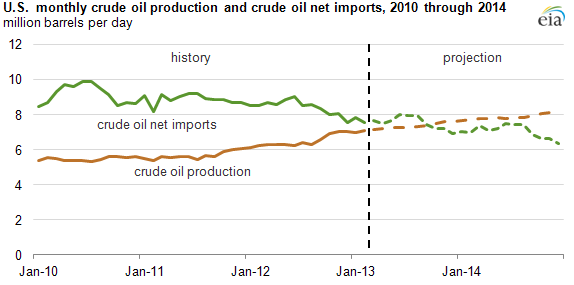
U.S. crude oil production on track to surpass imports for first time since 1995


Graph of U.S. crude production and imports, as explained in the article text

Source: U.S. Energy Information Administration, March 2013 Short-Term Energy Outlook.


Monthly crude oil production in the United States is expected to exceed the amount of U.S. crude oil imports later this year for the first time since February 1995. The gap between monthly U.S. crude oil production and imports is projected to be almost 2 million barrels per day (bbl/d) by the end of next year—according to EIA's March 2013 Short-Term Energy Outlook.

According to EIA's projections:
  • Monthly crude oil production could surpass net crude oil imports later this year.
  • Monthly crude oil production is forecast to top 8 million bbl/d in the fourth quarter of 2014, which would be the highest level since 1988.
  • Net crude oil imports are expected to fall below 7 million bbl/d in the fourth quarter of 2014 for the first time since 1995.
This projected change is primarily because of rising domestic crude oil production, particularly from shale and other tight rock formations in North Dakota and Texas.
(DOE-EIA)

California Air Resources Board Compliance Instrument Tracking System Service

The Air Resources Board (ARB) Compliance Instrument Tracking System Service (CITSS) is a market tracking system that supports the
implementation of greenhouse gas (GHG) cap-and-trade programs for
California and other jurisdictions.   CITSS provides accounts for
market participants to hold and retire compliance instruments and
to participate in transfers of compliance instruments with other account holders.  CITSS is used to register entities participating in the California Cap-and-Trade Program, track the ownership of compliance instruments, enable and record compliance instrument transfers, facilitate emissions compliance, and
support market oversight.

The CITSS Registrant Report continues ARB’s process of making market related information public.  ARB will continue to develop and release additional market related information as part of implementation of the Cap-and-Trade Program.  ARB has held three workshops to discuss release of market information and received many oral and written comments during that process.  The CITSS Registrant Report implements the regulatory requirements regarding information release and addresses stakeholder concerns related to releasing confidential business information that could place stakeholders at a market disadvantage.

The CITSS Registrant Report will include the names of account holders in the tracking system. This will allow counter parties to verify each other and will provide for program transparency.  For covered and opt-in entities, information will include the legal entity name, the four digit CITSS ID, and the status of the account as a covered or opt-in entity.  In the case of voluntarily associated entities, information will include the legal entity name, the four digit CITSS ID, and the status of the account holder as an organization or individual.  Where applicable, the report will also include the GHG reporting ID’s for any facilities associated with the CITSS account.  Individual
CITSS account numbers will not be released.

The Air Resources Board (ARB) releases information related to the Compliance Instrument Tracking System Service (CITSS) registrants on the ARB website.   Regular releases beginning in 2014 will be at 12:00 (noon) Pacific Time on the last business day of each quarter.  These releases include information about covered, opt-in, and voluntarily associated entities registered for the Cap-and-Trade Program in CITSS.

If you have any questions related to the Cap-and-Trade Program, please contact Jakub Zielkiewicz at (916) 445-6018.

More information on the California Cap-and-Trade Program

Thursday, December 26, 2013

Demolition of Retired Nuclear Power Plants

Entergy, owner of the Vermont Yankee nuclear-power station, agreed in August to shut the plant in 2015.  Under federal rules, plant operators that put their plants in the Nuclear Regulatory Commission "SAFESTOR" program have 60 years to complete tear down and site restoration. Vermont Yankee opened in 1972 and was bought by Entergy in 2002. Entergy is exercising its legal right to take as many as 60 years to demolish the plant, located 5 miles south of Brattleboro, Vermont.

Vermont Yankee

Vermont Governor Peter Shumlin announced a deal this week: Entergy agreed to begin the demolition as soon as possible and the state agreed to drop all legal action against the New Orleans-based utility company. The governor believes the agreement should make it possible to decommission in the 2020 time period, much shorter than 60 years.

The multipart agreement could serve as a template for other communities that are home to aging nuclear-power plants and facing a long goodbye.  The deal showed it was possible to address and balance the concerns of local residents, the company, regulators and other stakeholders.   Entergy will be allowed to run the plant, which now generates 70% of the electricity produced in Vermont, through 2014. In return, the company agreed to spend more than $20 million on tax payments, economic development and clean-energy projects in Vermont, and to set aside $25 million extra for site restoration.

In 2013, U.S. utilities announced plans to retire five reactors at four sites, joining 29 other reactors removed from service since 1964. Analysts expect more retirements in the next few years. A dozen of these reactors have been completely razed and the sites made safe, from a radiological standpoint. At least 38 reactors in 23 states—more than a third of the U.S. total—face headwinds that put them at risk of early retirement, according to an analysis by the Vermont Law School's Institute for Energy and the Environment.

Mark Cooper, the author of the study, said the most vulnerable reactors included Clinton in Illinois; Davis-Besse in Ohio; FitzPatrick, Ginna, Indian Point and Nine Mile Point plants in New York; Fort Calhoun in Nebraska; Millstone in Connecticut; Oyster Creek in New Jersey; Palisades in Michigan; and Pilgrim in Massachusetts.

At least eight reactors are already in the 60-year decommissioning program administered by the Nuclear Regulatory Commission, awaiting eventual demolition, including Exelon Corporation's Dresden 1 reactor in Morris, Ill., and its Peach Bottom 1 reactor in Delta, Pa. Five other reactors are in the process of being torn down now, according to the NRC.

Two plants that shut down in 2013—the San Onofre plant in Southern California and the Crystal River plant in Florida—were sunk by costly repairs. Two others—Vermont Yankee and the Kewaunee plant in Wisconsin—were felled by regional power prices too low to allow the aging plants to run profitably.

The Kewaunee nuclear plant, which is 27 miles southeast of Green Bay, had lots of local support when it was the biggest employer in the county. But once it closed last spring, residents said they wanted the plant "taken down sooner, rather than later.

Each plant has its own cleanup fund, but while Kewaunee has enough money to tear down the plant, it possibly doesn't have enough to set up a depot to store spent fuel indefinitely. The federal government hasn't yet created a national waste depository. (WSJ, 12/25/2013)

Tuesday, December 24, 2013

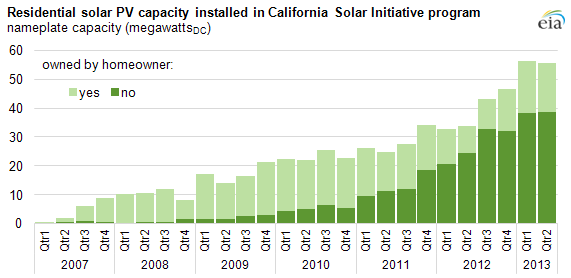
Most California Residential Solar Not Owned By Homeowners

graph of residential solar PV capacity, as explained in the article text
Source: U.S. Energy Information Administration, based on California Solar Initiative data
Note: Installation dates assumed to coincide roughly with the
date projects submitted
 an incentive claim request. Nameplate capacity given in direct current (DC) megawatts.
 (See end of this article for a brief discussion of DC vs. alternating current.)


One of the biggest developments in the U.S. residential solar photovoltaic (PV) market over the past few years has been the significant growth of residential solar PV systems not owned by homeowners. These are often referred to as third-party-owned systems.

Data from the California Solar Initiative (CSI) program, the largest and longest-running residential and commercial solar incentive program in the United States, show that third-party-owned residential installations grew rapidly as the solar industry created and refined the third-party ownership model. In 2012 and 2013, more than two-thirds of residential installations in the CSI program were third-party owned. Industry reports have indicated that the growth in popularity of third-party-owned residential solar PV systems is occurring in other states as well.

How the third-party ownership model works

Homeowners can contract with a company—sometimes called a solar leasing company, solar finance company, or third-party ownership company—to have a solar PV system installed on their rooftop (or elsewhere on their property). Depending on the agreement, the solar leasing company will often be responsible for financing, permitting, designing, installing, and maintaining the PV system. The contract between the homeowner and solar leasing company is typically structured in one of two ways:
  • PPA option: the homeowner buys all of the electricity produced by the solar PV system at an agreed-upon price (or set of prices) through what is known as a power purchase agreement (PPA). The PPA prices are usually lower than or competitive with the homeowner's local electric utility rate. PPAs are usually longer-term contracts with terms of up to 20 years.
  • Lease option: the homeowner makes pre-established monthly payments to the solar leasing company. The payment amount is not tied to the PV system's actual output, but it is calculated to be competitive with the homeowner's existing electric bill.
Both of these contract options will usually offer a buyout option at the end of the contract term or during certain points over the contract period that would allow the homeowner to purchase and own the PV system.

The solar leasing company, as the PV system's owner, will generally receive all of the federal, state, and local incentives for which the PV system is eligible. These include additional commercial incentives, such as the federal Modified Accelerated Cost Recovery System (MACRS) incentive for solar equipment, which the PV system would not otherwise be eligible for if the residential homeowner owned the system. The solar leasing company will also usually own the renewable energy certificates (RECs) generated by the PV system, where such incentives are available.

Benefits

The third-party ownership model is attractive to both parties involved for a number of reasons.

The homeowner:
  • Can install a PV system without paying large upfront costs or expending time and effort to knowledgeably purchase and arrange installation of the system.
  • Will not have to operate or maintain the PV system if these responsibilities are included in the service agreement.
  • Can lock in long-term costs for electricity, which could be a major benefit if the homeowner expects electricity prices to rise in the future.
The solar leasing company:
  • Secures a guaranteed buyer for all of the electricity produced from the PV system at agreed-upon prices that allows the company to ensure a sufficient return on its investment.
  • Can realize economies of scale not achievable by individual system owners, such as lower financing, operational, and PV system costs.
Challenges and limitations
  • The homeowner may pay for the convenience of having someone else build and maintain the system by having to share some of the available incentives with the solar leasing company, although this may be offset by the convenience of the arrangement and the potential reduced cost structure offered by the solar leasing company.
  • The third-party ownership option is not consistently available throughout the country. According to the Database of State Incentives for Renewables & Efficiency (DSIRE), third-party solar PV PPAs are currently allowed or in use in all or portions of at least 22 states and the District of Columbia.
The growing volume of distributed generation, aided in part by the rapid growth of third-party-owned solar PV in some states, is challenging the role that electric utilities have historically played as the sole provider of electricity to customers. This new development has led to debate around what the appropriate level of compensation should be for distributed solar generation fed to the grid and what distributed generation customers ought to pay to utilities for non-electricity services, such as grid maintenance, as well as for electricity when their distributed generation system is not producing power (e.g., when the sun isn't shining).

A 2012 report by the National Renewable Energy Laboratory (NREL) explored the third-party ownership model, along with other residential solar PV financing options, in more depth.  (DOE-EIA)

OSHA New Rules For Power Line Workers

OSHA is proposing to update the existing standard for the construction of electric power transmission and distribution installations and make it consistent with the more recently promulgated general industry standard addressing the maintenance and repair of electric power generation, transmission, and distribution lines and equipment. The proposal also makes some miscellaneous changes to both standards, including adding provisions related to host employers and contractors, flame resistant clothing, and training, and updates the construction standard for electrical protective equipment, makes it consistent with the corresponding general industry standard, and makes it applicable to construction generally.

The existing rules for this type of work were issued in 1971. They are out of date and are not consistent with the more recent, corresponding rules for theoperation and maintenance of electric power transmission and distribution systems. The revised standard would include requirements relating to enclosed spaces, working near energized parts, grounding for employee protection, work on underground and overhead installations, work in substations, and other special conditions and equipment unique to the transmission and distribution of electric energy.

OSHA is also proposing a new standard on electrical protective equipment for the construction industry. The current standards for the design of electrical protective equipment, which apply only to electric power transmission and distribution work, adopt several national consensus standards by reference. The new standard would replace the incorporation of these out-of-date consensus standards with a set of performance-oriented requirements that is consistent with the latest revisions of these consensus standards and with the corresponding standard for general industry.

Additionally, OSHA is proposing new requirements for the safe use and care of electrical protective equipment to complement the equipment design provisions. In addition, OSHA is proposing changes to the two correspondinggeneral industry standards. These changes address:
Class 00 rubber insulating gloves, electrical protective equipment made from materials other than rubber, training for electric power generation, transmission, and distribution workers, host-contractor responsibilities, job briefings, fall protection (including a requirement that employees in aerial lifts use harnesses), insulation and working position of employees working on or near live parts, protective clothing, minimum approach distances, deenergizing transmission and distribution lines and equipment, protective grounding, operating mechanical equipment near overhead power lines, and working in manholes and vaults.
These changes would ensure that employers, where appropriate, face consistent requirements for work performed under the construction and general industry standards and would further protect employees performing electrical work covered under the general industry standards.

The proposal would also update references to consensus standards in §§ 1910.137 and 1910.269 and would add new appendices to help employers comply with provisions on protective clothing and the inspection of work positioning equipment.

OSHA is also proposing to revise the general industry standard for foot protection. This standard has substantial application to employers performing work on electric power transmission and distribution installations, but that applies to employers in other industries as well. The proposal would remove the requirement for employees to wear protective footwear as protection against electric shock. (Federal Register, / Vol. 70, No. 114 / Wednesday, June 15, 2005 / Proposed Rules)

Monday, December 23, 2013

Sewage Treatment With Solar Power

WSSC turns to solar power to cut sewage- treatment electricity costs


DC Water turns to digester to produce electricity


WSSC Headquarters

Nearly 8,500 solar panels covering 13 acres in Germantown began operating this month at a sewage-treatment plant in Montgomery County, one of the first in the Washington region to try solar power. The panels, also installed at a Washington Suburban Sanitary Commission facility in Upper Marlboro, began operating in October.
 
Solar panels are expected to provide up to one-fifth of the two plants’ electrical needs at rates 25 percent cheaper than traditional electricity.  For a utility, it’s a huge milestone, because very few have solar power.  The idea is catching on with water and sewer utilities across the country, in part because they guzzle electricity. Operating round-the-clock, the facilities run enormous pumps to deliver drinking water and then use huge blowers, centrifuges and other equipment to treat sewage and return the disinfected water to local rivers. Those energy costs can fluctuate dramatically, putting pressure on operating budgets.

Diagram of a typical wastewater treatment plant
using the Cambi thermal hydrolysis process
(courtesy of Cambi).
Sewage-treatment plants, in particular, are being looked at for solar power because vast parcels of land bought decades ago as buffers for nearby communities can accommodate acres of the panels.
Utility officials say they also are exploring ways to reduce their dependence on the electrical grid during and after severe storms, when power outages can wreak havoc on sewer systems and cause overflows into streams.
It’s also about saving money.

Blue Plains, Washington, DC
DC Water, the largest consumer of electricity in the District, is installing equipment similar to a giant pressure cooker at its Blue Plains Advanced Wastewater Treatment Plant in Southwest Washington. The equipment will “cook” and sterilize the brown, goopy sludge collected from treated sewage and turn it into food for methane-generating bacteria. The methane gas will then be burned to power steam turbines that produce electricity. DC Water officials expect the system to save the utility $10 million in electricity costs — and another $10 million in trucking costs because half as much sludge will need to be hauled away. The utility also is exploring selling the sterilized sludge as fertilizer.

The annual savings are expected to more than cover the debt service on the $470 

DC Digester Centrifuges
million borrowed for the project. That will free up money needed to repair and replace aging infrastructure, such as underground pipes that burst after too much decay.

The new process also is expected to cut the treatment plant’s greenhouse gas emissions by one-third. Blue Plains has less open land available for solar panels than some other treatment plants, he said. Still, DC Water is considering putting panels on some structures on the 150-acre campus.

The WSSC solar program is a public-private partnership. Washington Gas Energy Systems paid the $12 million to install the solar panels and will operate them for 20 years. The WSSC pays only for the solar power it uses. WSSC expect to save $3.5 million total in electricity costs over the 20 years and cut the two plants’ annual carbon dioxide emissions by 3,200 metric tons — described as the equivalent of taking 665 cars off the road.  

DC Water is the largest user of electricity in DC.  (Wash Post, 12/21/2013)

Thursday, December 19, 2013

EPA Rule Provides a Clear Pathway for Using Carbon Capture and Sequestration Technologies

Today, the U.S. Environmental Protection Agency (EPA) issued a final rule that helps create a consistent national framework to ensure the safe and effective deployment of carbon capture and sequestration (CCS) technologies.

CCS technologies allow carbon dioxide to be captured at stationary sources - like coal-fired power plants and large industrial operations - and injected underground for long-term storage in a process called geologic sequestration.


The new rule clarifies that carbon dioxide streams captured from emission sources, injected underground via UIC Class VI wells approved for the purpose of geologic sequestration under the Safe Drinking Water Act, and meeting certain other conditions (e.g., compliance with applicable transportation regulations), will be excluded from EPA’s hazardous waste regulations. Further, EPA clarifies that carbon dioxide injected underground via UIC Class II wells for enhanced oil recovery (EOR) is not expected to be a waste management activity.

EPA concluded that the careful management of carbon dioxide streams under the specified conditions does not present a substantial risk to human health or the environment. EPA’s determination will help provide a clear pathway for the deployment of CCS technologies in a safe and environmentally protective manner while also ensuring protection of underground sources of drinking water.

Today’s rule is complementary to previous EPA rulemakings, including Safe Drinking Water Act regulations that ensure the Class VI injection wells are appropriately sited, constructed, tested, monitored, and closed.

EPA is also releasing draft guidance for public comment that provides information regarding transitioning Class II wells used to inject carbon dioxide for oil and gas development to Class VI wells used for carbon capture and sequestration. The comment period for the draft guidance is 75 days. (EPA)

Information on the final rule


Friday, December 13, 2013

NRDC Climate Change Tool

The Natural Resources Defense Council (NRDC) has developed a tool where you can learn about how your local area is vulnerable to climate change.

You can enter your ZIP Code below to and get specific results.

Department of Energy Releases $8 Billion Solicitation for Advanced Fossil Energy Projects

As part of President Obama’s Climate Action Plan, the Energy Department published a solicitation today, making up to $8 billion in loan guarantee authority available to support innovative advanced fossil energy projects that avoid, reduce, or sequester greenhouse gases.

Authorized by Title XVII of the Energy Policy Act of 2005, loan guarantees under this new solicitation will help provide critical financing to support new or significantly improved advanced fossil energy projects – such as advanced resource development, carbon capture, low-carbon power systems, and efficiency improvements – that reduce emissions of carbon dioxide, methane, and other greenhouse gas pollution.

Under the Obama Administration, the Energy Department is taking an all-of-the-above approach to American energy to ensure we develop all our abundant energy resources responsibly and sustainably. Currently providing 80 percent of our energy, coal and other fossil fuels will continue to be a critical part of our energy portfolio as we move toward a low-carbon future. By helping to accelerate the introduction of innovative, clean fossil energy technologies ready for deployment at commercial-scale today, investments under this solicitation will help ensure we continue to have access to affordable, clean energy from all our domestic energy resources tomorrow.

The Department published a draft solicitation on July 9, 2013, which opened a 60-day comment period. During this time, the Department listened to potential applicants and other stakeholders and then incorporated their feedback into the solicitation. As a result, the solicitation includes new provisions intended to facilitate applications, ensure quick review, and foster successful public-private partnerships.

Currently, the Department of Energy’s Loan Programs Office (LPO) supports a large, diverse portfolio of more than $30 billion supporting more than 30 closed and committed projects. Projects in the Department’s Loan Programs Office portfolio include one of the world’s largest wind farms; several of the world’s largest solar generation and thermal energy storage systems; the first new commercial nuclear power plant to be licensed and built in the U.S. in three decades; an electric vehicle manufacturing company that repaid its loan ahead of schedule and is now developing an export market; and more than a dozen new or retooled auto manufacturing plants across the country.

With the publication of the Advanced Fossil Energy Projects solicitation, the Department is accepting applications through the Loan Programs Office web portal at apply.loanprograms.energy.gov, and expects to receive the initial applications by the end of February 2014.

A copy of the solicitation, which includes application deadlines and eligibility requirements, and a fact sheet can be found at lpo.energy.gov.  (DOE/Energy .gov)

Energy Department Puts Half A Billion Dollars Into Small Reactors

The Energy Department will give NuScale Power, a small company in Corvallis, Oregon, up to $226 million to advance the design of small nuclear reactors.  The NuScale reactor would be installed under water, making meltdown far less likely and opening the door to markets around the world.
      
The award is the second of two under a $452 million, multiyear program to assist in the development of “small modular reactors,” which would be built in American factories, potentially improving quality and cutting costs, and delivered by truck.
 
The first award, in November 2012, went to Babcock & Wilcox, which formerly sold full-scale reactors. Its small model, called mPower, is a step ahead of NuScale’s because it has a preliminary agreement with a customer, the Tennessee Valley Authority.
      
While the two designs chosen by the Energy Department are radically smaller in their size and method of construction, both mPower and NuScale use ordinary water to transfer the heat created in the reactor so that the water can be used to make steam for electricity and help control the flow of neutrons, the subatomic particles that sustain the chain reaction.
 
The Nuclear Regulatory Commission, the agency that will decide whether to license the reactors.  (NYT, 12/12/2013) 

NuScale & Babcock & Wilcox Want To Build Small Reactors

A company called NuScale Power wants to make a reactor small enough so that if there is a loss of electric power, as happened at Fukushima, its tiny core will cool on its own, and quickly, the way a small cup of coffee chills faster than a big pot.

The NuScale reactor, which so far exists only in computer designs, sits inside a containment vessel that looks like a steel thermos bottle and measures 82 feet in height and 15 feet in diameter — a mini version of reactor containments some 200 feet in height and 120 feet in diameter at American nuclear plants now under construction.  Although the NuScale reactor delivers only one-twentieth the power of conventional reactors, the design is such that more reactors can be added as more power is needed.
      
The NuScale reactor would rest inside 10-million-gallon tanks of water, mostly below ground, which will lower the chance of meltdown to a thousandth of the risk of conventional reactors. Should all go wrong in one of his reactors and it boils over, the resulting steam would hit the cold outer wall that borders the pool and condense back into water to cool the core. The goal was simplicity.
      
The NuScale reactor has no pipes bigger than three inches. The NuScale reactor eliminates pumps and relies on thermodynamics.  The NuScale reactor is small enough to rely on the natural, cooling circulation that occurs because hot water rises and cold water sinks. NuScale also does not require emergency diesel generators.

The company has persuaded one important partner, Fluor, an engineering company that specializes in power plants, to invest in its technology. Fluor has invested $145 million in NuScale, on top of about $20 million raised elsewhere.    
      
The downside is that getting a new design licensed by the Nuclear Regulatory Commission, an essential precursor for sales in the United States, could cost $100 million or more.
      
In addition, the level of opposition, and the difficulty in getting approvals and permits, might not be much different for a small reactor than for a big one, some experts say, diminishing the logic of going small. For the economics to work, builders would have to convince regulators that the smaller plants can get by safely with less robust containment structures, smaller evacuation planning zones and smaller security forces. And, the industry has always calculated that with economies of scale, bigger means cheaper.
      
Babcock & Wilcox, a former builder of big reactors, is pushing a 180-megawatt design (four times the size of NuScale’s reactor) and has won support from the Department of Energy. The department is expected to issue a similar grant to another designer soon, a grant that NuScale is chasing.
      
Small reactors are considered potential export products.  NuScale is talking to a variety of potential customers, although mostly not in the United States, where the low cost of natural gas has made it hard for nuclear power to compete.  (NYT, 12/12/2013)

Thursday, December 12, 2013

Congress Passes A Budget

PRESIDENT'S CORNER

By Norris McDonald

I would like to see a balanced budget and a significant reduction in the debt.  Of course the budget that just passed in the U.S. Congress is not taking us in that direction.  Our budget is about $6 trillion and we spend about $7 trillion lately, give or take a hundred billion or so here and there.

The budget that passed this week does not address the underlying issues that prevent us from being on a fiscally sustainable path.  I am glad that it does not replace the full sequester.  The sequester was taking us in the right direction.

The agreement deals temporarily with preventing a cut in Medicare's physician reimbursement rate, but it needs to be dealt with on a permanent basis.  I would get the government out of the health car business.  But that isn't going to happen so I guess the reimbursements need a permanent fix if the government is going to stay in that business. 

The budget deal does not extend unemployment insurance and on December 28, 1.3 million Americans will lose their unemployment insurance. They will be joined by an additional 3.5 million Americans in 2014.  Unemployment insurance should last for 3 months. 

I want a small, efficient government that operates within its budget.  I don't know if any other country has ever printed more and more money ($80 billion per month from Treasury to The Fed) and artificially kept the interest rates low to prevent inflation, but how long will this experiment work?  I do not want to find out.

Fuel Economy of New Vehicles Sets Record High

Fuel Economy Gains to Continue Under President Obama’s Clean Car Programs

Today, EPA issued its annual report that tracks the average fuel economy of vehicles sold in the United States. The report shows that model year 2012 vehicles achieved an all-time high fuel economy of 23.6 miles per gallon (mpg). This represents a 1.2 mpg increase over the previous year, making it the second largest annual increase in the last 30 years. Fuel economy has now increased in seven of the last eight years.

Fuel economy will continue to improve under the Obama administration’s historic National Clean Car Program standards. The program doubles fuel economy standards by 2025 and cuts vehicle greenhouse gas emissions by half. The standards will save American families $1.7 trillion dollars in fuel costs, and by 2025 will result in an average fuel savings of more than $8,000 per vehicle. The program will also save 12 billion barrels of oil, and by 2025 will reduce oil consumption by more than 2 million barrels a day – as much as half of the oil imported from OPEC every day.


The large fuel economy improvement in model year 2012 is consistent with longer-term trends. Fuel economy has increased by 2.6 mpg, or 12 percent, since 2008, and by 4.3 mpg, or 22 percent, since 2004. The average carbon dioxide emissions of 376 grams per mile in model year 2012 also represented a record low. While EPA does not yet have final data for model year 2013, preliminary projections are that fuel economy will rise by 0.4 mpg, and carbon dioxide emissions will decrease by 6 grams per mile in 2013.

EPA’s annual “Light-Duty Automotive Technology, Carbon Dioxide Emissions, and Fuel Economy Trends: 1975 through 2013” attributes much of the recent improvement to the rapid adoption of more efficient technologies such as gasoline direct injection engines, turbochargers, and advanced transmissions.
Consumers have many more high fuel economy choices due to these and other technologies, such as hybrid, diesel, electric, and plug-in hybrid electric vehicles. Consumers can choose from five times more car models with a combined city/highway fuel economy of 30 mpg or more, and from twice as many SUVs that achieve 25 mpg or more, compared to just five years ago. (EPA)

The new report

Exxon Mobil Wants To Export Oil

Exxon Mobil Corporation, the nation's largest energy producer, is calling for the U.S. to lift restrictions on exporting domestic oil that date back to the Arab oil embargo of 1973.  According to its annual energy outlook, the company forecasts decades of abundant supplies of petroleum in the U.S. and elsewhere as well as increasing global demand for oil.

By 2015, energy companies will tap more oil in North America from dense layers of rock alone than the current output of members of the Organization of the Petroleum Exporting Countries except Saudi Arabia, Exxon projects. World-wide, companies will pump greater amounts of oil through 2040 and still leave nearly two-thirds of the earth's crude deposits untouched.

Exxon has long held that the same trade rules should apply to oil and gas as other products made in the U.S., and has said that North America was pumping enough oil and gas to become an exporter. But now the world's largest investor-owned energy company is explicitly calling for an end to America's effective ban on most crude exports.

The Center supports exporting American oil.

The primary laws prohibiting crude exports are the Mineral Leasing Act of 1920, the Energy Policy and Conservation Act of 1975, and the Export Administration Act of 1979. The so-called short supply controls in the Export Administration Regulations (EAR) of the Bureau of Industry and Security (BIS), an agency of the Department of Commerce, spell out these restrictions.

The ban was a response to the Arab oil embargoes.  The restrictions on exports were borne, as was the Department of Energy and the Strategic Petroleum Reserve, on oil disruptions.  Due to fracking and horizontal drilling, those restrictions no longer exist.

The U.S. allows some oil to be shipped to Canada, but bans most other exports of crude. 

The sheer abundance of oil and gas in the U.S. poses challenges for Exxon. Booming production has overwhelmed U.S. demand, pushing domestic prices lower and eroding profit margins for energy producers. Fracking and horizontal drilling in shale formations are making this petroleum production possible.
Some companies, including Exxon, are already seeking to export natural gas to countries willing to pay a premium for it. The U.S. government has approved licenses for several terminals to export natural gas, chilled into liquid form, to countries with which it doesn't have a free-trade agreement.
 
The energy company projects that carbon emissions will cost $80 a ton by 2040 as governments move to curb greenhouse gases, adding to its costs.  It also projets that unconventional sources of gas, such as shale, will make up a third of the world's gas supplies by 2040, the company predicts.  (WSJ, 12/11/2013, Council on Foreign Relations)