The Supreme Court has blocked Obama administration rules designed to sharply limit the hazardous air pollutants that spew from the nation's power plants.
The justices by a 5-4 vote agreed with the coal industry and Republican-led states that said the forced cutbacks were too costly and could lead to power outages.
Justice Antonin Scalia, speaking for the majority, said it was not reasonable for the Environmental Protection Agency to proceed with the new rules without weighing their cost, estimated to be about $9.6 billion a year. "It will be up to the agency to decide — as always, within the limits of reasonable interpretation — how to account for cost," Scalia said.
Chief Justice John G. Roberts Jr. and Justices Anthony M. Kennedy, Clarence Thomas and Samuel A. Alito Jr. agreed. Justice Elena Kagan wrote the dissenting opinion for Justices Ruth Bader Ginsburg, Stephen G. Breyer and Sonia Sotomayor.
The decision is a win for Michigan and several other Republican-led states that joined the power industry in challenging the rules.
The so-called "Mercury and Air Toxins" rule has been 25 years in the making. Congress in 1990 strengthened the Clean Air Act and told the EPA to identify the major sources for more than 180 hazardous air pollutants, including mercury and arsenic. And once the agency decided coal and oil-fired power plants were a major source of these pollutants, the EPA was told to adopt regulations that were "appropriate and necessary" to limit these emissions.
Mercury is highly toxic in the air and the water, and it builds up through the food chain. It is particularly dangerous for a pregnant woman and her developing baby. Other toxic pollutants are believed to trigger asthma attacks.
But the rules took far longer than lawmakers had anticipated.
The Clinton administration completed the study and prepared the rules, but the George W. Bush administration put forward an alternative rule that was not adopted by Congress. Under President Obama, the EPA issued proposed regulations in 2012 that were to take full effect this summer.
Lawyers for the coal and electric power industries went to court, alleging the costs of the new rule would vastly outweigh the benefits. They said the rules would cost $9.5 billion a year, while the benefit of removing mercury from the air would be only $5 million a year.
The EPA called this a false comparison. The agency said the rules would save 11,000 lives per year. And if all the impact of all the hazardous pollutants were considered, the EPA said the cleaner air would yield public health benefits of more than $37 billion a year.
Last year, a U.S. appeals court here upheld the regulations as justified under the law. But to the surprise of environmentalists, the Supreme Court agreed to hear the legal challenge brought by the affected industries and by Michigan and a coalition of states that rely on coal-fired power plants.
The case of Michigan vs. EPA posed a major test of whether the conservative-leaning high court would uphold the far-reaching regulations of a liberal administration.
An even bigger legal fight lies ahead on whether Obama and the EPA can impose climate-change regulations that would force a 30% reduction in carbon pollution by 2030. (L.A. Times, 6/29/2015)
The Center, founded in 1985, is an environmental organization dedicated to protecting the environment, enhancing human, animal and plant ecologies, promoting the efficient use of natural resources and expanding participation in the environmental movement.
Monday, June 29, 2015
Wednesday, May 27, 2015
California Increases Lawn Replacement Budget By $350 Million
The Metropolitan Water District (MWD) of Southern California on Tuesday voted to increase funding for its turf-removal program, as more and more residents and businesses swap water-guzzling lawns for more drought-tolerant landscaping. The MWD will boost its turf-replacement budget by $350 million for one year, but will also change certain terms and conditions of the extremely popular program.
The district voted to cap the total reimbursement for residential customers at $6,000, paying $2 per square foot of lawn removed.
So far, the MWD has received more than $330 million in applications for rebates. Application submissions increased dramatically after Governor Jerry Brown ordered a 25% reduction in urban water use last month.
During the summer months, outdoor water use traditionally accounts for 50% to 80% of residential consumption. The MWD estimates that removing one square foot of grass can save 42 gallons of water a year.
The MWD is a consortium of 26 cities and water districts that provides drinking water to nearly 19 million people in parts of Los Angeles, Orange, San Diego, Riverside, San Bernardino and Ventura counties. Not all members are thrilled by the turf-replacement program and believe that the program is not sustainable. Some members believe the state cannot buy its way out of the drought by removing turf, (L.A. Times, 5/27/2015)
Thursday, May 21, 2015
Pipeline Oil Spill in Santa Barbara, California
A citizen first reported the leak around noon at Refugio State Beach in California's Santa Barbara County and the Coast Guard had stopped it by 3 P.M.—but an estimated 21,000 gallons of crude oil still spilled onto the shore and into the Pacific Ocean, creating a four-mile-long sheen. The area is home to an array of species, such as sea lions and seabirds, as well as migrating whales.
The pipeline, owned by Plains All American, is capable of transporting 150,000 barrels of crude every day, from a facility owned by Exxon Mobil.
Santa Barbara's beaches were fouled with crude oil in 1969 during what was the third-largest oil spill in United States waters. (NRDC)
Wednesday, May 13, 2015
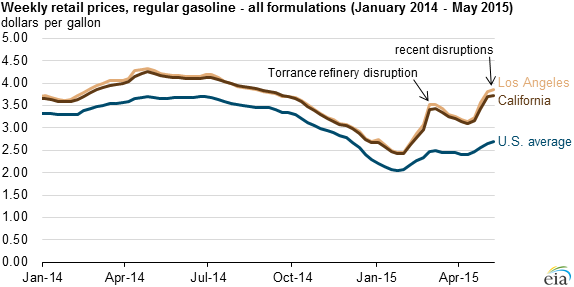
California Gasoline Prices Higher Than Rest of Country

Source: U.S. Energy Information Administration, Gasoline and Diesel Fuel Update
Supply disruptions in the tightly balanced and relatively isolated California gasoline market have increased wholesale and retail gasoline prices over the past several weeks. This comes after markets had adjusted to compensate for lost production following the February explosion and fire at ExxonMobil's refinery in Torrance, California. Average retail prices for regular gasoline in California as a whole, and in Los Angeles specifically, have increased by 57¢ per gallon (¢/gal), and 63¢/gal, respectively, in the past three weeks, while U.S. average retail gasoline prices have increased by 20¢/gal.
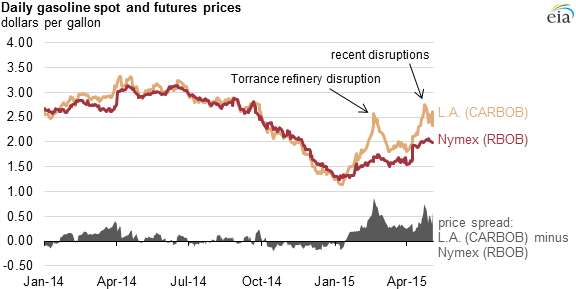
The costs of adjusting supply sources, along with planned and unplanned refinery outages and delayed resupply, have contributed to the gasoline price increases. The spot price in Los Angeles for CARBOB (California Reformulated Blendstock for Oxygenate Blending) gasoline was $2.76/gal on April 29, a premium of 75¢/gal to the New York Mercantile Exchange (Nymex) Reformulated Blendstock for Oxygenate Blending (RBOB) front month futures contract, a standard pricing basis for gasoline. CARBOB and RBOB are different formulations of the petroleum-based component of gasoline, into which ethanol is blended to form finished gasoline.

Source: U.S. Energy Information Administration, Bloomberg
Note: L.A. denotes Los Angeles; CARBOB denotes California Reformulated Blendstock for Oxygenate Blending; Nymex denotes New York Mercantile Exchange; RBOB denotes Reformulated Blendstock for Oxygenate Blending.
The West Coast (defined as Petroleum Administration for Defense District (PADD) 5) is relatively isolated from other U.S. markets and located far from other sources of supply, making the region dependent on in-region production to meet demand. Additionally, California's more-restrictive gasoline specifications can limit the availability of supply from other markets. When a supply disruption occurs on the West Coast, the region can be resupplied in four ways: in-region inventories, intra-PADD marine movements from other West Coast refineries, PADD-to-PADD marine movements, and imports.
In-region inventories. West Coast inventories of gasoline typically fall in the months of February, March, and April. However, inventories fell by 4.2 million barrels in the six weeks following the Torrance refinery outage (February 20-March 27), a decline of 2.2 million barrels more than the five-year average decline for the same period. As the region's supply patterns adjusted, PADD 5 gasoline inventories stabilized, and they are currently 27.6 million barrels, 0.8 million barrels above the same time last year.
Intra-PADD marine movements. Mainland PADD 5 lacks pipeline infrastructure to move supplies between the in-region refining centers (Washington, San Francisco, and Los Angeles). As a result, supplies must move via coastwise-compliant marine vessels. However, recent planned and unplanned refinery outages on the West Coast have limited the availability of gasoline supplies to be shipped to Southern California. PADD 5 gross refinery inputs fell to 2.3 million barrels per day (b/d) for the week ending April 24, the lowest since April 2013, and remained near 2.3 million b/d for the week ending May 1, compared to 2.5 million b/d last year, contributing to higher gasoline prices.
PADD-to-PADD marine movements. Gasoline supplies may also move from PADD to PADD, using coastwise-compliant vessels. Historically, there have been marine movements of gasoline from the Gulf Coast (PADD 3) to the West Coast (PADD 5), although infrequently and in small quantities. The last shipments of gasoline from the Gulf Coast to the West Coast occurred in June 2013, totaling 53,000 barrels.
Imports. Companies have also increased West Coast imports. However, because Asia is the closest global source of additional California-specification gasoline, it takes several weeks for resupply to reach the West Coast. PADD 5 imported an average of 19,000 barrels per day (b/d) of motor gasoline in 2014, but approximately five weeks after the Torrance refinery disruption, PADD 5 imports of motor gasoline had increased to 143,000 b/d for the week ending March 27. PADD 5 has since continued to import motor gasoline above normal levels, with a four-week average of 49,000 b/d for the week ending May 1 helping to keep inventory levels stable. With imports accounting for a greater share of supply, recent disruptions and delays in shipments have contributed to wholesale and retail gasoline price increases. (DOE-EIA)
Monday, May 11, 2015
Obama To Renew Nuclear Power Plant Cooperation Agreement With China
President Obama has notified Congress that he intends to renew a nuclear cooperation agreement with China. The deal would allow Beijing to buy more U.S.-designed reactors and pursue a facility or the technology to reprocess plutonium from spent fuel. China would also be able to buy reactor coolant technology that experts say could be adapted to make its submarines quieter and harder to detect.
The Senate Foreign Relations Committee is set to hear from five Obama officials in a closed-door meeting today to weigh the commercial, political and security implications of extending the accord. The private session will permit discussion of a classified addendum from the director of national intelligence analyzing China’s nuclear export control system and what Obama’s notification called its “interactions with other countries of proliferation concern.”
The new agreement should clear the way for U.S. companies to sell dozens of nuclear reactors to China, the biggest nuclear power market in the world.
Yet the new version of the nuclear accord — known as a 123 agreement under the Atomic Energy Act of 1954 — would give China leeway to buy U.S. nuclear energy technology at a sensitive moment: The Obama administration has been trying to rally support among lawmakers and the public for a deal that would restrict Iran’s nuclear program — a deal negotiated with China’s support.
Congress can vote to block the agreement, but if it takes no action during a review period, the agreement goes into effect. If Congress rejects the deal, “that would allow another country with lower levels of proliferation controls to step in and fill that void,
Although the current nuclear agreement with China does not expire until the end of the year, the administration had to give Congress notice with 90 legislative days left on the clock. Obama also hopes to seal a global climate deal in December featuring China — less than three weeks before the current nuclear accord expires.
The United States has bilateral 123 agreements with 22 countries, plus Taiwan, for the peaceful use of nuclear power. Some countries that do not have such agreements, including Saudi Arabia, Jordan and Malaysia, have expressed interest in clearing obstacles to building nuclear reactors.
China and the United States reached a nuclear cooperation pact in 1985, before China agreed to safeguards with the International Atomic Energy Agency. IAEA safeguards went into force in 1989, but Congress imposed new restrictions after the Chinese government’s June 1989 crackdown on protesters in Tiananmen Square. The 123 agreement finally went into effect in March 1998; President Bill Clinton waived the 1989 sanctions after China pledged to end assistance to Pakistan’s nuclear weapons program and nuclear cooperation with Iran.
In December 2006, Westinghouse Electric — majority-owned by Toshiba — signed an agreement to sell its AP1000 reactors to China. Four are under construction, six more are planned, and the company hopes to sell 30 others, according to an April report from the Congressional Research Service (CRS).
Reprocessing plutonium
China has a pilot plant engaged in reprocessing in Jiu Quan, a remote desert town in Gansu province. Satellite photos show that it is next to a former military reprocessing plant. There is not even any fencing between the sites. (Wash Post, 5/10/2015)
Friday, May 01, 2015
Tesla Home & Industrial Battery Packs
Tesla Motors Inc. Chief Executive Elon Musk has unveiled home and industrial battery packs--power wall” batteries--ranging from a $3,000 7 kilowatt-hour wall-mounted unit to a $3,500 10 kwh unit.
The batteries cost far less than the going rate for large-scale batteries and can be easier to install. Palo Alto, Calif.-based Tesla will begin delivering units by the summer from its California car factory, and later shift production to a $5 billion battery plant under construction near Reno, Nevada.
Tesla also will sell massive battery blocks for industrial users.
Tesla’s first battery customers include Green Mountain Power Corp., Vermont’s largest utility. It plans to buy Tesla packs and sell them to customers that already have solar power. Another customer is TreeHouse Inc., an Austin-based home improvement store concentrating on ecologically friendly goods. The store will sell the battery packs along with its own solar installation options.
Utilities such as Duke Energy Corp. and Edison International have installed large battery systems next to wind farms. The batteries store electricity that the wind turbines generate at night and release the power to the grid in the late afternoon and early evening when electricity demand spikes.
Other companies, such as Stem Inc. and Green Charge Networks are installing batteries for large retailers and hotels, to help the companies limit their power usage and cut their utility bills.
Government subsidies can reduce the cost of installing the batteries. In California, state rebates cover up to 60% of the price of the battery. Nationwide, batteries that are connected to solar panels are eligible for federal tax credits equal to 30% of the price of the battery. California’s subsidies and a mandate requiring utilities to use batteries or other devices to store power have put that state at the center of the stationary energy-storage market.
Hawaii, Texas and some eastern states also are using batteries to store electricity from solar panels and wind farms, and to keep the flow of electricity on transmission lines moving smoothly. Tesla batteries initially will use cells made by Panasonic Corp., the supplier of batteries in its Model S electric sedan. When production shifts to Reno, costs will drop by 30%, it estimates.
The new battery models include large, standing industrial-level batteries intended for use by utilities sold in units of 100 kilowatt-hours, which cost $250 per kilowatt-hour. The company already has a customer with plans to install 250 megawatt-hours-worth of such batteries.
Its home model, called “power wall,” comes in sleek black and white models and will be aimed at people who want to more efficiently use power from solar panels or go entirely off the electrical grid. The larger home model can store enough electricity to power a home for 10 hours. The Power Wall batteries will be installed through certified third parties, including SolarCity Corp., where Mr. Musk is chairman.
There are two key details here that are worth considering — the cost of the battery itself, and what it would actually mean to have 10 kilowatt-hours of backup power or power storage in your home. When it comes to price, these numbers are hardly cheap, but they’re also lower than some analysts were suggesting — figures like $13,000 were common in press coverage prior to Tesla’s announcement.
According to the U.S. Energy Information Administration, the average annual kilowatt-hour use for a U.S. utility customer (in the year 2013) is 10,908, or 909 kilowatt-hours per month. Divide that by 30 and per day, an average U.S. customer uses about 30 kilowatt-hours. So the battery could cover roughly a third of this. one idea behind pairing a home battery with solar panels is to store solar energy harnessed during the day and then deploy it in the evening, overnight, and the next morning. While the battery might not cover all energy uses during these times, it could reduce how much power needs to be purchased from a traditional utility and drawn from the grid. (WSJ, 5/1/2015, Wash Post, 6/1/2015)
The batteries cost far less than the going rate for large-scale batteries and can be easier to install. Palo Alto, Calif.-based Tesla will begin delivering units by the summer from its California car factory, and later shift production to a $5 billion battery plant under construction near Reno, Nevada.
Tesla also will sell massive battery blocks for industrial users.
Tesla’s first battery customers include Green Mountain Power Corp., Vermont’s largest utility. It plans to buy Tesla packs and sell them to customers that already have solar power. Another customer is TreeHouse Inc., an Austin-based home improvement store concentrating on ecologically friendly goods. The store will sell the battery packs along with its own solar installation options.
Utilities such as Duke Energy Corp. and Edison International have installed large battery systems next to wind farms. The batteries store electricity that the wind turbines generate at night and release the power to the grid in the late afternoon and early evening when electricity demand spikes.
Other companies, such as Stem Inc. and Green Charge Networks are installing batteries for large retailers and hotels, to help the companies limit their power usage and cut their utility bills.
Government subsidies can reduce the cost of installing the batteries. In California, state rebates cover up to 60% of the price of the battery. Nationwide, batteries that are connected to solar panels are eligible for federal tax credits equal to 30% of the price of the battery. California’s subsidies and a mandate requiring utilities to use batteries or other devices to store power have put that state at the center of the stationary energy-storage market.
Hawaii, Texas and some eastern states also are using batteries to store electricity from solar panels and wind farms, and to keep the flow of electricity on transmission lines moving smoothly. Tesla batteries initially will use cells made by Panasonic Corp., the supplier of batteries in its Model S electric sedan. When production shifts to Reno, costs will drop by 30%, it estimates.
The new battery models include large, standing industrial-level batteries intended for use by utilities sold in units of 100 kilowatt-hours, which cost $250 per kilowatt-hour. The company already has a customer with plans to install 250 megawatt-hours-worth of such batteries.
Its home model, called “power wall,” comes in sleek black and white models and will be aimed at people who want to more efficiently use power from solar panels or go entirely off the electrical grid. The larger home model can store enough electricity to power a home for 10 hours. The Power Wall batteries will be installed through certified third parties, including SolarCity Corp., where Mr. Musk is chairman.
There are two key details here that are worth considering — the cost of the battery itself, and what it would actually mean to have 10 kilowatt-hours of backup power or power storage in your home. When it comes to price, these numbers are hardly cheap, but they’re also lower than some analysts were suggesting — figures like $13,000 were common in press coverage prior to Tesla’s announcement.
According to the U.S. Energy Information Administration, the average annual kilowatt-hour use for a U.S. utility customer (in the year 2013) is 10,908, or 909 kilowatt-hours per month. Divide that by 30 and per day, an average U.S. customer uses about 30 kilowatt-hours. So the battery could cover roughly a third of this. one idea behind pairing a home battery with solar panels is to store solar energy harnessed during the day and then deploy it in the evening, overnight, and the next morning. While the battery might not cover all energy uses during these times, it could reduce how much power needs to be purchased from a traditional utility and drawn from the grid. (WSJ, 5/1/2015, Wash Post, 6/1/2015)
EARTH DAY Trek Across America 2015
PRESIDENT'S CORNER
By Norris McDonald
Just before Earth Day, I made the announcement below on Facebook:
Not a good start. Before I could get on the the highway, steam started coming from under my hood. Just a ruptured radiator hose. At Precision Tune Auto. Should be repaired within 30 minutes. Maybe I can get to Roanoke before dark. My target was Knoxville. Maybe I should wait until tomorrow to leave.
TREK ACROSS AMERICA: Day 1. Riding through Appalachian Mountains. Beautiful. Stop every 2 hours. Near Roanoke. Car running well. Cruise works. Never used on this car.
TREK ACROSS AMERICA: Day 2. In Nashville. Tornado watch. Staying with old friend afternoon & evening. Wait out bad weather. Amazing the number of trees mangled and killed by the winter ice storm between Knoxville and Nashville.
TREK ACROSS AMERICA: Day 3: Leaving Nashville. Great day at my old friend's compound yesterday. Grand Ole Opry behind me. Just pulled off the highway for the selfie. Batman building is the most famous building downtown. Looks like Batman's helmet with two pointy spikes. On to Memphis.
Trek Across America: Day 4. Crossing Arkansas. Hope to cross Oklahoma today. At Waffle House right. I love a Waffle House breakfast. Thank you all for your well wishes. Great trip so far.
Trek Across America: Day 5. Leaving Oklahoma this morning and heading into Texas. Had a little shaking in the front of the car at the end of the day yesterday. Hope the old girl was just getting tired. Supposed to rain this morning and I am kind of waiting to see. I hate driving in the rain.
TREK ACROSS AMERICA: Day 6. Leaving the Sunset Motel on famous Route 66. How many of you remember that show? Just outside Albuquerque, New Mexico. Arizona is next.
TREK ACROSS AMERICA: Day 7. I am about 6 hours from Los Angeles. I have 2,200 miles behind me. And to think I never liked driving over 3 hours. I am actually posting this the night before because I intend to get up early and get started. They are talking about high temperatures tomorrow and I want to beat those temps. My girl can't take the heat.
By Norris McDonald
Just before Earth Day, I made the announcement below on Facebook:
"I will be driving across America starting on Earth Day. I have never driven across this incredible country even though I have flown over it many times. This Earth Day trek is to gain a greater appreciation for this great land we live in. I want to see it. I want to see it up close and personal. It will be a 6-day drive: Washington, DC to Los Angeles, California. Wish me luck. I am hoping my 20 year old Toyota Camry will make the trip successfully. I will share video and photos with you. Stay tuned."It was a great trip and I am ready to do it again. I took the southern route. I will take the northern route next time.
Not a good start. Before I could get on the the highway, steam started coming from under my hood. Just a ruptured radiator hose. At Precision Tune Auto. Should be repaired within 30 minutes. Maybe I can get to Roanoke before dark. My target was Knoxville. Maybe I should wait until tomorrow to leave.
TREK ACROSS AMERICA: Day 1. Riding through Appalachian Mountains. Beautiful. Stop every 2 hours. Near Roanoke. Car running well. Cruise works. Never used on this car.
TREK ACROSS AMERICA: Day 2. In Nashville. Tornado watch. Staying with old friend afternoon & evening. Wait out bad weather. Amazing the number of trees mangled and killed by the winter ice storm between Knoxville and Nashville.
TREK ACROSS AMERICA: Day 3: Leaving Nashville. Great day at my old friend's compound yesterday. Grand Ole Opry behind me. Just pulled off the highway for the selfie. Batman building is the most famous building downtown. Looks like Batman's helmet with two pointy spikes. On to Memphis.
Trek Across America: Day 4. Crossing Arkansas. Hope to cross Oklahoma today. At Waffle House right. I love a Waffle House breakfast. Thank you all for your well wishes. Great trip so far.
Trek Across America: Day 5. Leaving Oklahoma this morning and heading into Texas. Had a little shaking in the front of the car at the end of the day yesterday. Hope the old girl was just getting tired. Supposed to rain this morning and I am kind of waiting to see. I hate driving in the rain.
![]() |
| Coal Plant in Arizona |
![]() |
| Wind Turbines in Arizone |
TREK ACROSS AMERICA: Day 6. Leaving the Sunset Motel on famous Route 66. How many of you remember that show? Just outside Albuquerque, New Mexico. Arizona is next.
TREK ACROSS AMERICA: Day 7. I am about 6 hours from Los Angeles. I have 2,200 miles behind me. And to think I never liked driving over 3 hours. I am actually posting this the night before because I intend to get up early and get started. They are talking about high temperatures tomorrow and I want to beat those temps. My girl can't take the heat.
Monday, April 20, 2015
EARTH DAY, Nuclear Power & America
PRESIDENT'S CORNER
By Norris McDonald
Earth Day is middle aged now. Forty-five years old and counting. We have organized and participated in numerous Earth Day activities for the past three decades. From river and creek clean ups to National Mall activities to local events, Earth Day has been quite a tradition for us. Yet, when it comes to the environmental community's most important issue(s), climate change and global warming, we believe nuclear power should be a central component in reducing emissions into the atmosphere.
FiereceEnergy published my views for Earth Day:
We simply cannot win our fight to mitigate global warming and climate change without utilizing nuclear power.
Now for additional news. I begin a cross country trek starting on Earth Day (April 22) across the Unites States of America. I have never driven across this great land of ours, even though I have flown across it many times. I want to see this great country. So I will be driving from Washington, DC to Los Angeles, California. I anticipate that it will take 5 to 6 days to complete this trip. I am driving my 20 year old Toyota Camry. It still gets pretty good mileage. I will chronicle the trip on my Facebook page. Wish me luck.
By Norris McDonald
Earth Day is middle aged now. Forty-five years old and counting. We have organized and participated in numerous Earth Day activities for the past three decades. From river and creek clean ups to National Mall activities to local events, Earth Day has been quite a tradition for us. Yet, when it comes to the environmental community's most important issue(s), climate change and global warming, we believe nuclear power should be a central component in reducing emissions into the atmosphere.
FiereceEnergy published my views for Earth Day:
It's a little-known fact -- especially among the environmentalist community -- that America's nuclear plants are the workhorses of our clean air energy production. Each year, these plants produce 63 percent of all the carbon-free energy generated in the U.S. These plants helped us avoid 589 million metric tons of carbon dioxide emissions in 2013. To put that in perspective, that equals the amount of carbon emissions emitted by 113 million passenger cars annually. Plus, nuclear energy's life-cycle emissions -- including any emissions from mining, fuel production, plant construction, operation, and decommissioning -- are among the lowest of all electricity sources. (More)
We simply cannot win our fight to mitigate global warming and climate change without utilizing nuclear power.
Now for additional news. I begin a cross country trek starting on Earth Day (April 22) across the Unites States of America. I have never driven across this great land of ours, even though I have flown across it many times. I want to see this great country. So I will be driving from Washington, DC to Los Angeles, California. I anticipate that it will take 5 to 6 days to complete this trip. I am driving my 20 year old Toyota Camry. It still gets pretty good mileage. I will chronicle the trip on my Facebook page. Wish me luck.
Thursday, April 16, 2015
EPA Publishes 20th Annual U.S. Greenhouse Gas Inventory
The U.S. Environmental Protection Agency (EPA) released its 20th Inventory of U.S. Greenhouse Gas Emissions and Sinks today, showing a two percent increase in greenhouse gas emissions in 2013 from 2012 levels, but a nine percent drop in emissions since 2005.
![]() |
| EPA |
Total U.S. greenhouse emissions were 6,673 million metric tons of carbon dioxide equivalent in 2013. By sector, power plants were the largest source of emissions, accounting for 31 percent of total U.S. greenhouse gas pollution. The transportation sector was the second largest source, at 27 percent. Industry and manufacturing were the third largest source, at 21 percent. The increase in total national greenhouse gas emissions between 2012 and 2013 was due to increased energy consumption across all sectors in the U.S. economy and greater use of coal for electricity generation.
This year, EPA is publishing key data in a new, online Greenhouse Gas Inventory Data Explorer tool, which allows users to view, graph and download data by sector, year and greenhouse gas. EPA will be holding an informational webinar on April 22 at 1 p.m. EST to demonstrate the Data Explorer tool and its features, and provide a tutorial on common searches.
Greenhouse gas emissions are driving climate change, which threatens the health and well-being of Americans and future generations through decreased air quality; extremes in heat and other weather events; increased incidence of food-, water-, and insect-borne diseases; and other impacts. Comprehensive greenhouse gas emissions data are an essential tool to help understand the primary sources of emissions and identify cost-effective opportunities to reduce them.
Under President Obama’s Climate Action Plan, EPA is taking steps to address carbon pollution from the power and transportation sectors, and to improve energy efficiency in homes, businesses and factories. Current greenhouse gas and fuel economy standards for cars and light trucks and EPA’s proposed Clean Power Plan will eliminate billions of tons of greenhouse gas pollution, save lives through air quality benefits and save Americans money at the pump.
The agency prepares the inventory annually in collaboration with other federal agencies and submits the report to the Secretariat of the United National Framework Convention on Climate Change every year on April 15. The inventory presents historical emissions since 1990 and covers seven key greenhouse gases: carbon dioxide, methane, nitrous oxide, hydrofluorocarbons, perfluorocarbons, sulfur hexafluoride, and nitrogen trifluoride. In addition to tracking U.S. greenhouse gas emissions, the inventory also calculates carbon dioxide that is removed from the atmosphere through the uptake of carbon in forests and other vegetation. EPA has been publishing the inventory since 1994, but tracks back to 1990.
View and sort the data in EPA’s Greenhouse Gas Inventory Data Explorer:
Thursday, April 02, 2015
California's First Mandatory Water Restrictions
Governor Jerry Brown on Wednesday ordered cities and towns across California to cut water use by 25% as part of a sweeping set of mandatory drought restrictions, the first in state history.
The directive comes more than a year after Brown asked for a 20% voluntary cut in water use that most parts of the state have failed to attain, even as one of the most severe modern droughts drags into a fourth year. It also came on the day that water officials measured the lowest April 1 snowpack in more than 60 years of record-keeping in the Sierra Nevada.
Brown announced the executive order in a Sierra Nevada meadow that provided a dramatic illustration of the state's parched conditions. Emphasizing that the drought could persist, Brown said Californians must change their water habits. The order focused on urban life even though agriculture accounts for roughly three quarters of Californians' water usage:
The order aims to reduce the amount of water used statewide in urban areas in 2013 by 25%. The State Water Resources Control Board will release draft regulations in mid-April to implement the order. It plans to approve the regulations in early May. Local agencies will receive targets for cutting water use based on how well they've done so far.
Most of the burden of enforcement will fall on local agencies. If they don't follow the governor's order, the state can fine them as much as $10,000 a day. (L.A. Times, 4/1/2015)
![]() |
| California Governor Jerry Brown |
Brown announced the executive order in a Sierra Nevada meadow that provided a dramatic illustration of the state's parched conditions. Emphasizing that the drought could persist, Brown said Californians must change their water habits. The order focused on urban life even though agriculture accounts for roughly three quarters of Californians' water usage:
- Cities have to stop watering the median strips that run down the middle of roads.
- The state will partner with local agencies to remove 50 million square feet of grass — the equivalent of about 1,150 football fields — and replace it with drought-tolerant landscaping.
- State agencies will create a temporary rebate program to encourage homeowners to replace water-guzzling appliances with high-efficiency ones.
- Golf courses, campuses and cemeteries must cut their water use.
- New developments will have to install drip or microspray systems if they irrigate with drinking water.
- Water agencies will discourage water waste with higher rates and fees.
The order aims to reduce the amount of water used statewide in urban areas in 2013 by 25%. The State Water Resources Control Board will release draft regulations in mid-April to implement the order. It plans to approve the regulations in early May. Local agencies will receive targets for cutting water use based on how well they've done so far.
Most of the burden of enforcement will fall on local agencies. If they don't follow the governor's order, the state can fine them as much as $10,000 a day. (L.A. Times, 4/1/2015)
Wednesday, April 01, 2015
CO2 Allowances Sold for $5.41 in 27th RGGI Auction
Total Proceeds for Reinvestment Now Exceed $2 Billion
The nine Northeastern and Mid-Atlantic states participating in the Regional Greenhouse Gas Initiative (RGGI), the nation’s first market-based regulatory program to reduce greenhouse gas (GHG) pollution, today announced the results of their 27th auction of carbon dioxide (CO2) allowances. The March 11th auction was the first auction of 2015.
15,272,670 CO2 allowances were sold at the auction at a clearing price of $5.41. Allowances sold represent 100 percent of the CO2 allowances offered for sale by the nine states. Bids for the CO2 allowances ranged from $2.05 to $12.50 per allowance. Additional details are available in the Market Monitor Report for Auction 27.
.
10 million cost containment reserve (CCR) allowances were also available for sale. None of the CCR allowances were sold. The CCR is a fixed additional supply of allowances that are only available for sale if CO2 allowance prices exceed certain price levels ($6 in 2015, $8 in 2016, $10 in 2017, and rising by 2.5 percent each year thereafter to account for inflation). The 10 million CCR allowances remain available for sale in 2015..
The auction generated more than $82 million for reinvestment in strategic energy and consumer benefit programs, including energy efficiency, renewable energy, direct bill assistance, and GHG abatement programs. Cumulative proceeds from all RGGI CO2 allowance auctions now exceed $2 billion dollars.
To receive announcements relating to future auctions and other RGGI news, please join the RGGI, Inc. mailing list at http://www.rggi.org/news/mailing_list.
| Auction 27 Results At-A-Glance | |
| Auction Date | March 11, 2015 |
| Allowances Offered for Sale | 15,272,670 |
| Allowances Sold | 15,272,670 |
| Ratio of Bids to Initial Supply | 2.8 |
| Clearing Price | $5.41 |
| Reserve Price | $2.05 |
| Proceeds from Auction 27 | $82,625,144.70 |
| Total Cumulative Proceeds (All Auctions) | $2,017,671,088.75 |
| Number of Bidders in Auction 27 | 45 |
| Percent of Allowances Purchased by Compliance Entities & their Corporate Affiliates in Auction 27 | 100% |
| Percent of Allowances Purchased by Compliance Entities & their Corporate Affiliates in Auctions 1-27 | 78% |
More data is also available at: http://www.rggi.org/market/co2_auctions/results.
Monthly Data Track Crude Oil Movements by Rail

Source: U.S. Energy Information Administration based on data from the Surface Transportation Board and other information
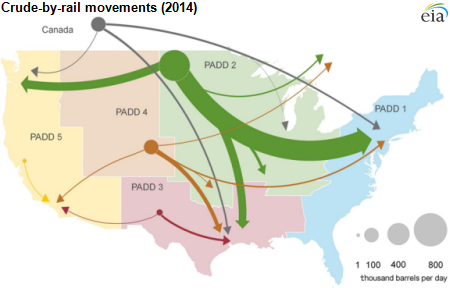
Note: Crude-by-rail movements greater than 1,000 barrels per day are represented on the map; short-distance movements between rail yards within a region are excluded. PADD denotes Petroleum Administration for Defense District.
For the first time, EIA is providing monthly data on rail movements of crude oil, which have significantly increased over the past five years. The new data on crude-by-rail (CBR) movements are integrated with EIA's existing monthly petroleum supply statistics, which already include movements by pipeline, tanker, and barge. The new monthly time series of crude oil rail movements includes shipments to and from Canada and dramatically reduces the absolute level of unaccounted for volumes in EIA's monthly balances for each region.
EIA is initiating the new series with monthly data from January 2010 through the current reporting month, January 2015. Total CBR movements in the United States and between the United States and Canada were more than 1 million barrels per day (bbl/d) in 2014, up from 55,000 bbl/d in 2010. The regional distribution of these movements has also changed over this period.
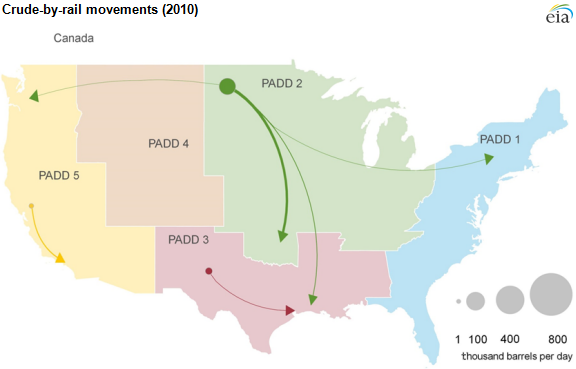
The maps below provide general flows of CBR movements annually from 2010 through 2014.

Source: U.S. Energy Information Administration based on data from the Surface Transportation Board and other information
Note: Crude-by-rail movements greater than 1,000 barrels per day are represented on the map; short-distance movements between rail yards within a region are excluded.
The Williston Basin in North Dakota (PADD 2) was the primary origin of 55,000 bbl/d of CBR shipments in 2010, with most shipments remaining in the Midwest region. Rail tank cars were used mainly to move Bakken crude oil to the Cushing, Oklahoma, storage and pipeline hub. The remaining volumes of Bakken CBR shipments went to Gulf Coast and East Coast refineries (PADDs 3 and 1, respectively). (DOE-EIA)
Subscribe to:
Posts (Atom)