Tuesday, December 10, 2013

Feed-In Tariffs

Feed-in tariff: A policy tool encouraging deployment of renewable electricity technologies
graph of Mexican crude production and exports, as explained in the article text.
Source: U.S. Energy Information Administration and Energy Velocity.


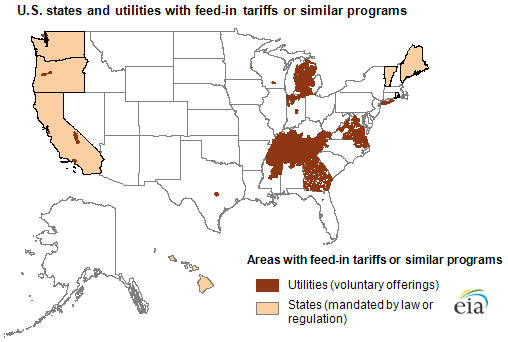
Feed-in tariffs (FITs) are a policy mechanism used to encourage deployment of renewable electricity technologies. A FIT program typically guarantees that customers who own a FIT-eligible renewable electricity generation facility, such as a roof-top solar photovoltaic system, will receive a set price from their utility for all of the electricity they generate and provide to the grid.

FITs, or similarly structured programs, are mandated to varying degrees in a limited number of states. However, a different model has also emerged in which utilities independently establish a utility-level FIT, either voluntarily or in response to state or local government mandates.

In a recent example, Dominion Virginia Power's voluntary FIT for residential and commercial solar photovoltaic (PV) generators was approved by the Virginia State Corporation Commission in March 2013. Participants will receive 15 cents/kilowatthour (kWh) for a contract term of five years for all PV-generated electricity provided to the grid, and will continue to pay the retail rate for all electricity that they consume. Virginia's average 2012 retail electricity price was 10.5 cents/kWh for residential customers and 7.8 cents/kWh for commercial customers.

Comparison with other policy tools

Other types of policies encouraging development of new renewable capacity that are more commonly used in the United States include:
A FIT is a performance-based incentive rather than an investment-based incentive, and in that respect is more similar to production tax credits and the renewable energy credits of an RPS market than to investment tax credits or other investment subsidies. In the United States, FITs are typically used in combination with one or more of these other incentives.

Variations on feed-in tariff policies

In general, feed-in tariff rates that lead to significant additional renewable energy investment are set above the retail cost of electricity.  In a recent example, in 2012 Japan implemented a new FIT with particularly high PV tariff rates (more than 40 cents/kWh) as part of its post-Fukushima policy.

However, without additional controls, generous FIT levels can lead to more investment than intended. One illustration is the Spanish experience, in which the government significantly reduced the tariff a year after its start, and suspended the FIT altogether in 2012, to contain costs to the government and other utility customers.

Rate and contract terms—Excluding some experimental programs, most U.S. contracts are long term (10-20 years). This assures project owners of a stable long term revenue stream. Utilities often set rates that depend on project size (smaller projects tend to receive higher rates) and technology (solar PV tends to receive higher rates than other technologies). Rates can also depend on the overall program goal or size limits (e.g., tariffs that decrease as capacity approaches the program ceiling), and utilities or states may revise their tariffs in cases of over- or under-subscription.

System size and sector restrictions—Most U.S. FIT programs have a maximum size for individual projects and may limit participation to certain sectors, like residential customers. The new Dominion Virginia Power Solar Purchase Program, for example, applies only to residential systems up to 20 kilowatts (kW) and commercial systems up to 50 kW in size, while Hawaii's FIT, which applies to all of Hawaii's investor-owned utilities, has a maximum system size ranging from 2,700 kW to 5,000 kW, depending on the island.

Program size limitations—Most U.S. programs designate a cumulative ceiling, set either annually or at the program level, capping the amount of capacity that can take advantage of the tariff. This is an important cost containment mechanism for FIT programs.  (DOE-EIA)

National Defense Authorization Act for 2014

The House and Senate are suspending regular order on a $607 billion Defense authorization bill in a last-ditch effort to get it to President Obama's desk before the end of the year.  Under the agreement reached by the House and Senate panels, the National Defense Authorization Act authorizes $526.8 billion in base defense spending, as well as $80.7 billion for war funding in Afghanistan.  The bill has been signed into law for 51 straight years.  (The Hill, 12/9/2013)

Monday, December 09, 2013

Defense Energy Reservations


Defense Energy Reservations (DER) would be renewable energy projects retrofitted, constructed and operated at United States military installations worldwide.  The purpose of DERs is to fight global warming, provide reliable and redundant energy systems for military preparedness and to harden facilities against the threat climate change poses to the military and our national security.

The first step in implementing this fight would be a Declaration of War by the U.S. Congress and a program to pursue this climate change mitigation effort with military precision.  This Declaration of War on global warming and climate change can be authorized by the U.S. Congress under the War Powers Resolution of 1973.  The U.S. Congress should authorize the President to fight the war because climate change poses a significant threat to the military and our national security.  Energy infrastructure investment combined with military branch participation can become the next American industrial revolution.   Economic growth, electricity reliability and smart grid construction can be accomplished by mid-century if we declare war on global warming.

The President should issue an Executive Order declaring his intention to go to war on global warming and climate change.  The President has control over the military and an Executive Order can also streamline the solicitation, bidding and construction of projects at military facilities.  We envision this being a two-way process where contractors petition the Administration to post generic solicitations for energy retrofits and deployment of large-scale renewable generating systems, including wind, solar and geothermal projects.

Private sector contractors will work in partnership with the federal government to fight this war. DERs will significantly boost private sector renewable energy retrofits, generation and efficiency investments.  We need adequate emission free electricity generation in order to meet future economic growth and we need redundant energy systems for military preparedness.

The U.S. Congress will need to authorize the Department of Defense (DoD) to establish a Defense National Energy Association (Danny Mae) that can issue Defense Backed Securities (DBS) to assist in fighting this climate change mitigation war.  DBS will be similar to Fannie Mae and Freddie Mae Mortgage Backed Securities (MBS).   A mortgage-backed security is a type of asset-backed security that is secured by a mortgage, or more commonly a collection ("pool") of sometimes hundreds of mortgages. The mortgages are sold to a group of individuals (a government agency or investment bank) that "securitizes", or packages, the loans together into a security that can be sold to investors. The mortgages of a MBS may be residential or commercial; in the United States they may be issued by structures set up by government-sponsored enterprises like Fannie Mae or Freddie Mac, or they can be "private-label", issued by structures set up by investment banks. DBS will be established in the model of MBS with collateralization provided by carbon dioxide (CO2).

The federal government owns the carbon dioxide it generates.  Reductions in CO2 have market value in international, regional and state CO2 trading markets. For instance, the current market value of a ton of CO2 in the Regional Greenhouse Gas Initiative (RGGI) in the American Northeast is about $3.00 per ton.  CO2 will be the collateral held by Danny Mae.  Danny Mae DBS will be available for purchase in the global marketplace. DBS should also be available for purchase by The Federal Reserve.

The Federal Reserve will need to purchase Defense Backed Securities, for a short period, in order to assure a return on investment for private sector renewables entrepreneurs.  This will require DoD to establish a DBS service that should also be available to investors.

DER projects will need DoD to streamline the solicitation, bidding and construction of projects at military facilities.  We envision this being a two-way process where contractors petition the Administration to post generic solicitations for energy retrofits and deployment of large-scale renewable generating systems, including wind, solar and geothermal projects.

The National Defense Authorization Act of 2007 codifies the DoD's voluntary goal of 25% of all energy to be derived from renewable technologies by 2025, but doesn't include any interim targets. And the pace of procurement for renewable technologies within the military is slowed by regulations and now the sequestration cuts. Some identified Federal Acquisition Regulations are time-consuming for vendors and are amplified when the DoD is the contracting officer.  That can also be changed iby Executive Order.

The U.S. Department of Energy reports 51% of all generating capacity was at least 30 years old while 74% of all coal-fired capacity was 30 years or older at the end of 2012.  New coal starts are greatly in decline. Renewal of our energy infrastructure is in order.  And, bold new ideas must lead the way.

The Department of Defense should be an instrument for change and should be the focus of a government-wide implementation of shared energy savings, power purchase agreements and leasing agreements.  DoD manages more than several hundred thousand individual buildings and structures located at more than 5,000 different sites.  It utilizes over 30 million acres of  land. 

DoD has begun development of non-essential tracts by issuing a $7 billion Multiple Award Task Order Contract to develop renewable and alternative energy power production.  That is a small step relative to the potential. 

We are collaborating with other appropriate government agencies, NGOs, current and former military officials and private sector companies to realize this potential for scaling up the public/private energy program partnership.

We are calling for the creation of Defense Energy Reservations (DER) to host private sector energy generation and efficiency investments.  We also call on the U.S. Congress to utilize its Constitutional powers to declare war on global warming and to give the president authorization to fight this climate change mitigation war.   We need adequate emission free electricity generation in order to meet future economic growth and we need redundant energy systems for military preparedness.

OPEN LETTER TO PRESIDENT OBAMA

DEFENSE ENERGY RESERVATIONS

Barack Hussein Obama
President
Commander In Chief
The White House
1600 Pennsylvania Avenue, NW
Washington, DC  20500

RE: Executive Order Requesting Declaration of War on Global Warming

President Obama,

The Center for Environment, Commerce & Energy (CfECE) hereby requests that you immediately issue an Executive Order declaring your intention to go to war on global warming and climate change.  We want you to request the U.S. Congress to declare war on global warming.  Your role as commander-in-chief gives you the power to repel attacks against the United States and climate change poses a clear threat to the military and our national security.  Energy infrastructure investment combined with military branch participation can become the next American industrial revolution.   Economic growth, electricity reliability and smart grid construction can be accomplished by mid-century if we declare war on global warming.

We are calling for the creation of Defense Energy Reservations (DER) to host private sector energy generation and efficiency investments.  We also call on the U.S. Congress to utilize its Constitution powers to declare war on global warming and to give you authorization to fight this climate change mitigation war.   We need adequate emission free electricity generation in order to meet future economic growth and we need redundant energy systems for military preparedness.

We also call on you to establish a Defense National Energy Association (Danny Mae) in the Defense Department that can issue Defense Backed Securities (DBS) to assist in fighting this climate change mitigation war.   DBS would be similar to Mortgage Backed Securities (MBS) and would be available for purchase by The Fed and investors.

We are calling on The Federal Reserve to purchase Defense Backed Securities in order to assure a return on investment for private sector renewables entrepreneurs.  The DoD DBS service will provide and income stream for Danny Mae renewable energy infrastructure projects.

The President has control over the military and the Executive Order can also streamline the solicitation, bidding and construction of projects at military facilities.  We envision this being a two-way process where contractors petition the Administration to post generic solicitations for energy retrofits and deployment of large-scale renewable generating systems, including wind, solar and geothermal projects.

The National Defense Authorization Act of 2007 codifies the Department of Defense's (DoD) voluntary goal of 25% of all energy to be derived from renewable technologies by 2025, but doesn't include any interim targets. And the pace of procurement for renewable technologies within the military is slowed by regulations and now the sequestration cuts. Some identified Federal Acquisition Regulations are time-consuming and to vendors and are amplified when the DoD is the contracting officer.  That can also be changed in the Executive Order.

The U.S. Department of Energy reports 51% of all generating capacity was at least 30 years old while 74% of all coal-fired capacity was 30 years or older at the end of 2012.  New coal starts are greatly in decline. Renewal of our energy infrastructure is in order.  And, bold new ideas must lead the way.

The Department of Defense should be an instrument for change and should be the focus of a government-wide implementation of shared energy savings, power purchase agreements and leasing agreements.  DoD manages more than several hundred thousand individual buildings and structures located at more than 5,000 different sites.  It utilizes over 30 million acres of  land. 

This year DoD began development of non-essential tracts by issuing a $7 billion Multiple Award Task Order Contract to develop renewable and alternative energy power production.  That is a small step relative to the potential. 

We are collaborating with other agencies, NGOs, current and former military officials and private sector companies to realize this potential for scaling up the public/private energy program partnership.

We look forward to the day when you will issue the global warming war Executive Order.

Sincerely yours,
Norris McDonald

Norris McDonald
President

OPEN LETTER TO SENATE ARMED SERVICES COMMITTEE

DEFENSE ENERGY RESERVATIONS

Honorable Carl Levin
Chairman
Senate Armed Services Committee
Room 228
Russell Senate Office Building
Washington, DC  20510

RE: Declaration of War on Global Warming and Climate Change

Dear Chairman Levin,

The Center for Environment, Commerce & Energy (CfECE) hereby requests that you immediately introduce legislation declaring war on global warming and climate change under the War Powers Resolution of 1973.  We want the U.S. Congress to authorize the President to fight the war because climate change poses a significant threat to the military and our national security.  Energy infrastructure investment combined with military branch participation can become the next American industrial revolution.   Economic growth, electricity reliability and smart grid construction can be accomplished by mid-century if we declare war on global warming.

We are calling for the creation of Defense Energy Reservations (DER) to host private sector energy generation and efficiency investments.  We also call on the U.S. Congress to authorize DoD to establish a Defense National Energy Association (Danny Mae) that can issue Defense Backed Securities (DBS) to assist in fighting this climate change mitigation war.   We need adequate emission free electricity generation in order to meet future economic growth and we need redundant energy systems for military preparedness.

We are also calling on The Federal Reserve to purchase Defense Backed Securities, similar to Mortgage Backed Securities (MBS), in order to assure a return on investment for private sector renewables entrepreneurs.  This will require DoD to establish a DBS service that should also be available to investors.

Congress should streamline the solicitation, bidding and construction of projects at military facilities.  We envision this being a two-way process where contractors petition the Administration to post generic solicitations for energy retrofits and deployment of large-scale renewable generating systems, including wind, solar and geothermal projects.

The National Defense Authorization Act of 2007 codifies the Department of Defense's  voluntary goal of 25% of all energy to be derived from renewable technologies by 2025, but doesn't include any interim targets. And the pace of procurement for renewable technologies within the military is slowed by regulations and now the sequestration cuts. Some identified Federal Acquisition Regulations are time-consuming for vendors and are amplified when the DoD is the contracting officer.  That can also be changed in the Executive Order.

The U.S. Department of Energy reports 51% of all generating capacity was at least 30 years old while 74% of all coal-fired capacity was 30 years or older at the end of 2012.  New coal starts are greatly in decline. Renewal of our energy infrastructure is in order.  Bold new ideas must lead the way and the EDR program can accomplish multiple missions.

The Department of Defense should be an instrument for change and should be the focus of a government-wide implementation of shared energy savings, power purchase agreements and leasing agreements.  DoD manages more than several hundred thousand individual buildings and structures located at more than 5,000 different sites.  It utilizes over 30 million acres of  land. 

This year DoD began development of non-essential tracts by issuing a $7 billion Multiple Award Task Order Contract to develop renewable and alternative energy power production.  That is a small step relative to the potential. 

We are collaborating with other appropriate government agencies, NGOs, current and former military officials and private sector companies to realize this potential for scaling up this public/private energy program partnership.

We look forward to the introduction of this legislation.

Sincerely yours,

Norris McDonald

Norris McDonald
President

OPEN LETTER TO HOUSE ARMED SERVICES COMMITTEE

DEFENSE ENERGY RESERVATIONS

Honorable Buck McKeon
Chairman
House Armed Services Committee
Room 2120
Rayburn House Office Building
Washington, DC

RE: Declaration of War on Global Warming and Climate Change

Dear Chairman McKeon,

The Center for Environment, Commerce & Energy (CfECE) hereby requests that you immediately introduce legislation declaring war on global warming and climate change under the War Powers Resolution of 1973.  We want the U.S. Congress to authorize the President to fight the war because climate change poses a significant threat to the military and our national security.  Energy infrastructure investment combined with military branch participation can become the next American industrial revolution.   Economic growth, electricity reliability and smart grid construction can be accomplished by mid-century if we declare war on global warming.

We are calling for the creation of Defense Energy Reservations (DER) to host private sector renewable energy generation and efficiency investments.  We also call on the U.S. Congress to authorize Department of Defense (DoD) to establish a Defense National Energy Association (Danny Mae) that can issue Defense Backed Securities (DBS) to assist in fighting this climate change mitigation war.   We need adequate emission free electricity generation in order to meet future economic growth and we need redundant energy systems for military preparedness.

We are also calling on The Federal Reserve to purchase Defense Backed Securities, similar to Mortgage Backed Securities (MBS), in order to assure a return on investment for private sector renewables entrepreneurs.  This will require DoD to establish a DBS service that should also be available to investors.

Congress should streamline the solicitation, bidding and construction of projects at military facilities.  We envision this being a two-way process where contractors petition the Administration to post generic solicitations for energy retrofits and deployment of large-scale renewable generating systems, including wind, solar and geothermal projects.

The National Defense Authorization Act of 2007 codifies the DoD's voluntary goal of 25% of all energy to be derived from renewable technologies by 2025, but doesn't include any interim targets. And the pace of procurement for renewable technologies within the military is slowed by regulations and now the sequestration cuts. Some identified Federal Acquisition Regulations are time-consuming for vendors and are amplified when the DoD is the contracting officer.  That can also be changed in the Executive Order.

The U.S. Department of Energy reports 51% of all generating capacity was at least 30 years old while 74% of all coal-fired capacity was 30 years or older at the end of 2012.  New coal starts are greatly in decline. Renewal of our energy infrastructure is in order.  And, bold new ideas must lead the way.

The Department of Defense should be an instrument for change and should be the focus of a government-wide implementation of shared energy savings, power purchase agreements and leasing agreements.  DoD manages more than several hundred thousand individual buildings and structures located at more than 5,000 different sites.  It utilizes over 30 million acres of  land. 
This year DoD began development of non-essential tracts by issuing a $7 billion Multiple Award Task Order Contract to develop renewable and alternative energy power production.  That is a small step relative to the potential. 

We are collaborating with other appropriate government agencies, NGOs, current and former military officials and private sector companies to realize this potential for scaling up the public/private energy program partnership.

We look forward to the introduction of this legislation.

Sincerely yours,

Norris McDonald

Norris McDonald
President

Supreme Court To Review EPA Air Rules

EPA's major air quality regulations, including two rules governing emissions from power plants, are slated for review by the Supreme Court and a top appellate court.

Air Rules On Trial


The Supreme Court and a key appellate court will hold oral arguments this week over several key Clean Air Act issues including EPA's ability to regulate interstate air pollution; its power plant air toxics rule; the agency's ability to revise air law settlements; and air law preemption of state non-road engine air rules.

The Supreme Court will hear arguments Dec. 10 in EPA's appeal of the U.S. Court of Appeals for the District of Columbia Circuit's 2-1 ruling in EME Homer City Generation et al. v. EPA et al. that scrapped the Cross-State Air Pollution Rule (CSAPR), an emissions cap-and-trade program aimed at curbing upwind states' air pollution hindering air quality in downwind states.

The D.C. Circuit majority found that EPA exceeded its Clean Air Act authority in how it crafted the rule and imposed it on states. Issues of federalism and the scope of EPA's ability to implement trading programs for emissions are likely be key issues for the high court justices.

While the lawsuit is pending, EPA has said it is working on a replacement rule in case the court scraps the regulation. And several eastern states announced Dec. 9 that they are petitioning EPA to expand the scope of an "ozone transport region" subject to stricter pollution controls, in a bid to try and force the agency to require more pollution cuts from upwind states.

While the Supreme Court hears arguments in the CSAPR suit, the D.C. Circuit the same day will hear arguments in White Stallion Energy Center LLC et al. v. EPA et al., in which environmentalists, industry and others are challenging EPA's power plant air toxics rule. The litigation echoes claims that often arise in EPA lawsuits over rules -- environmentalists say that the rule is weaker than the air law requires, while industry argues that is is unlawfully strict.  The outcome of both cases is seen as a major test of two flagship Obama EPA power sector regulations.

Later this week, the D.C. Circuit Dec. 11 hears arguments in USA v. Volvo Powertrain Company, a case in which engine maker Volvo Powertrain is challenging the agency's expansion of a landmark Clean Air Act settlement after it was signed. Industry groups say the litigation is a key test of the certainty of EPA's future settlement agreements. In briefs filed earlier this year in the lawsuit, Volvo Powertrain and a coalition of industry supporters say that upholding the expanded settlement would undermine the basis for all EPA consent decrees with industry.

The D.C. Circuit also hears arguments Dec. 13 in the American Road and Transportation Builders Association's (ARTBA) lawsuit challenging an April 4, 2012, EPA rule granting a waiver for California's state non-road engines emission standards for large spark ignition engines.

The lawsuit is the latest in ARTBA's long-running strategy of pursuing multiple cases in an effort to have courts impose some limits on states' ability to regulate non-road engines. ARTBA argues that the Clean Air Act's general preemption of state mobile source regulations bars rules such as California's engine policies, but has yet to persuade the D.C. Circuit of its claims. (EPA Environmental News Stand, 12/9/2013)

Saturday, December 07, 2013

Reject Fossil Fuel Divestment Campaigns

One of the Center's primary goals is to use energy and natural resources as efficiently as possible.  We reject campaigns by some environmental groups to completely eliminate the use of fossil fuels.  Such campaigns are promoting unrealistic, impractical and radical approaches to energy use. 

Although we aggressively support renewable technologies to operate our society, these sources alone cannot provide the amenities required by Americans. Fossil fuels are, and should remain, a vital part of the energy mix in America and throughout the world.

Global warming is a very important issue and the Center is working very hard to mitigate its negative consequences.  We believe that technological innovations provide the best opportunities for reducing greenhouse gas emissions into the atmosphere.  The Center is promoting multiple approaches and technologies to address climate change.

Coal, natural gas and gasoline provide the energy that powers America.  To call for their complete elimination is to call for significantly reducing the standard of living in the United States. Why divest from resources that provide incredible benefits to American society?  Why divest from stocks that provide dependable and profitable returns?  We hope you will find the information below on fossil fuel divestment campaigns to be useful.

District of Colombia
Bill encouraging divestment from fossil fuels

A hearing on DC Bill 20-481, Fossil Fuel Divestment Act of 2013 was held on Tuesday November 26th. The bill requires the divestment, and prohibits the investment, of public funds in the stocks, securities, or other obligations of certain companies which hold the largest fossil fuel reserves and provides for the identification of companies with the largest fossil fuel reserves. D.C. Council Chairman Phil Mendelson, along with four others, is sponsoring the measure. This is similar to efforts in other cities.

The Center opposes this bill.

General Background on Divestment Campaigns:

Divestment Campaign Would Hurt American Retirees and College Students

Oil and natural gas company stocks outperform all other asset classes in public pension funds and college/university endowments

In 2012, activist Bill McKibben and his group 350.org launched a divestment campaign to encourage colleges, cities, and churches to fight climate change by selling their fossil fuel stocks. According to 350.org, “the movement has already spread to over 300 colleges and universities and 100 cities and states in the United States, Australia, and Canada. Over 15 cities, six colleges, and numerous religious institutions, have already committed to dump their fossil fuel holdings.”

Pension funds and colleges/universities have enjoyed strong returns from their investments in America’s oil and natural gas companies over the last decade. State pension fund investments in oil and natural gas companies are providing very healthy returns for teachers, firefighters, police officers, and other public pension retirees, far outperforming other public pension holdings.

A series of studies have found that while 2.1 percent of endowments in fiscal year 2010-2011 were oil and gas stocks, that 2.1 percent generated 5.7 percent of all endowment gains. During that period, oil and natural gas stocks achieved returns of almost 53 percent, far better than the pension funds and endowments’ performance as a whole and the performance of the S&P 500.

While oil and natural gas stocks made up an average of 4.6 percent of holdings in the top public pension funds, they accounted for an average of 15.7 percent of the returns in these funds over a five-year time period for the 48.1 percent of U.S. workers who participate in state and local government pension plans. In fact, they also outperformed as a whole and outperformed every other asset class examined in their investments.

Cities and Colleges Reject Divestment Proposals

The City of San Francisco recently rejected a proposal to divest.

Harvard University announced that the institution will not divest from the fossil fuel industry. The President of Harvard said that the “strength and growth” of the endowment, which pays for more than one-third of Harvard activities each year, is crucial to the support and opportunities the university can provide to its students, faculty, and researchers.

Yale and many other schools have turned down this idea.

Middlebury College, McKibben’s school, announced, after an extensive process of open meetings and group discussions with both sides, they decided too many questions raise serious concerns or remain unanswered for the board to support divestment. The college went on to note, “Given its fiduciary responsibilities, the board cannot look past the lack of proven alternative investment models, the difficulty and material cost of withdrawing from a complex portfolio of investments, and the uncertainties and risks that divestment would create.”

Interior Department Gives Wind Farms 30-Year Exemption From Bird Kills

Today, the U.S. Interior Department issued a rule that would grant 30-year permits allowing wind farms and other projects to accidentally kill federally protected eagles, provided they meet certain criteria.

Large birds can be killed when they are struck by the spinning blades of wind turbines that have become a common sight around the nation in recent years.  The new rule highlights a tension lingering between two key goals of the environmental movement: developing renewable energy sources and protecting wildlife.

The new rule allows the department to issue permits to wind farms or other projects that harm or kill eagles otherwise protected under the decades old Bald and Golden Eagle Protection Act. To receive the permit, companies must show that they are taking measures to try to preserve eagles, according to the Fish and Wildlife Service.

The new rule isn't a free pass. To get a permit wind developers have to persuade the government they are going to conduct an extensive regime or offset [bird harm] by preserving habitat.

Renewable energy sources such as hydroelectric dams, solar arrays and other clean-energy projects often create collateral damage in nearby ecosystems.

Some environmental groups strongly protested the changes as harmful to the environment, believing the new rule will lead to more dead eagles. (WSJ, 12/6/2013)

Friday, December 06, 2013

California Utility Plans Power Lines to Export Renewables

The Imperial Irrigation District is a fiscally responsible public agency whose mission it is to provide reliable, efficient and affordably priced water and energy service to the communities it serves.

Imperial Irrigation District (IID) is proposing a massive transmission project designed to deliver renewable energy onto the California grid and to neighboring states.  IID, which serves southeastern California, believes the lines could help utilities meet their renewable requirements and fill in for the unexpected retirement of the 2,200-MW San Onofre nuclear power plant outside Los Angeles.  The plan includes building 500-kV lines from IID's system to a San Onofre substation and to an Arizona Public Service substation in Arizona. The lines could each deliver 1,100 MW.

This proposal aims to remove real barriers that limit the export of geothermal, solar/wind and biomass resources located in the Imperial Valley, including from the Salton Sea. 

The California Independent System Operator is reviewing the proposal, which could cost up to $1.7 billion. There are roughly a dozen proposed transmission projects that are being developed to deliver renewables to California from nearby states. This is the first major proposal that would export renewable generation from California towards the east.
 
Imperial Irrigation wants to add more power lines in California

California public power and water company Imperial Irrigation District (IID) proposed to expand its Southern California transmission system to boost the amount of renewable energy it can export to the rest of the state and to the U.S. Southwest.
IID said in a release that the increased exports will help California replace generation lost by the retirement of the San Onofre nuclear power plant, located on the Pacific Coast between San Diego and Los Angeles.

The expansion project could cost $431 million to $1.7 billion, depending on what transmission lines IID builds and what partnerships it establishes with other utilities to share the costs.
IID proposed to recover the costs from companies that take the renewable energy.

IID wants to build a 2,200-megawatt (MW) 30-kilovolt (kV) system to export 1,100 MW to the rest of California and simultaneously export another 1,100 MW to utilities in the Southwest.
One megawatt can power about 1,000 homes.

The project includes the development of a 500-kV alternating current (AC) line rated at 1,200 MW to connect to Arizona Public Service's territory in Arizona, and the construction of a 500-kV direct current (DC) transmission line rated at 1,100 MW from the Salton Sea area to a substation at San Onofre.
Arizona Public Service is a unit of Arizona power company Pinnacle West Capital Corp.

IID said it can add more transmission to increase the amount of power it can export from 2,200 MW to 4,100 MW as the need for additional renewable energy occurs.
California is approaching the second renewable portfolio standard compliance period (2014-2016), whereby utilities are required to provide a minimum of 25 percent of the energy from their supply portfolios with renewable resources, IID said.

The final compliance period (2017-2020) requires that amount to increase to a minimum of 33 percent in 2020.
IID said it submitted its plan to the California Independent System Operator (ISO), which operates the power grid for much of California, in November and expects to hear from the ISO by the end of the first quarter of 2014.

The biggest power companies in California are units of PG&E Corp, Edison International Inc and Sempra Energy.  (IID)

Wednesday, December 04, 2013

RGGI Wants Flexibility From EPA

RGGI States Recommend that EPA Support Flexible Market-Based Carbon Pollution Programs

States Submit Comments on Proposed Carbon Pollution Rules for Existing Power Plants
The nine Northeastern and Mid-Atlantic states participating in the Regional Greenhouse Gas Initiative (RGGI), the nation’s first market-based regulatory program to reduce greenhouse gas (GHG) pollution, have submitted comments to the United States Environmental Protection Agency (EPA) for consideration as EPA develops guidelines for state programs to reduce carbon dioxide (CO2) emissions from power plants under Clean Air Act section 111(d).

Building on their states’ success in cutting carbon dioxide emissions by approximately 40 percent since 2005, the RGGI states encourage EPA to view the RGGI success story as a benchmark for national action. The RGGI states are also recommending that EPA’s new rules empower states to develop market-based GHG emission reduction programs designed to work for their region(s).

Regional Model

The RGGI states highlight several reasons for why EPA should recognize the RGGI model as an effective system of emission reduction for GHG emissions from the power sector – combining various policy tools with an enforceable cap.
  • It is a proven model. RGGI’s “cap-and-trade, auction-and-invest” model has helped the New England and Mid-Atlantic states make dramatic reductions in GHG emissions.
  • It is extremely cost-effective. RGGI enables compliance through market mechanisms that seek out the least expensive emission reductions across the region.
  • It provides economic benefits. According to an independent analysis, the RGGI states’ investment of auction proceeds from just the first three years of the program (2009-11) is creating thousands of jobs, reducing energy bills by more than $1 billion, and adding a net of $1.6 billion to the economies in the RGGI states.
  • It aligns with the regional nature of the electricity grid and fosters regional cooperation. The nation’s regional electricity grids allow electricity to flow from the cheapest, most efficient producer to meet consumer demand, wherever located. The RGGI cap ensures that emissions decrease across the region, even as it allows increases in some locations in order to reap the benefits of more efficient sources in those locations.
  • It provides a simple, transparent, verifiable compliance system. Under RGGI, the emissions are limited by the allowances that are distributed, providing certainty that the projected emission reductions will be achieved, including reductions attributable to energy efficiency and renewable energy.

The RGGI states discuss how their experience demonstrates that regional cooperation can achieve the most cost-effective emission reductions, enable a transition to a lower-emitting and more efficient power sector, and create economic benefits and jobs across the United States.

Between 2005 and 2012, CO2 emissions from the power sector in the nine RGGI states dropped more than 40 percent even as the regional economy continued to grow.


Preliminary Recommendations


 The comments also provide preliminary recommendations for EPA based upon the RGGI states’ experience in implementing a successful market-based power sector carbon pollution program.

 The RGGI states recommend that:
  • EPA guidelines achieve meaningful nationwide emissions reductions, and ensure that all states have a common target to reach, even if some states are given more time to reach that target;
  • EPA should provide equitable treatment to states, such as the RGGI states, that have taken action to lower GHG emissions prior to issuance of EPA’s new rule;
  • EPA should provide clear guidelines for a rigorous demonstration of equivalency of state programs;
  • EPA should ensure that state plans are enforceable and that the GHG reductions are verifiable; and
  • EPA should allow states maximum flexibility in reaching a common target by allowing states to:
    - Use a mass-based system of compliance;
    - Demonstrate compliance on a regional basis; and
    - Demonstrate compliance on a multi-year basis.
 
About the Regional Greenhouse Gas Initiative

The Northeast and Mid-Atlantic states participating in the second RGGI control period (Connecticut, Delaware, Maine, Maryland, Massachusetts, New Hampshire, New York, Rhode Island, and Vermont) have implemented the first mandatory market-based regulatory program in the U.S. to reduce greenhouse gas emissions. Power sector CO2 emissions are capped at 165 million short tons for 2013.

RGGI is composed of individual CO2 budget trading programs in each state, based on each state’s independent legal authority. A CO2 allowance represents a limited authorization to emit one short ton of CO2, as issued by a respective state. A regulated power plant must hold CO2 allowances equal to its emissions to demonstrate compliance for each three-year control period. RGGI’s second control period began on January 1, 2012 and extends through December 31, 2014. For more information visit www.rggi.org

CO2 Market Improves In California

Offsets Issued & Auctions Upheld

The “cap-and-trade” system enacted under California’s Global Warming Solution Act of 2006 (“AB 32”) aims to reduce greenhouse gas (“GHG”) emissions in that state to 1990 levels by the year 2020.

Two developments in the last month have moved the cap-and-trade system closer to becoming fully operational.

First, the California Air Resources Board issued the first “compliance grade” offsets for forestry projects, establishing a market for offsets derived from the forestry industry (including out-of-state projects).

Second, a California trial court rejected a challenge to CARB’s carbon allowance auction program.  (More at Marten Law, 12/1/2013)

White House & EPA Meet With Greens on Fracking Diesel

Representatives from five environmental and government watchdog groups met with White House and Environmental Protection Agency (EPA) officials to discuss the new guidance for fracking efforts that involve diesel.  Officials from the Natural Resources Defense Council, Earthworks, Food and Water Watch, Clean Water Action and the Center for Effective Government attended the Nov. 26 meeting.

Some of the groups have urged the EPA to ban energy companies from using diesel fuels in their fracking activities, since it could pose risks to human health and the environment.

In a comment submitted to the agency last summer, after the guidance was first
proposed, the organizations joined a coalition saying that a ban “will allow EPA to fully and efficiently achieve its agency goals of improving regulatory certainty, improving compliance and protecting the environment.”

Fracking involves shooting high-pressure jets of water, sand, and other chemicals into rock formations. Environmental groups have worried that some of the fluid can leak into the groundwater.

In 2005, Congress exempted most fracking activities from laws to protect clean drinking water. The rules still apply to fracking that involves diesel as part of the chemical mix injected to release energy, however.

The EPA unveiled draft guidance last year. Since September, a final version has been under an interagency review at the White House’s regulations office. Though the White House office has a 90-day deadline when it reviews regulations, there are no similar rules for reviewing guidance.  (The Hill, 12/3/2013)

Obama Extends Federal Performance Contracting

The Obama administration on Tuesday announced an extension of the president's initiative to increase energy efficiency in federal buildings.
 
The 2011 executive order, which jumpstarted a two-year campaign to achieve $2 billion in energy savings in federal buildings, was set to expire at the end of this year.
 
Center President Norris McDonald cowrote the original federal performance contract legislation with the National Association of Energy Services Companies, which was signed into law by President Ronald Reagan in 1986.
 
 
Lawmakers from both sides of the aisle recently called on Obama to grant a five-year extension of the project.
 
Led by Rep. Peter Welch (D-Vt.), House members asked the administration to set a goal of $1 billion a year for the federal government to use performance contracts in achieving energy savings.
 
The extension announced on Tuesday however, falls short of that goal.
 
Agencies will team with the Department of Energy (DOE) in early 2014 to determine avenues for additional projects aimed at reducing energy through 2016 -- a two-year extension. (The Hill, 12/3/2013)

Tuesday, December 03, 2013

2014 Fuel Economy Guide

EPA and DOE Release Annual Fuel Economy Guide with 2014 Models

The U.S. Environmental Protection Agency (EPA) and the Department of Energy (DOE) are releasing the 2014 Fuel Economy Guide, providing consumers with a valuable resource to identify and choose the most fuel efficient and low greenhouse gas emitting vehicles that meet their needs. The 2014 models include efficient and low-emission vehicles in a variety of classes and sizes, ensuring a wide variety of choices available for consumers.
 
 
The guide provides “Top Ten” lists allowing consumers to see the most efficient advanced technology vehicles as well as the most efficient gasoline and diesel powered vehicles. Consumers will also find a broad range of information in the guide that can be helpful while shopping for a new vehicle— including an estimated annual fuel cost for each vehicle. The estimate is based on the vehicle’s miles per gallon (mpg) rating and national estimates for annual mileage and fuel prices. An online version of the guide, available through www.fueleconomy.gov, allows consumers to enter local gasoline prices and typical driving habits to receive a personalized fuel cost estimate. Also, for the second consecutive year, the guide includes a 1-10 greenhouse gas rating for each model, providing a quick and easy way for consumers to identify vehicles with low greenhouse gas emissions.
 
 EPA fuel economy estimates are the best way to compare the fuel economy among vehicles. Official fuel economy testing is controlled, repeatable, and accounts for a variety of real-world conditions for the average driver, like air conditioning usage and a variety of speed and temperature conditions. Individual mileage will vary depending on factors such as driving style, high air conditioning usage, carrying extra weight and towing, and weather.

For tips on more efficient driving check out the gas mileage tips at http://fueleconomy.gov/feg/drive.shtml.

More information, including a complete version of the guide and details on the fuel economy labels and for mobile devices. EPA and DOE will update the guide online as more 2014 vehicles become available.  (EPA & DOE Press Release)

EPA & USDA Support Water Quality Trading

USDA, EPA Partnership Supports Water Quality Trading To Benefit Environment, Economy

The U. S. Department of Agriculture (USDA) and the Environmental Protection Agency (EPA) have announced an expanded partnership to support water quality trading and other market-based approaches that provide benefits to the environment and economy.

New water quality trading markets hold incredible potential to benefit rural America by providing new income opportunities and enhancing conservation of water and wildlife habitat.  Additionally, these efforts will strengthen businesses across the nation by providing a new pathway to comply with regulatory requirements.
 

Water quality trading provides a cost-effective approach for regulated entities to comply with EPA Clean Water Act requirements, including water quality-based effluent limits in National Pollutant Discharge Elimination System permits. Trading would allow regulated entities to purchase and use pollutant reduction credits generated by other sources in a watershed. Cost savings and other economic incentives are key motivators for parties engaged in trading. Water quality trading can also provide additional environmental and economic benefits, such as air quality improvements, enhanced wildlife habitat, carbon capture and storage, and new income and employment opportunities for rural America.

The Center is operating a Stormwater Credit Exchange to support water quality trading in Washington, DC.

EPA and USDA are working together to implement and coordinate policies and programs that encourage water quality trading. The Department and the Agency will identify opportunities to work collaboratively to help improve water quality trading programs across the country. Cooperative management and technical assistance will improve resource management and public services, and accelerate implementation.

USDA and EPA will:

- Coordinate and enhance communications and outreach to states, agricultural producers, regulated sources, and interested third parties on water quality trading;
- Engage expertise across agencies in the review of grants, loans or technical assistance programs focused on water quality trading;
- Share information on the development of rules and guidance that have the potential to affect water quality trading;
- Collaborate on developing tools and information resources for states and credit generators to guide decision making, reduce costs in program design and implementation, improve environmental performance, and foster consistency and integrity across regional initiatives;
- Co-host a workshop by 2015 to share tools and resources available to assist in stakeholder decision making and opportunities.

The purpose of this policy is to support states, interstate agencies and tribes as they develop and implement water quality trading programs for nutrients, sediments and other pollutants where opportunities exist to achieve water quality improvements at reduced costs. (USDA/EPA Press Release)

Thursday, November 28, 2013

Virginia Approves Power Line Over James River

Scott Neville/For The Washington Post
           Dominion Power has proposed installing towers
 across the James River that would be visible
 from College Creek Beach on the Colonial Parkway.
 Local history buffs and nature lovers are
 trying to protect the scenic beauty of the area.
The State Corporation Commission (SCC) of Virginia in Richmond approved a controversial request by Dominion Power on Tuesday to build a 500,000-volt transmission line over the James River — a plan that faces heavy opposition from preservationists and other organizations around America’s founding waterway.

The Center generally supports these sorts of projects and supports this plan.

Now, the focus — and fight — moves to the federal level. The project requires a permit from the Army Corps of Engineers, and the groups that have denounced Dominion’s plan on historic and economic grounds say they’re digging in.

The National Trust for Historic Preservation believes the SCC missed the mark but  hopes the Army Corps will take a hard look at this and make a meaningful evaluation of the historic and environmental impacts of Dominion’s plan.

The utility’s 7.4-mile transmission line would span the same stretch of river that some of the first English settlers navigated in 1607 before landing at Jamestown. It would cross the James on a series of as many as 17 towers — the largest being nearly as tall as the Statue of Liberty and, critics say, be visible from the tip of Jamestown Island and along the historic Colonial Parkway.

The SCC concluded, “the evidence is clear that the proposed project is necessary to continue reliable electric service to the hundreds of thousands of people who live and work across this broad region of Virginia.”  Dominion Virginia Power noted it, “is sensitive to historic and environmental concerns and the Commission ultimately agreed that the company’s recommended routes are the least impactful.”

The Colonial Williamsburg Foundation, the College of William and Mary, and Preservation Virginia are among those opposing the project. In June, the National Trust for Historic Preservation added the James River to its list of America’s Most Endangered Historic Places in an effort to amplify the controversy.

Construction of the transmission line could begin before the end of the year. The SCC ordered Dominion to finish the project by June 1, 2015.  (Wash Post, 11/27/

Wednesday, November 27, 2013

Coal Mine Closures & Layoffs Hitting Kentucky Hard

Unprecedented pressures on the U.S. coal industry in Central Appalachian coalfields are seriously hurting counties in eastern Kentucky.  While the coal industry overall is losing market share to abundant natural gas, mines in Central Appalachia have become increasingly uneconomical. Natural gas is cheaper, and so is coal mined in two other big coal basins centered in Wyoming and Illinois.
 
A Wall Street Journal analysis of Mine Safety and Health Administration (MSHA) data reveals that the picture is bleakest across a swath of 26 counties in Kentucky's eastern coalfields.  The number of coal-mining and related jobs in the region remained fairly steady between 2000 through 2011. Since 2011, the area has seen an unrelenting decline and state officials say there are now fewer miners working in Kentucky than any other time in records dating to the 1920s.
 
 
The state's eastern coalfields had 161 active mines in the second quarter of this year, down from an average of 256 active mines for the four quarters of 2011. There were 22 mines with coal production in the second quarter of this year, down from 44 at the beginning of 2011, according to the MSHA data.
 
At the same time, competition among mines has heated up. It costs utilities about 40% more to generate the same amount of electricity using the region's coal compared with coal from Wyoming. Coal from Wyoming doesn't generate as much electricity per ton and costs more to transport. Still, it is a better deal for utilities because the costs to mine coal from seams 60-feet thick are far less.
 
In Central Appalachia, the region's coal seams are thinner, and so are mining companies' profit margins. It typically costs $60 to $70 to extract a ton of coal there, while the current price for coal from the region used by utilities, known as thermal coal, is under $65 a ton.
 
 
Even West Virginia and Virginia have some advantages over eastern Kentucky. They possess higher grades of coal, including more reserves of metallurgical coal used in steelmaking that currently sell for about $150 a ton.

 
Since January, the Eastern Kentucky Concentrated Employment Program, the 23-county agency, has used funds from a two-year $5.2 million grant from the U.S. Labor Department to retrain 407 unemployed miners. The program has so far helped another 430 find new jobs in manufacturing, construction and health care.

Many unemployed miners blame President Obama and the Environmental Protection Agency for their plight. They cited a series of regulations to tighten emissions rules for coal-burning power plants, which they believe amounts to what has popularly been called a "war on coal."

Most coal industry executives believe the stepped-up regulations have exacerbated a market depression brought about by new fracking technologies that have revolutionized natural gas drilling and made it possible to tap massive reservoirs of gas from deep shale layers.


Coal accounted for 39% of U.S. electricity generation through August of this year, compared to 27% for natural gas. In 2003, coal powered 51% of generation, compared to 17% for natural gas.

Utilities have frequently cited new emissions standards among reasons for closing aging coal-fired power plants. Roughly 9% of coal-fired capacity is slated for closure between 2013 and 2018, according to the EIA.

Alpha, the nation's third-largest coal operator by production and the biggest in Central Appalachia, has laid off 594 workers at Kentucky mines and related coal facilities since January 2012. It now operates 10 underground mines in the state, down from 23 underground and six surface mines in 2011. It also shut four facilities that process coal.  (WSJ, 11/26/2013)