Highlights:
The Department’s 2014 budget request totals $11.9 billion in current authority. This is an increase of $486.4 million over the 2012 enacted level.
The 2014 request for the Bureau of Reclamation including the Central Utah Project Completion Act, funded in the Energy and Water Development Appropriations Act, is $1.0 billion in current appropriations, a reduction of $26.8 million and 2.5 percent when compared to the 2012 level.
In 2014, Interior will generate receipts of approximately $14.1 billion.
Bureau of Land Management – The 2014 request is $1.2 billion, an increase of $32.6 million over the 2012 enacted budget.
To advance the America’s Great Outdoors initiative, the request includes $8.0 million in programmatic increases for recreation and the National Landscape Conservation System to improve opportunities for recreation, education, and scientific activities while enhancing the conservation and protection of BLM-managed lands and resources.
Bureau of Ocean Energy Management - The 2014 operating request is $169.4 million, including $71.5 million in current appropriations and $97.9 million in offsetting collections. This is an increase of $11.9 million in net current appropriations above the 2012 enacted level.
Bureau of Safety and Environmental Enforcement – The 2014 budget request is $222.1 million, including $98.2 million in current appropriations and $124.0 million in offsetting collections. This is an increase of $24.8 million in net current appropriations above the 2012 enacted level.
Office of Surface Mining – The 2014 budget request for the Office of Surface Mining is $143.1 million, a decrease of $7.1 million from the 2012 enacted level.
Bureau of Reclamation– The 2014 budget request totals $1.0 billion, a decrease of $26.8 million below the 2012 enacted level and $33.4 million below the 2013 Continuing Resolution, P.L. 112-175, annualized.
U. S. Geological Survey – The USGS budget request is $1.2 billion, $98.8 million above the 2012 enacted level.
Fish and Wildlife Service– The 2014 Fish and Wildlife Service budget includes $1.6 billion in current appropriations, an increase of $76.4 million above the 2012 level. This includes America’s Great Outdoors initiative related increases of $68.9 million in the Resource Management account.
National Park Service – The 2014 budget request for NPS of $2.6 billion is $56.6 million above the 2012 enacted level. In 2014, a total of $2.5 billion is requested for NPS as part of the America’s Great Outdoors initiative. This includes $2.3 billion for park operations, as represented by the Operation of the National Park System account, which is a total increase of $48.4 million over 2012.
Indian Affairs – The 2014 budget includes $2.6 billion for Indian Affairs programs, an increase of $31.3 million from the 2012 enacted level.
Departmental Offices and Department-wide Programs – The 2014 request for the Office of the Secretary is $268.9 million, an increase of $7.0 million from the 2012 enacted level.
(DOI FY 2014 Budget)
The Center, founded in 1985, is an environmental organization dedicated to protecting the environment, enhancing human, animal and plant ecologies, promoting the efficient use of natural resources and expanding participation in the environmental movement.
Friday, April 12, 2013
Thursday, April 11, 2013
Obama FY 2014 Budget: Environment
The Obama Administration proposed a Fiscal Year 2014 (FY 2014) budget of $8.153 billion for the U.S.
Environmental Protection Agency (EPA). This request is $296 million below the EPA’s budget for Fiscal Year 2012.
Fiscal Year 2014 budget highlights include:
E-Enterprise to Assist Businesses and Improve EPA and States’ Access to Data. E-Enterprise, a $60 million initiative will enable EPA to begin developing tools and expanding systems designed to reduce the reporting burden on regulated entities and provide EPA and state regulators with easier access to and use of environmental data. E-Enterprise seeks to replace out-dated, paper reporting with integrated e-reporting systems using technology and shared IT services, while encouraging greater transparency and compliance. Similar to online banking, the new single portal system will allow regulated businesses to register and receive tailored information based on their unique needs. This electronic system will facilitate commercial entities’ permit applications and emissions reporting as well as provide information on applicable regulations and compliance status.
EPA’s request includes essential resources for our state, local and tribal partners to build integrated data systems that will improve the quality of data collected by EPA and the states for verifying compliance with regulations, and reduce reporting burden on industry and improve services for the regulated entities and the American public. Additionally, E-Enterprise builds on efforts such as e-manifest, which is projected to reduce reporting costs for regulated businesses in the range of $77 to $126 million annually by replacing the 5.1 million paper manifests for hazardous waste shipments with a modern tracking and reporting system.
Supporting State and Tribal Partners. The FY 2014 budget includes a total of $1,135.8 million in categorical grants, an increase of $47 million over FY 2012 levels. EPA remains committed to supporting our state and tribal partners, the primary implementers of environmental programs, remains a priority of the EPA. Funding to states and tribes in the State and Tribal Assistance Grants (STAG) account continues to be the largest percentage of the EPA's budget request, at nearly 40% in FY 2014.
Climate Change. EPA is proposing $176.5 million for the agency’s work with partners and stakeholders to provide information and tools to cut greenhouse gas emissions. These funds will support reducing emissions in the U.S. and abroad through careful, cost-effective rulemaking and voluntary programs that focus on the largest entities while also encouraging businesses and consumers to limit unnecessary greenhouse gas emissions.
These funds will allow the agency to continue utilizing approaches like ENERGY STAR, the Global Methane Initiative, the GHG Reporting Rule, and state and local technical assistance and partnership programs, such as SmartWay. The ENERGY STAR program continues to yield significant results through its 20,000 partners. Americans, with the help of ENERGY STAR, prevented emissions of an estimated 242 million metric tons of carbon dioxide equivalent (MMTCO2E), saving a total of $24 billion on their annual utility bills in 2012 alone. The budget also includes $20 million for research to understand the impacts of climate change on human health and vulnerable ecosystems. This research will evaluate the interactions between climate change and air quality and develop approaches to adapt to a changing climate and provide state, local and Tribal partners with tools and technologies to support their climate change programs.
Enforcement and Compliance. EPA’s budget proposal requests $625 million to maintain the strength of core national enforcement and compliance assurance programs and for the Next Generation Compliance Initiative. In light of fiscal constraints, the need to innovate is even greater in order for the EPA to achieve gains in compliance over the long-term. Through the Next Generation Compliance initiative, the EPA is developing and implementing new methods based on advances in both monitoring and information technology that will improve efficiency, leading to better compliance and enabling our ability to focus on the most serious violations. By leveraging electronic reporting and working to reduce redundant paperwork and regulatory reporting burdens on business and our governmental partners, EPA will contribute to improving environmental and human health protection. Next Generation Compliance complements the agency’s E-Enterprise initiative.
Improving Air Quality. The agency’s proposal requests $175 million to support its work to meet its court-ordered deadlines to develop, implement and review statutorily mandated ambient air quality standards and guidance and air toxics regulations. In addition, EPA will continue to provide support to its state, local and Tribal partners to implement these rules by providing analytical tools for emissions and quality assurance, as well as air quality systems to house and exchange data and technology.
Addressing Phosphorus and Nitrogen Pollution in America’s Waters. Nutrient pollution is one of the nation’s most widespread and challenging environmental problems. To assist in tackling this challenge, EPA is requesting an increase of $15 million in Clean Water Act Section 106 Water Pollution Control grant funding to support states, interstate agencies and tribes that commit to strengthening their nutrient management efforts. Additionally, EPA will work to achieve water quality improvements in key watersheds across the country in partnership with states and the U.S. Department of Agriculture. This is in addition to EPA’s core clean water programs and grants that support states in the development and implementation of nutrient pollution reduction strategies, as well as provide technical guidance and resources to help states develop water quality criteria for nutrients. These efforts may also reduce the need for treatment of drinking water, as sources are better protected from these pollutants.
Promoting Sustainable Community Water Resources. This Fiscal Year 2014 budget seeks to ensure that federal dollars provided through the State Revolving Funds (SRF) support efficient system-wide planning, improvements in technical, financial, and managerial capacity, and the design, construction, and ongoing management of sustainable water infrastructure. The FY 2014 budget requests $1.1 billion for the Clean Water SRF and $817 million for the Drinking Water SRF. EPA is working to increase the use of upfront planning that considers a full range of alternatives, including “green” infrastructure, to ensure timely, relevant and cost-effective investments.
Protecting Our Land. In FY 2014, the Agency is requesting over $1.34 billion to continue to apply the most effective approaches to preserve and restore land by developing and implementing prevention programs, improving response capabilities, and maximizing the effectiveness of response and cleanup actions under RCRA, Superfund, Leaking Underground Storage Tank and other authorities. This strategy will help ensure that human health and the environment are protected and that land is returned to beneficial use in the most effective way.
Ensuring the Safety of Chemicals. Ensuring the safety of new or existing chemicals in commerce to protect the American people remains a key EPA priority. Chemicals are used in the production of our homes and automobiles as well as the food we eat. Chemicals often are released into the environment as a result of their manufacturing, processing, use, and disposal. The $686.2 million requested in FY 2014 will allow the EPA to sustain its success in managing the potential risks of new chemicals entering commerce without impacting progress in assessing and ensuring the safety of existing chemicals.
Continuing EPA’s Commitment to Innovative Research Solutions. EPA’s research budget provides $554 million to support critical research in key areas such as chemical safety; sustainable water resources; healthy communities; air, climate and energy, homeland security; and human health risk assessment. EPA’s 2014 request reflects the Obama Administration’s commitment to drive strong economic growth by supporting innovative research to reduce pollution to our environment and public health, prepare our communities for the consequences of climate change, and transition our country to move towards a clean energy future.
Reducing EPA’s Physical Footprint and Energy Costs. Since 2006, the EPA has released approximately 417,000 square-feet of office space, resulting in a cumulative annual rent avoidance of over $14.2 million. In addition, across all agency facilities, on-going improvements in operating efficiency combined with the use of advanced technologies and energy sources have reduced energy utilization, resulting in annual cost savings of $5.9 million. The FY 2014 request includes $17 million to accelerate the space consolidation effort, with $12 million to the support design and engineering of a consolidated federally-owned EPA multi-use facility in Las Vegas, NV. The new facility will consolidate offices currently in leased locations, create a smaller energy-efficient office and lab footprint, and lower operating costs.
Reducing and Eliminating Programs. The budget includes $54 million in savings by eliminating several EPA programs that have either completed their goals or can be implemented through other federal or state efforts. This request also identifies 20 programs that are being reduced by 10% or more in FY 2014. (EPA)
Environmental Protection Agency (EPA). This request is $296 million below the EPA’s budget for Fiscal Year 2012.
Fiscal Year 2014 budget highlights include:
E-Enterprise to Assist Businesses and Improve EPA and States’ Access to Data. E-Enterprise, a $60 million initiative will enable EPA to begin developing tools and expanding systems designed to reduce the reporting burden on regulated entities and provide EPA and state regulators with easier access to and use of environmental data. E-Enterprise seeks to replace out-dated, paper reporting with integrated e-reporting systems using technology and shared IT services, while encouraging greater transparency and compliance. Similar to online banking, the new single portal system will allow regulated businesses to register and receive tailored information based on their unique needs. This electronic system will facilitate commercial entities’ permit applications and emissions reporting as well as provide information on applicable regulations and compliance status.
EPA’s request includes essential resources for our state, local and tribal partners to build integrated data systems that will improve the quality of data collected by EPA and the states for verifying compliance with regulations, and reduce reporting burden on industry and improve services for the regulated entities and the American public. Additionally, E-Enterprise builds on efforts such as e-manifest, which is projected to reduce reporting costs for regulated businesses in the range of $77 to $126 million annually by replacing the 5.1 million paper manifests for hazardous waste shipments with a modern tracking and reporting system.
Supporting State and Tribal Partners. The FY 2014 budget includes a total of $1,135.8 million in categorical grants, an increase of $47 million over FY 2012 levels. EPA remains committed to supporting our state and tribal partners, the primary implementers of environmental programs, remains a priority of the EPA. Funding to states and tribes in the State and Tribal Assistance Grants (STAG) account continues to be the largest percentage of the EPA's budget request, at nearly 40% in FY 2014.
Climate Change. EPA is proposing $176.5 million for the agency’s work with partners and stakeholders to provide information and tools to cut greenhouse gas emissions. These funds will support reducing emissions in the U.S. and abroad through careful, cost-effective rulemaking and voluntary programs that focus on the largest entities while also encouraging businesses and consumers to limit unnecessary greenhouse gas emissions.
These funds will allow the agency to continue utilizing approaches like ENERGY STAR, the Global Methane Initiative, the GHG Reporting Rule, and state and local technical assistance and partnership programs, such as SmartWay. The ENERGY STAR program continues to yield significant results through its 20,000 partners. Americans, with the help of ENERGY STAR, prevented emissions of an estimated 242 million metric tons of carbon dioxide equivalent (MMTCO2E), saving a total of $24 billion on their annual utility bills in 2012 alone. The budget also includes $20 million for research to understand the impacts of climate change on human health and vulnerable ecosystems. This research will evaluate the interactions between climate change and air quality and develop approaches to adapt to a changing climate and provide state, local and Tribal partners with tools and technologies to support their climate change programs.
Enforcement and Compliance. EPA’s budget proposal requests $625 million to maintain the strength of core national enforcement and compliance assurance programs and for the Next Generation Compliance Initiative. In light of fiscal constraints, the need to innovate is even greater in order for the EPA to achieve gains in compliance over the long-term. Through the Next Generation Compliance initiative, the EPA is developing and implementing new methods based on advances in both monitoring and information technology that will improve efficiency, leading to better compliance and enabling our ability to focus on the most serious violations. By leveraging electronic reporting and working to reduce redundant paperwork and regulatory reporting burdens on business and our governmental partners, EPA will contribute to improving environmental and human health protection. Next Generation Compliance complements the agency’s E-Enterprise initiative.
Improving Air Quality. The agency’s proposal requests $175 million to support its work to meet its court-ordered deadlines to develop, implement and review statutorily mandated ambient air quality standards and guidance and air toxics regulations. In addition, EPA will continue to provide support to its state, local and Tribal partners to implement these rules by providing analytical tools for emissions and quality assurance, as well as air quality systems to house and exchange data and technology.
Addressing Phosphorus and Nitrogen Pollution in America’s Waters. Nutrient pollution is one of the nation’s most widespread and challenging environmental problems. To assist in tackling this challenge, EPA is requesting an increase of $15 million in Clean Water Act Section 106 Water Pollution Control grant funding to support states, interstate agencies and tribes that commit to strengthening their nutrient management efforts. Additionally, EPA will work to achieve water quality improvements in key watersheds across the country in partnership with states and the U.S. Department of Agriculture. This is in addition to EPA’s core clean water programs and grants that support states in the development and implementation of nutrient pollution reduction strategies, as well as provide technical guidance and resources to help states develop water quality criteria for nutrients. These efforts may also reduce the need for treatment of drinking water, as sources are better protected from these pollutants.
Promoting Sustainable Community Water Resources. This Fiscal Year 2014 budget seeks to ensure that federal dollars provided through the State Revolving Funds (SRF) support efficient system-wide planning, improvements in technical, financial, and managerial capacity, and the design, construction, and ongoing management of sustainable water infrastructure. The FY 2014 budget requests $1.1 billion for the Clean Water SRF and $817 million for the Drinking Water SRF. EPA is working to increase the use of upfront planning that considers a full range of alternatives, including “green” infrastructure, to ensure timely, relevant and cost-effective investments.
Protecting Our Land. In FY 2014, the Agency is requesting over $1.34 billion to continue to apply the most effective approaches to preserve and restore land by developing and implementing prevention programs, improving response capabilities, and maximizing the effectiveness of response and cleanup actions under RCRA, Superfund, Leaking Underground Storage Tank and other authorities. This strategy will help ensure that human health and the environment are protected and that land is returned to beneficial use in the most effective way.
Ensuring the Safety of Chemicals. Ensuring the safety of new or existing chemicals in commerce to protect the American people remains a key EPA priority. Chemicals are used in the production of our homes and automobiles as well as the food we eat. Chemicals often are released into the environment as a result of their manufacturing, processing, use, and disposal. The $686.2 million requested in FY 2014 will allow the EPA to sustain its success in managing the potential risks of new chemicals entering commerce without impacting progress in assessing and ensuring the safety of existing chemicals.
Continuing EPA’s Commitment to Innovative Research Solutions. EPA’s research budget provides $554 million to support critical research in key areas such as chemical safety; sustainable water resources; healthy communities; air, climate and energy, homeland security; and human health risk assessment. EPA’s 2014 request reflects the Obama Administration’s commitment to drive strong economic growth by supporting innovative research to reduce pollution to our environment and public health, prepare our communities for the consequences of climate change, and transition our country to move towards a clean energy future.
Reducing EPA’s Physical Footprint and Energy Costs. Since 2006, the EPA has released approximately 417,000 square-feet of office space, resulting in a cumulative annual rent avoidance of over $14.2 million. In addition, across all agency facilities, on-going improvements in operating efficiency combined with the use of advanced technologies and energy sources have reduced energy utilization, resulting in annual cost savings of $5.9 million. The FY 2014 request includes $17 million to accelerate the space consolidation effort, with $12 million to the support design and engineering of a consolidated federally-owned EPA multi-use facility in Las Vegas, NV. The new facility will consolidate offices currently in leased locations, create a smaller energy-efficient office and lab footprint, and lower operating costs.
Reducing and Eliminating Programs. The budget includes $54 million in savings by eliminating several EPA programs that have either completed their goals or can be implemented through other federal or state efforts. This request also identifies 20 programs that are being reduced by 10% or more in FY 2014. (EPA)
Obama FY 2014 Budget: Energy
Highlights:
In total, the President’s 2014
Budget provides $28.4 billion in discretionary funds for DOE to support its mission, an eight percent increase over the 2012 enacted level. It includes $11.7 billion for nuclear security, a six percent increase over the 2012 enacted level.
The Budget provides $2.8 billion for the Office of Energy Efficiency and Renewable Energy (EERE) to accelerate research and development, to build on ongoing successes, and to further reduce the costs and increase the use of critical clean energy technologies. Within EERE, the Budget increases funding by 75 percent above 2012 levels for development and demonstration of the next generation of advanced vehicles and by 42 percent for the next generation of advanced biofuels and biorefineries. It increases funding by 29 percent for innovative projects to make clean, renewable power, such as solar energy and off-shore wind, more easily integrated onto the electric grid and as affordable as electricity from conventional sources, without subsidies.
The Budget provides $735 million for the Office of Nuclear Energy, which includes funding for advanced small modular reactors R&D. The Budget also includes $379 million for the Advanced Research Projects Agency–Energy, a program that seeks to fund transformative energy research.
The Budget includes $200 million in one-time funding for Race to the Top performance based awards to support State governments that implement effective policies to cut energy waste and modernize the grid.
The Budget provides DOE with $365 million to expand important efforts on innovative manufacturing processes and advanced industrial materials. These innovations will enable U.S. companies to cut manufacturing costs and reduce the life cycle energy consumption of technologies, while improving product quality and accelerating product development.
The Budget advances innovative technologies through $575 million in discretionary funding for vehicle technology activities—an increase of 75 percent over the 2012 enacted level. The Budget continues to promote fuel supply diversification by providing $282 million at DOE to develop and demonstrate conversion technologies to produce cellulosic ethanol and other advanced biofuels, such as algae-derived biofuels and “drop-in” replacements for diesel and jet fuel, for civilian and military uses.
The Budget provides over $5 billion to the Office of Science, which funds research grants and unique scientific facilities in several areas of science, including physics, biology, climate and environmental sciences, fusion sciences, computational sciences, materials science, and chemistry. This ia a 5.7 percent increase over the 2012 enacted level for the Office of Science.
The Budget provides $421 million for the Fossil Energy Research and Development program, including an investment of $266 million in fossil energy R&D primarily dedicated to developing cost-effective carbon capture and storage and advanced power systems.
The Budget includes a one-time, $25 million inducement prize for the first natural gas combined cycle power plant to integrate large-scale carbon capture and storage. The Budget also includes $12 million to fund DOE’s participation in a multi-agency research initiative aimed at advancing technology and methods to safely and responsibly develop America’s natural gas resources.
Within the Office of Electricity Delivery and Energy Reliability, the Budget invests $153 million in R&D and other activities that will further transition to a Smart Grid. The Budget proposes $7.87 billion for Weapons Activities, an increase of $654 million, or nine percent above the 2012 enacted level, to maintain a safe, secure, and effective nuclear deterrent as described in the Administration’s Nuclear Posture Review (NPR) of 2010.
The Budget also proposes $1.25 billion for work on naval reactors, an increase of $166 million, or 15 percent above the 2012 enacted level. The Budget proposes $2.14 billion to prevent the proliferation of nuclear weapons. The plutonium disposition program has been building the Mixed Oxide (MOX) Fuel Fabrication Facility in South Carolina to enable DOE to dispose of plutonium by converting it to MOX fuel and burning it in commercial nuclear reactors.
The Budget includes $5.6 billion for Environmental Management (EM) to ensure that nuclear wastes from the production of weapons during the Cold War are safely processed, secured, and disposed of in a timely manner. The EM program continues to clean up waste and contamination, focusing on its legally enforceable regulatory commitments. (DOE)
In total, the President’s 2014
Budget provides $28.4 billion in discretionary funds for DOE to support its mission, an eight percent increase over the 2012 enacted level. It includes $11.7 billion for nuclear security, a six percent increase over the 2012 enacted level.The Budget provides $2.8 billion for the Office of Energy Efficiency and Renewable Energy (EERE) to accelerate research and development, to build on ongoing successes, and to further reduce the costs and increase the use of critical clean energy technologies. Within EERE, the Budget increases funding by 75 percent above 2012 levels for development and demonstration of the next generation of advanced vehicles and by 42 percent for the next generation of advanced biofuels and biorefineries. It increases funding by 29 percent for innovative projects to make clean, renewable power, such as solar energy and off-shore wind, more easily integrated onto the electric grid and as affordable as electricity from conventional sources, without subsidies.
The Budget provides $735 million for the Office of Nuclear Energy, which includes funding for advanced small modular reactors R&D. The Budget also includes $379 million for the Advanced Research Projects Agency–Energy, a program that seeks to fund transformative energy research.
The Budget includes $200 million in one-time funding for Race to the Top performance based awards to support State governments that implement effective policies to cut energy waste and modernize the grid.
The Budget provides DOE with $365 million to expand important efforts on innovative manufacturing processes and advanced industrial materials. These innovations will enable U.S. companies to cut manufacturing costs and reduce the life cycle energy consumption of technologies, while improving product quality and accelerating product development.
The Budget advances innovative technologies through $575 million in discretionary funding for vehicle technology activities—an increase of 75 percent over the 2012 enacted level. The Budget continues to promote fuel supply diversification by providing $282 million at DOE to develop and demonstrate conversion technologies to produce cellulosic ethanol and other advanced biofuels, such as algae-derived biofuels and “drop-in” replacements for diesel and jet fuel, for civilian and military uses.
The Budget provides over $5 billion to the Office of Science, which funds research grants and unique scientific facilities in several areas of science, including physics, biology, climate and environmental sciences, fusion sciences, computational sciences, materials science, and chemistry. This ia a 5.7 percent increase over the 2012 enacted level for the Office of Science.
The Budget provides $421 million for the Fossil Energy Research and Development program, including an investment of $266 million in fossil energy R&D primarily dedicated to developing cost-effective carbon capture and storage and advanced power systems.
The Budget includes a one-time, $25 million inducement prize for the first natural gas combined cycle power plant to integrate large-scale carbon capture and storage. The Budget also includes $12 million to fund DOE’s participation in a multi-agency research initiative aimed at advancing technology and methods to safely and responsibly develop America’s natural gas resources.
Within the Office of Electricity Delivery and Energy Reliability, the Budget invests $153 million in R&D and other activities that will further transition to a Smart Grid. The Budget proposes $7.87 billion for Weapons Activities, an increase of $654 million, or nine percent above the 2012 enacted level, to maintain a safe, secure, and effective nuclear deterrent as described in the Administration’s Nuclear Posture Review (NPR) of 2010.
The Budget also proposes $1.25 billion for work on naval reactors, an increase of $166 million, or 15 percent above the 2012 enacted level. The Budget proposes $2.14 billion to prevent the proliferation of nuclear weapons. The plutonium disposition program has been building the Mixed Oxide (MOX) Fuel Fabrication Facility in South Carolina to enable DOE to dispose of plutonium by converting it to MOX fuel and burning it in commercial nuclear reactors.
The Budget includes $5.6 billion for Environmental Management (EM) to ensure that nuclear wastes from the production of weapons during the Cold War are safely processed, secured, and disposed of in a timely manner. The EM program continues to clean up waste and contamination, focusing on its legally enforceable regulatory commitments. (DOE)
Wednesday, April 10, 2013
DC Water "Lady Bird" Tunnel Machine Digging 13 Mile Storm Water Storage Tunnel
The tunnel-boring machine, nicknamed “Lady Bird,” made its debut Tuesday at the Blue Plains Advanced Wastewater Treatment Plant, where DC Water officials heralded it as part of a plan to significantly reduce the amount of raw sewage that flows into local rivers and basements during rainstorms. The tunnel-boring machine was named after Lady Bird Johnson as a tribute to her environmental activism.
The four-mile tunnel will start beneath the treatment plant just north of the Woodrow Wilson Bridge and then dig beneath the Anacostia, ending near Nationals Park. It will become part of a 12.8-mile tunnel, scheduled for completion in 2022, that will serve as an enormous holding tank during rainstorms. The first four-mile section is scheduled to operate in 2018. DC Water officials said the entire 12.8-mile tunnel will extend from the treatment plant to Sixth and R streets NW.
The rain-sewage mixture that now overwhelms older sewer pipes and overflows into waterways and basements will instead be held in the big tunnel. Once the storm subsides, the rain-sewage mixture will flow downhill to the treatment plant.
The problem stems from the fact that, as in some other older cities, one-third of the District’s sewer pipes also carry rainwater runoff. (In the rest of the city, stormwater is carried away in pipes separate from the sewer system.)
The District must reduce the sewer overflows as part of a 2005 consent decree related to a federal environmental lawsuit. The rain-sewage mixture also contains animal feces, oil, pesticides and other pollutants that run off lawns and roads. (Wash Post, 4/9/2013)
Tuesday, April 09, 2013
Renewables & Nuclear Power In California
Wall Street Journal
Letter To The Editor
Theodore F. Craver Jr.
Chairman and CEO
Edison International
Rosemead, Calif.
Letter To The Editor
We believe that the state's broad goals of clean energy and environmental protection can be met, but only if done deliberately and sensibly. Specifically, we need balanced solutions that address renewables integration, greenhouse-gas reduction, new generation and a rate design that minimizes unfair cross subsidies between customer groups.
At the intersection of our state's reliability needs and environmental goals stands our San Onofre nuclear plant, which provides around-the-clock, emission-free electric power. It is crucial that we bring this plant back online before the next summer heat waves if possible. We are working under the oversight of the Nuclear Regulatory Commission to make this happen as soon as it is safe to do so. (WSJ, 4/9/2013)
Theodore F. Craver Jr.
Chairman and CEO
Edison International
Rosemead, Calif.
Monday, April 08, 2013
Outdoor Air Pollution Killed 1.2 Million in China in 2010
![]() |
| Shanghai in January |
Air pollution ranked seventh on the worldwide list of risk factors, contributing to 3.2 million deaths in 2010.
Interestingly, a James Hansen report shows that nuclear power plants prevented 1.8 million deaths because of its emission free operation.
By comparison with China, India, which also has densely populated cities grappling with similar levels of pollution, had 620,000 premature deaths in 2010 because of outdoor air pollution, the study found.
The study was led by an institute at the University of Washington and several partner universities and institutions, including the World Health Organization.
Calculations of premature deaths because of outdoor air pollution are politically threatening in the eyes of some. (NYT, 4/2/2013)
Hydrogen from Methane Without CO2 Emissions?
The production of hydrogen from methane without carbon dioxide emissions is the objective of a project at the Karlsruhe Liquid Metal Laboratory (KALLA). Researchers are setting up a novel liquid-metal bubble column reactor, in which methane is decomposed into hydrogen and elemental carbon at high temperature. Energy production from fossil fuels without emissions of climate-affecting carbon dioxide might come true through this research program.
Hydrogen represents a promising medium for the storage and transport of energy in the future. However, it is bound in water (H2O) or hydrocarbons, such as petroleum, natural gas or coal. Consequently, the hydrogen has to be separated first. In the course of conventional separation processes, the climate-affecting greenhouse gas carbon dioxide is formed. Today's worldwide hydrogen production causes about 5% of the global CO2 emissions.
The Center would like to explore combining this program with our Energy Defense Reservations (EDR) Program, which seeks to convert CO2 into diesel fuel. It might also fit nicely with the Liquid Fluoride Thorium Reactor program, which utilizes liquefied uranium and thorium in liquefied salts to produce electricity.
CO2-free hydrogen production will be achieved by thermal decomposition of methane in a high-temperature bubble column reactor. The liquid-metal bubble column reactor to be built up at KALLA in the next months is a vertical column of about half a meter in height and a few centimeters in diameter. The column is filled with liquid metal that is heated up to 1000°C. Fine methane bubbles enter the column through a porous filling at the bottom. These bubbles rise up to the surface. At such high temperatures, the ascending methane bubbles are increasingly decomposed into hydrogen and carbon.
In the reactor planned to be built, the shell of the bubbles assumes the role of the wall. Only when the bubbles burst at the surface of the liquid metal, is carbon released. The reactor wall is constantly renewed. Again, any excess carbon could be utilized in our EDR to produce diesel fuel. (Science Daily, 4/8/2013)
Hydrogen represents a promising medium for the storage and transport of energy in the future. However, it is bound in water (H2O) or hydrocarbons, such as petroleum, natural gas or coal. Consequently, the hydrogen has to be separated first. In the course of conventional separation processes, the climate-affecting greenhouse gas carbon dioxide is formed. Today's worldwide hydrogen production causes about 5% of the global CO2 emissions.
The Center would like to explore combining this program with our Energy Defense Reservations (EDR) Program, which seeks to convert CO2 into diesel fuel. It might also fit nicely with the Liquid Fluoride Thorium Reactor program, which utilizes liquefied uranium and thorium in liquefied salts to produce electricity.
CO2-free hydrogen production will be achieved by thermal decomposition of methane in a high-temperature bubble column reactor. The liquid-metal bubble column reactor to be built up at KALLA in the next months is a vertical column of about half a meter in height and a few centimeters in diameter. The column is filled with liquid metal that is heated up to 1000°C. Fine methane bubbles enter the column through a porous filling at the bottom. These bubbles rise up to the surface. At such high temperatures, the ascending methane bubbles are increasingly decomposed into hydrogen and carbon.
In the reactor planned to be built, the shell of the bubbles assumes the role of the wall. Only when the bubbles burst at the surface of the liquid metal, is carbon released. The reactor wall is constantly renewed. Again, any excess carbon could be utilized in our EDR to produce diesel fuel. (Science Daily, 4/8/2013)
Tuesday, April 02, 2013
Monday, April 01, 2013
Exxon Mobil Arkansas Pipeline Spill
An Exxon Mobil pipeline carrying tar sands oil from Canada spilled in Arkansas on Friday, sending thousands of gallons of heavy crude oil flowing through residential streets outside Little Rock, forcing families to evacuate 22 homes, and threatening a reservoir treasured by sport fishermen. Those storm drains head towards Lake Conway, a huge manmade reservoir stocked with bass, catfish, bream and crappie.
“Exxon Mobil officials said the total amount of water and oil pumped out of a Mayflower subdivision nearly tripled Sunday, reaching 12,000 barrels, or 504,000 gallons, compared with estimates on Saturday that crews had pumped 4,500 barrels,” reports the Arkansas Democrat-Gazette this morning. (National Wildlife Federation)
Energy Capital Partners
Energy Capital Partners is a private equity firm focused on investing in North America’s energy
They strive to utilize a disciplined investment approach focused on acquiring and developing interests in high quality assets, contracts and businesses primarily in the following sectors: infrastructure. Since 2005, the Firm has raised over $8 billion in commitments, utilizing this capital to build and acquire investment platforms across multiple energy sub-sectors.
With offices in Short Hills, New Jersey and San Diego, California, Energy Capital Partners seeks to leverage its team’s decades of energy experience in investing and managing energy infrastructure assets and businesses to serve its investors and portfolio companies.
Recent news: In early March, Dominion Resources sold three power plants totaling 4.1 gigawatts of capacity to Energy Capital Partners. After stripping out tax benefits, the implied underlying price paid per kilowatt of capacity was just over $100. In contrast, the Department of Energy estimates the cost of building a new coal-fired plant at about $3,000 per kilowatt.
Doug Kimmelman, founder of Energy Capital, says the majority of the value in the deal with Dominion related to a 1.2-gigawatt plant in Kincaid, Ill. It was recently fitted with equipment to control sulfur dioxide emissions and sells power into the regional electricity market served by the PJM Interconnection transmission system. (WSJ, 3/31/2013, Energy Capital Partners)
Related:
The Department of Justice and the U.S. Environmental Protection Agency (EPA) announced today that Dominion Energy has agreed to pay a $3.4 million civil penalty and spend approximately $9.8 million on environmental mitigation projects to resolve Clean Air Act (CAA) violations.
They strive to utilize a disciplined investment approach focused on acquiring and developing interests in high quality assets, contracts and businesses primarily in the following sectors: infrastructure. Since 2005, the Firm has raised over $8 billion in commitments, utilizing this capital to build and acquire investment platforms across multiple energy sub-sectors.
With offices in Short Hills, New Jersey and San Diego, California, Energy Capital Partners seeks to leverage its team’s decades of energy experience in investing and managing energy infrastructure assets and businesses to serve its investors and portfolio companies.
| Power Generation | Fossil fuel generation and renewable energy facilities |
| Midstream Oil & Gas | Gas storage, pipelines and other related assets |
| Electric Transmission | New and existing lines |
| Energy Equipment & Services | Manufacturing, construction and services related to the energy industry |
| Environmental Services | Assets addressing environmental challenges of fossil and nuclear power generators |
| Other Energy Related Assets | Other products and services supporting the power, oil and natural gas sectors as well as energy efficiency and construction platforms |
Recent news: In early March, Dominion Resources sold three power plants totaling 4.1 gigawatts of capacity to Energy Capital Partners. After stripping out tax benefits, the implied underlying price paid per kilowatt of capacity was just over $100. In contrast, the Department of Energy estimates the cost of building a new coal-fired plant at about $3,000 per kilowatt.
Doug Kimmelman, founder of Energy Capital, says the majority of the value in the deal with Dominion related to a 1.2-gigawatt plant in Kincaid, Ill. It was recently fitted with equipment to control sulfur dioxide emissions and sells power into the regional electricity market served by the PJM Interconnection transmission system. (WSJ, 3/31/2013, Energy Capital Partners)
Related:
The Department of Justice and the U.S. Environmental Protection Agency (EPA) announced today that Dominion Energy has agreed to pay a $3.4 million civil penalty and spend approximately $9.8 million on environmental mitigation projects to resolve Clean Air Act (CAA) violations.
The settlement will result in reductions of nitrogen oxides, sulfur dioxide, and particulate matter by more than 70,000 tons per year, across three of the utility’s coal-fired power plants, located in Kincaid, Ill., State Line, Ind., and Somerset, Mass.
Under the settlement, Dominion must install or upgrade pollution control technology on two plants, and permanently retire a third plant. Dominion will be required to continuously operate the new and existing pollution controls, and will be required to comply with stringent emission rates and annual tonnage limitations. The actions taken by Dominion to comply with this settlement will result in annual reductions at the Brayon Point and Kincaid plants of sulfur dioxide (SO2) and nitrogen oxides (NOx) emissions by 52,000 tons from 2010 levels. The retirement of the State Line plant will result in an additional reduction of 18,000 tons of SO2 and NOx.
The settlement also requires Dominion to spend $9.75 million on projects that will benefit the environment and human health in communities located near the Dominion facilities. A total of $9 million will be spent on such projects as ; 1) wood stove changeouts, including $2 million for changeouts in southeastern Massachusetts, Rhode Island, and eastern Connecticut; 2) switcher locomotive idle reduction for Chicago rail yards, 3) land acquisition and restoration adjacent to, or near, the Indiana Dunes National Lakeshore, 4) energy efficiency and geothermal/solar projects for local schools and food banks, and 5) clean diesel engine retrofits for municipalities and school districts. Dominion must also pay a total of $750,000 to the United States Forest Service and the National Park Service, to be used on projects to address the damage done from Dominion’s alleged excess emissions. (EPA)
Friday, March 29, 2013
New EPA Clean Fuels & Cars Standard
EPA Will Propose Achievable Cleaner Fuels and Cars Standard, Slashing Air Pollution and Providing Extensive Health Benefits
Based on extensive input from auto manufactures, refiners, and states, the U.S. Environmental Protection Agency (EPA) today proposed sensible standards for cars and gasoline that will significantly reduce harmful pollution, prevent thousands of premature deaths and illnesses, while also enabling efficiency improvements in the cars and trucks we drive.
The draft rules on auto emissions and low-sulfur gasoline are designed to curb smog-forming, soot and toxic pollution. The new requirements for vehicles and fuels include a mandate that refiners cut the sulfur content of gasoline by more than 60 percent to 10 parts per million in 2017, which is intended to improve the performance of catalytic converters. This means that vehicles built prior to the proposed standards will run cleaner on the new low-sulfur gas, providing significant and immediate benefits by reducing emissions from every gas-powered vehicle on the road.
Following a proven systems approach that addresses vehicles and fuels as an integrated system, today’s proposal will enable the greatest pollution reductions at the lowest cost. The proposal will slash emissions of a range of harmful pollutants that can cause premature death and respiratory illnesses, including reducing smog-forming volatile organic compounds and nitrogen oxides by 80 percent, establish a 70 percent tighter particulate matter standard, and reduce fuel vapor emissions to near zero. The proposal will also reduce vehicle emissions of toxic air pollutants, such as benzene and 1,3-butadiene, by up to 40 percent.
The proposal supports efforts by states to reduce harmful levels of smog and soot and eases their
ability to attain and maintain science-based national ambient air quality standards to protect public health, while also providing flexibilities for small businesses, including hardship provisions and additional lead time for compliance.
Today’s proposed standards – which will save thousands of lives and protect the most vulnerable -- are the next step in our work to protect public health and will provide the automotive industry with the certainty they need to offer the same car models in all 50 states.
By 2030, EPA estimates that the proposed cleaner fuels and cars program will annually prevent up to 2,400 premature deaths, 23,000 cases of respiratory ailments in children, 3,200 hospital admissions and asthma-related emergency room visits, and 1.8 million lost school days, work days and days when activities would be restricted due to air pollution. Total health-related benefits in 2030 will be between $8 and $23 billion annually.
The program would also reduce exposure to pollution near roads. More than 50 million people live, work, or go to school in close proximity to high-traffic roadways, and the average American spends more than one hour traveling along roads each day.
The proposed sulfur standards will cost refineries less than a penny per gallon of gasoline on average once the standards are fully in place. The proposed vehicle standards will have an average cost of about $130 per vehicle in 2025. The proposal also includes flexibilities for small businesses, including hardship provisions and additional lead time for compliance.
The proposed standards will work together with California’s clean cars and fuels program to create a harmonized nationwide vehicle emissions program that enables automakers to sell the same vehicles in all 50 states. The proposal is designed to be implemented over the same timeframe as the next phase of EPA’s national program to reduce greenhouse gas (GHG) emissions from cars and light trucks beginning in model year 2017. Together, the federal and California standards will maximize reductions in GHGs, air pollutants and air toxics from cars and light trucks while providing automakers regulatory certainty and streamlining compliance.
Once published in the Federal Register, the proposal will be available for public comment and EPA will hold public hearings to receive further public input.
Information on EPA’s notice of proposed rulemaking
Based on extensive input from auto manufactures, refiners, and states, the U.S. Environmental Protection Agency (EPA) today proposed sensible standards for cars and gasoline that will significantly reduce harmful pollution, prevent thousands of premature deaths and illnesses, while also enabling efficiency improvements in the cars and trucks we drive.
The draft rules on auto emissions and low-sulfur gasoline are designed to curb smog-forming, soot and toxic pollution. The new requirements for vehicles and fuels include a mandate that refiners cut the sulfur content of gasoline by more than 60 percent to 10 parts per million in 2017, which is intended to improve the performance of catalytic converters. This means that vehicles built prior to the proposed standards will run cleaner on the new low-sulfur gas, providing significant and immediate benefits by reducing emissions from every gas-powered vehicle on the road.
Following a proven systems approach that addresses vehicles and fuels as an integrated system, today’s proposal will enable the greatest pollution reductions at the lowest cost. The proposal will slash emissions of a range of harmful pollutants that can cause premature death and respiratory illnesses, including reducing smog-forming volatile organic compounds and nitrogen oxides by 80 percent, establish a 70 percent tighter particulate matter standard, and reduce fuel vapor emissions to near zero. The proposal will also reduce vehicle emissions of toxic air pollutants, such as benzene and 1,3-butadiene, by up to 40 percent.
The proposal supports efforts by states to reduce harmful levels of smog and soot and eases their
ability to attain and maintain science-based national ambient air quality standards to protect public health, while also providing flexibilities for small businesses, including hardship provisions and additional lead time for compliance.
Today’s proposed standards – which will save thousands of lives and protect the most vulnerable -- are the next step in our work to protect public health and will provide the automotive industry with the certainty they need to offer the same car models in all 50 states.
By 2030, EPA estimates that the proposed cleaner fuels and cars program will annually prevent up to 2,400 premature deaths, 23,000 cases of respiratory ailments in children, 3,200 hospital admissions and asthma-related emergency room visits, and 1.8 million lost school days, work days and days when activities would be restricted due to air pollution. Total health-related benefits in 2030 will be between $8 and $23 billion annually.
The program would also reduce exposure to pollution near roads. More than 50 million people live, work, or go to school in close proximity to high-traffic roadways, and the average American spends more than one hour traveling along roads each day.
The proposed sulfur standards will cost refineries less than a penny per gallon of gasoline on average once the standards are fully in place. The proposed vehicle standards will have an average cost of about $130 per vehicle in 2025. The proposal also includes flexibilities for small businesses, including hardship provisions and additional lead time for compliance.
The proposed standards will work together with California’s clean cars and fuels program to create a harmonized nationwide vehicle emissions program that enables automakers to sell the same vehicles in all 50 states. The proposal is designed to be implemented over the same timeframe as the next phase of EPA’s national program to reduce greenhouse gas (GHG) emissions from cars and light trucks beginning in model year 2017. Together, the federal and California standards will maximize reductions in GHGs, air pollutants and air toxics from cars and light trucks while providing automakers regulatory certainty and streamlining compliance.
Once published in the Federal Register, the proposal will be available for public comment and EPA will hold public hearings to receive further public input.
Information on EPA’s notice of proposed rulemaking
Senate Symbolic Vote On Carbon Tax To Reduce Deficit
![]() |
| Sheldon Whitehouse |
The Center opposes carbon taxes and supports cap and trade and Energy Defense Reservations as better alternatives to mitigating climate change.
His amendment called for revenue from any carbon tax to be returned to the U.S. public through deficit reduction, reducing other tax rates and other “direct” benefits. Whitehouse recently launched a Capitol Hill climate task force with Rep. Henry Waxman (D-Calif.), and they have floated a draft plan to impose emissions fees on big polluters.
Such plans for more aggressive steps to fight global warming face grim political prospects. But they are part of broader efforts by liberal Democrats to enhance support for battling climate change as President Obama prepares new executive actions.
It was part of a symbolic fight on climate during the budget battle, going head-to-head with a GOP anti-carbon tax plan that won more support (more on that here). (The Hill, 3/28/2013)
Thursday, March 28, 2013
Restart San Onofre Nuclear Generating Station Unit 2
Recommendation To Restart SONGS Unit 2 and Accelerate Review and Restart
of Unit 3
The Center believes Southern California Edison can operate the San
Onofre Nuclear Generating Station (SONGS) without undue
risk to public health and safety. The
Center commends the U.S.
Nuclear Regulatory Commission (NRC) for its exhaustive review of the steam
generator situation at the San Onofre Nuclear Generating Station. The Center reached its conclusion after
exhaustive review of the NRC evaluation of SONGS Unit 2 and Unit 3 steam
generators. We believe the NRC has been
thorough and that the licensee has been completely responsive to any and all
Requests for Additional Information (RAIs) related to the Confirmatory Action
Letter (CAL). As such, the NRC should
grant permission for SONGS (Unit 2) to restart immediately.
We support NRC's prudence and know that the agency will not allow restart until it is satisfied the licensee can operate the plant without undue risk to public health and safety. Edison has proposed re-starting San Onofre’s Reactor 2 at 70 percent power for five months. We believe this is a prudent proposal and NRC should allow it. We believe the licensee will shut down again if there is a problem because their principle concern is the safety of the public. This safeguard assures public safety and health. The NRC should complete its technical evaluation and render a decision to restart Unit 2 in May.
![]() |
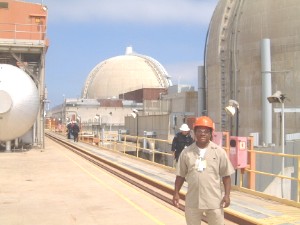
| Norris McDonald at SONGS on July 6, 2005 |
We support NRC's prudence and know that the agency will not allow restart until it is satisfied the licensee can operate the plant without undue risk to public health and safety. Edison has proposed re-starting San Onofre’s Reactor 2 at 70 percent power for five months. We believe this is a prudent proposal and NRC should allow it. We believe the licensee will shut down again if there is a problem because their principle concern is the safety of the public. This safeguard assures public safety and health. The NRC should complete its technical evaluation and render a decision to restart Unit 2 in May.
We also
believe the licensee will complete its CAL actions for Unit 3 and that unit
should be restarted as soon as possible.
The licensee shut down immediately upon
detecting one of the Unit 3 generators was leaking and causing a tiny, but
measurable increase in the radioactivity of the normally non-radioactive water
in the secondary (steam) side of the steam generators. The licensee also
reported the leak incident to the NRC.
Subsequent repairs and tube plugging have been completed and all of
NRC's additional information requests have been, or are being, satisfied. SONGS
has been shut down for too long and the NRC should take immediate steps to
allow the licensee to restart both units.
Chino Hills Obstruction of the Tehachapi Renewable Transmission Project
The Center supports the timely completion of the Tehachapi Renewable Transmission Project (TRTP). The
California Public Utility Commission (CPUC) should reject the Chino Hills
underground transmission line proposal.
The Center opposes undergrounding the Chino Hills section of the line because it is an unnecessary alteration of an already approved plan.
The
Center is particularly concerned about threats to a project that provides
emission free electricity to Californians.
The California Renewable Portfolio Standard (RPS) program
requires investor-owned utilities, electric service providers, and community
choice aggregators to increase procurement from eligible renewable energy
resources to 33% of total procurement by 2020. California
ratepayers do not need the significant increase in the cost of the transmission
line simply to appease the aesthetic requirements of some stakeholders.
The
underground proposal undermines the CPUC's approval of the Alta Wind Power
Project in the Tehachapi area, one of the largest wind energy contracts in the
United States. The underground proposal
is also unacceptable because 12 of 16 transmission structures have already been
completed as part of the approved overhead position in the existing utility
right-of-way corridor.
TRTP CPUC Order To Analyze Underground Options in Chino Hills
Tehachapi Renewable Transmission Project (TRTP)
Overview of TRTP Segments 4-11
and
CPUC Order to Analyze Underground Options in Chino Hills
Project Overview:
TRTP Segments 4-11 consist of new and upgraded electrical transmission facilities spanning approximately 173 miles and are being constructed to deliver up to 4,500 megawatts of renewable energy, enough capacity to power three million homes.
(TRTP Segments 1-3 were approved by the CPUC in March 2007 and construction is now complete).
The project traverses over 20 communities and three counties.
It is the first major transmission project in California being constructed specifically to access multiple renewable generators in a remote, renewable-rich resource area.
TRTP 4-11 was approved in December 2009, after two years of review and analysis by the California Public Utilities Commission (CPUC) and its team of environmental consultants.
| Project Timeline: Fall 2009 |
CPUC approves TRTP 4-11 after a two-year licensing phase |
| Spring 2010 | Construction of TRTP 4-11 begins |
| Winter 2012-13 | Segments 4, 5 and 10 completed |
| Fall 2013 | Segment 6 expected to be completed |
| Winter 2015 | Expected project completion |
CPUC Order to Analyze Underground Options in Chino Hills
Currently the CPUC is considering whether or not the portion of TRTP within Chino Hills should be placed undergrounded instead of the already-approved overhead configuration.
The underground options being considered would cost approximately $540-$893 million* for the 3.5 mile area in Chino Hills, which is $370–$723 million more than the approved overhead portion in Chino Hills. These additional costs would likely impact ratepayers throughout California.
In the area considered for an underground option, 12 of 16 transmission structures have already been completed as part of the approved overhead position in the existing utility right-of-way corridor (the completed and partially-completed structures would need to be demolished and removed if the CPUC orders an underground option).
SCE’s cost and schedule estimates are based on optimistic scenarios. If SCE is ordered by the CPUC to underground TRTP in Chino Hills and delays are encountered, the operational date of TRTP could be pushed beyond the goal of 2015 and increase the total cost beyond estimates.
The CPUC issued a decision allowing SCE to recover as much as $33 million in pre-construction costs it would incur before the CPUC makes a final decision on whether to proceed with an underground option in Chino Hills. (SCE)
*Based upon SCE underground testimony served on 12/3/2012
**Based upon SCE rate recovery testimony served on 1/17/2013
City of Chino Hills Objections:
The map to the left depicts the SCE proposed route (Segment 8A) that would travel right through the heart of Chino Hills as part of the Tehachapi Renewable Transmission Project (TRTP). While all Californians recognize the need for renewable energy (and the corresponding infrastructure), there is concern over a section of the chosen route’s proximity to homes, schools, and parks. Community concerns are widespread and range from health and safety issues to aesthetics, noise, and property value impacts.
Chief among the concerns are the following:
A 3-mile portion of the TRTP would consist of double circuit 500 kV transmission lines that would be located within 500 feet of more than 1,000 homes, directly affecting approximately 3,500 people in Chino Hills. In some areas, new 198-foot towers would be located as close as 40 feet from residents’ backyards.
Existing single circuit 220kV transmission lines on the 3-mile portion have been largely inactive for the past 30 years. Transmission towers that now rise 98 feet and are currently no closer than 50 feet from property boundaries. (City of Chino Hills)
Oil Spills On Railroad Tracks
As energy companies have turned to trains to move crude fromNorth American oil fields not adequately served by pipelines, railroad-related incidents have risen sharply in the past few years, according to federal data. From 2010 to 2012, 112 oil spills were reported from U.S. rail tanker cars, up from just 10 in the previous three years, according to the Pipeline and Hazardous Materials Safety Administration, a part of the Department of Transportation that tracks most releases of hazardous materials.
Pipelines carry much more crude than trains and have fewer leaks per mile, though failures can be serious. In 2010, for example, an Exxon Mobil Corporation pipeline spilled 1,500 barrels of oil into Montana's Yellowstone River in an hour. The possibility of oil spills from derailments is only beginning to be on the public's radar.
Derailments, which are typically the cause of the largest rail spills, are down significantly in recent decades as railroads have beefed up monitoring the condition of equipment and the integrity of rail lines, according to BNSF Railway, which has become the largest shipper of crude via rail. In addition to regularly inspecting cars for leaks, BNSF also employs its own hazardous-materials response teams.
From 2008 to 2012, daily U.S. oil production has grown to an average of 6.5 million barrels, its highest level in more than 15 years, according to the Energy Information Administration. It is expected to grow to 7.3 million barrels a day this year and to 7.9 million barrels in 2014.
The surge comes thanks to a combination of technologies—horizontal drilling and hydraulic fracturing, or fracking, which involves pumping water, chemicals and sand down wells to break up rock formations. The increased production, much of which has occurred in remote areas of North Dakota and South Texas, has outpaced the ability of companies to build new pipelines or expand existing ones to move the oil to refineries.
Historically, railways have spilled more oil on a gallons-per-mile basis than pipelines, according to several studies. One 2009 analysis of oil spills between 1980 and 2003 done for the American Petroleum Institute by Environmental Research Consulting found 80 out of every 1 billion gallons transported via rail spilled, compared to 38 out of every 1 billion gallons transported via pipeline. (WSJ, 3/27/2013)
Pipelines carry much more crude than trains and have fewer leaks per mile, though failures can be serious. In 2010, for example, an Exxon Mobil Corporation pipeline spilled 1,500 barrels of oil into Montana's Yellowstone River in an hour. The possibility of oil spills from derailments is only beginning to be on the public's radar.

Energy companies typically foot the cleanup bills. The railroad industry says the amount of oil spilled is tiny compared to the volume of oil transported by the U.S. rail system, which has surged from 9,500 carloads in 2008, the year widely seen as the beginning of the current oil boom, to 233,811 carloads in 2012, according to the Association of American Railroads.
From 2008 to 2012, daily U.S. oil production has grown to an average of 6.5 million barrels, its highest level in more than 15 years, according to the Energy Information Administration. It is expected to grow to 7.3 million barrels a day this year and to 7.9 million barrels in 2014.
The surge comes thanks to a combination of technologies—horizontal drilling and hydraulic fracturing, or fracking, which involves pumping water, chemicals and sand down wells to break up rock formations. The increased production, much of which has occurred in remote areas of North Dakota and South Texas, has outpaced the ability of companies to build new pipelines or expand existing ones to move the oil to refineries.
Historically, railways have spilled more oil on a gallons-per-mile basis than pipelines, according to several studies. One 2009 analysis of oil spills between 1980 and 2003 done for the American Petroleum Institute by Environmental Research Consulting found 80 out of every 1 billion gallons transported via rail spilled, compared to 38 out of every 1 billion gallons transported via pipeline. (WSJ, 3/27/2013)
Wednesday, March 27, 2013
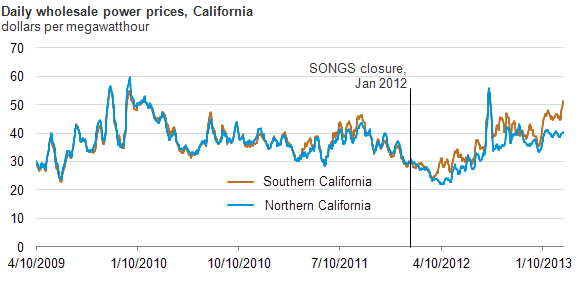
SONGS Extended Outage Raising Southern California Electricity Rates

Note: Day-ahead, on-peak power prices from the California
Independent System Operator
for the SP-15 (Southern California) and NP-15
(Northern California) hubs.
Daily prices are averaged on a rolling 10-day period
to reduce apparent
volatility and make the persistent difference between the two
prices more visible.
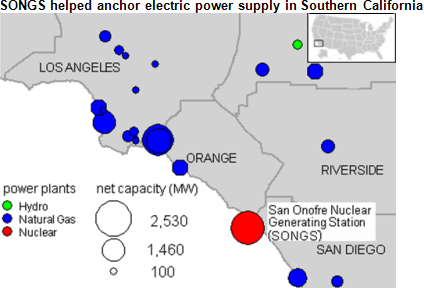
The outages of both units at Southern California Edison's San Onofre Nuclear Generating Station (SONGS), starting in January 2012, have created a persistent spread in wholesale power prices between Northern and Southern California.
Historically, wholesale power prices for Northern and Southern California tracked closely with one another, indicating minimal market differences between the two areas. However, after the shutdown of SONGS in early 2012, the relatively inexpensive nuclear generation produced by SONGS had to be replaced with power from more expensive sources. Consequently, since April 2012 Southern California power prices have persistently exceeded Northern California prices, with the spread averaging $4.15/MWh, or 12% of the Northern California price.
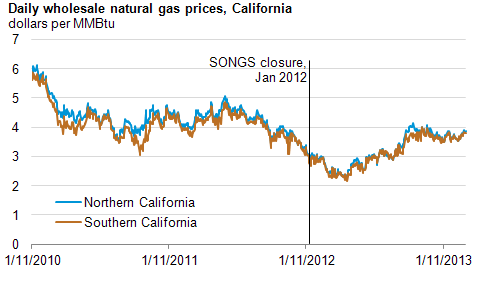
Relative differences in natural gas prices do not seem to be driving the gap between Northern and Southern California power prices (see chart below). Although SoCal Citygate spot natural gas prices have increased slightly compared to the northern PG&E Citygate, this difference accounts for less than $1 per megawatthour of the average change in the wholesale power price in Southern California.
Thus, higher wholesale power prices in Southern California more likely are attributable to the need for more-expensive generation in that region to fill the shortage. To ensure electric reliability in the densely populated Los Angeles and San Diego regions, Southern California needs to use local generation sources and cannot solely rely on imported electricity to replace generation from SONGS. The major nearby alternative sources, however, are more expensive, and seem to be contributing to higher wholesale power prices.
Note: Daily spot wholesale natural gas prices for Pacific Gas
& Electric hub
(Northern California) and Southern California Edison Citygate
(Southern California).
In 2012, the continuing SONGS closure put pressure on the electric power grid operator, the California Independent System Operator (CAISO), to adjust both generation and transmission in order to meet summer demand for electricity, and in general, continues to change the generation profile in the area.
In a recent filing with the Federal Energy Regulatory Commission, CAISO requested changes to a transmission constraint rule in an attempt to resolve transmission congestion that is contributing to higher prices. The proposed change would reduce the price point at which CAISO relaxes a transmission operating limit and allows more electricity to flow.
Southern California Edison released an operational assessment on March 14 for restarting SONGS unit 2; the restart requires the approval of the Nuclear Regulatory Commission (NRC). The NRC is holding public meetings and conducting a technical evaluation of restarting this unit and has tentatively scheduled a decision for some time after May 2013. (DOE-EIA)
International Monetary Fund Wants To Reform Energy Subsidies
January 28, 2013 (Report Release Date)
EXECUTIVE SUMMARY
While aimed at protecting consumers, subsidies aggravate fiscal imbalances, crowd-out priority public spending, and depress private investment, including in the energy sector. Subsidies also distort resource allocation by encouraging excessive energy consumption, artificially promoting capital-intensive industries, reducing incentives for investment in renewable energy, and accelerating the depletion of natural resources. Most subsidy benefits are captured by higher-income households, reinforcing inequality. Even future generations are affected through the damaging effects of increased energy consumption on global warming. This paper provides: (i) the most comprehensive estimates of energy subsidies currently available for 176 countries; and (ii) an analysis of ―how to do‖ energy subsidy reform, drawing on insights from 22 country case studies undertaken by IMF staff and analyses carried out by other institutions.
Energy subsidies are pervasive and impose substantial fiscal and economic costs in most regions.
On a ―pre-tax‖ basis, subsidies for petroleum products, electricity, natural gas, and coal reached $480 billion in 2011 (0.7 percent of global GDP or 2 percent of total government revenues). The cost of subsidies is especially acute in oil exporters, which account for about two-thirds of the total. On a ―post-tax‖ basis—which also factors in the negative externalities from energy consumption—subsidies are much higher at $1.9 trillion (2½ percent of global GDP or 8 percent of total government revenues). The advanced economies account for about 40 percent of the global post-tax total, while oil exporters account for about one-third. Removing these subsidies could lead to a 13 percent decline in CO2 emissions and generate positive spillover effects by reducing global energy demand.
Country experiences suggest there are six key elements for subsidy reform.
These are: (i) a comprehensive energy sector reform plan entailing clear long-term objectives, analysis of the impact of reforms, and consultation with stakeholders; (ii) an extensive communications strategy, supported by improvements in transparency, such as the dissemination of information on the magnitude of subsidies and the recording of subsidies in the budget; (iii) appropriately phased price increases, which can be sequenced differently across energy products; (iv) improving the efficiency of state-owned enterprises to reduce producer subsidies; (v) targeted measures to protect the poor; and (vi) institutional reforms that depoliticize energy pricing, such as the introduction of automatic pricing mechanisms. (IMF)
California Renewables Portfolio Standard (RPS)
Established in 2002 under Senate Bill 1078, accelerated in 2006 under Senate Bill 107 and expanded in 2011 under Senate Bill 2, California's Renewables Portfolio Standard (RPS) is one of the most ambitious renewable energy standards in the country. The RPS program requires investor-owned utilities, electric service providers, and community choice aggregators to increase procurement from eligible renewable energy resources to 33% of total procurement by 2020.

In the ongoing effort to codify the ambitious 33 percent by 2020 goal, Senate Bill X1-2 was signed by Governor Edmund G. Brown, Jr., in April 2011. This new RPS preempts the California Air Resources Boards' 33 percent Renewable Electricity Standard and applies to all electricity retailers in the state including publicly owned utilities (POUs), investor-owned utilities, electricity service providers, and community choice aggregators. All of these entities must adopt the new RPS goals of 20 percent of retails sales from renewables by the end of 2013, 25 percent by the end of 2016, and the 33 percent requirement being met by the end of 2020. (California Public Utilities Commission, California Energy Commission)
The California Public Utilities Commission (CPUC) and the California Energy Commission jointly implement the RPS program. The CPUC's responsibilities include:
- Determining annual procurement targets and enforcing compliance.
- Reviewing and approving each IOU's renewable energy procurement plan.
- Reviewing IOU contracts for RPS-eligible energy.
- Establishing the standard terms and conditions used by IOUs in their contracts for eligible renewable energy.

- Certify renewable facilities as eligible for the RPS.
- Design and implement a tracking and verification system to ensure that renewable energy output is counted only once for the purpose of the RPS and for verifying retail product claims in California or other states.
- Directs the Energy Commission to adopt regulations specifying procedures for enforcement of the RPS for publicly owned utilities.
- Requires the Energy Commission to certify and verify eligible renewable energy resources procured by publicly owned utilities and to monitor their compliance with the RPS. The Energy Commission will continue to certify and verify RPS procurements by retail sellers.
- The Energy Commission refers the failure of a publicly owned utility to comply to the Air Resources Board, which may impose penalties.
In the ongoing effort to codify the ambitious 33 percent by 2020 goal, Senate Bill X1-2 was signed by Governor Edmund G. Brown, Jr., in April 2011. This new RPS preempts the California Air Resources Boards' 33 percent Renewable Electricity Standard and applies to all electricity retailers in the state including publicly owned utilities (POUs), investor-owned utilities, electricity service providers, and community choice aggregators. All of these entities must adopt the new RPS goals of 20 percent of retails sales from renewables by the end of 2013, 25 percent by the end of 2016, and the 33 percent requirement being met by the end of 2020. (California Public Utilities Commission, California Energy Commission)
Tehachapi Renewable Transmission Project
Formerly Antelope Valley
In order to increase its ability to deliver this renewable wind energy to customers, SCE must upgrade its transmission lines and substations south of the Tehachapi Wind Resource Area by constructing the TRTP. These upgrades are also necessary to serve Southern California’s overall growing demand for electricity. (Southern California Edison, IQRA Associates)
Read the CPUC Project Approval
Read the Project EIR (Environmental Impact Report)
TRTP Segments 1-3
TRTP Segments 4-11
Southern California Edison’s Tehachapi Renewable Transmission Project (TRTP) is the first major transmission project in California being constructed specifically to access multiple renewable generators in a remote renewable-rich resource area. Segments 4 to 11 include new and upgraded electric transmission lines and substations between eastern Kern County and San Bernardino County.
A series of new and upgraded transmission facilities equaling 250 miles (spanning an area of approximately 173 miles) is being built to deliver electricity from renewable wind energy generators in Kern County south through Los Angeles County and east to the existing Mira Loma Substation in Ontario, San Bernardino County.
California’s demand for electricity continues to grow. So too does its demand for electricity produced
by renewable power sources such as wind. The Tehachapi Renewable Transmission Project, which would interconnect renewable wind energy to the existing electric system, would help meet an important state requirement concerning renewable resources. State law requires that at least 33 percent of the electricity SCE delivers to customers be produced by renewable sources by 2020. New and modified transmission facilities are needed to help the state meet that target. TRTP can help meet these targets.
A series of new and upgraded transmission facilities equaling 250 miles (spanning an area of approximately 173 miles) is being built to deliver electricity from renewable wind energy generators in Kern County south through Los Angeles County and east to the existing Mira Loma Substation in Ontario, San Bernardino County.
California’s demand for electricity continues to grow. So too does its demand for electricity produced
by renewable power sources such as wind. The Tehachapi Renewable Transmission Project, which would interconnect renewable wind energy to the existing electric system, would help meet an important state requirement concerning renewable resources. State law requires that at least 33 percent of the electricity SCE delivers to customers be produced by renewable sources by 2020. New and modified transmission facilities are needed to help the state meet that target. TRTP can help meet these targets.
Currently, energy developers are planning new “wind farms” in an area of Kern County referred to as the “Tehachapi Wind Resource Area” that would help meet the demand for more renewable power. Although SCE does not have an ownership interest in any of the proposed wind farms, SCE is required to construct extensions of its transmission system to these proposed wind farms so that wind power can be delivered into the state’s energy grid.
In order to increase its ability to deliver this renewable wind energy to customers, SCE must upgrade its transmission lines and substations south of the Tehachapi Wind Resource Area by constructing the TRTP. These upgrades are also necessary to serve Southern California’s overall growing demand for electricity. (Southern California Edison, IQRA Associates)
Read the CPUC Project Approval
Read the Project EIR (Environmental Impact Report)
Current Project Activities
TRTP Segments 1-3
TRTP Segments 4-11
Tuesday, March 26, 2013
Center for Sustainable Shale Development
The Center for Sustainable Shale Development (CSSD), spearheaded by the Heinz Endowments, is a coalition of industry and environmental and philanthropic groups offering a voluntary certification process to make hydraulic fracturing, or fracking, less damaging to the environment and less risky to human health.
Based in Pittsburgh, Pennsylvania, the Center for Sustainable Shale Development (CSSD) is an independent organization whose mission is to support continuous improvement and innovative practices through performance standards and third-party certification. Focused on shale development in the Appalachian Basin, the Center provides a forum for a diverse group of stakeholders to share expertise with the common objective of developing solutions and serving as the center of excellence for shale gas development.
The result of this unique collaboration: the development of rigorous performance standards for sustainable shale development and a commitment to continuous improvement to ensure safe and environmentally responsible development of our abundant shale resources. CSSD will offer an independent, third-party evaluation process to certify companies that achieve and maintain these standards.
Funded by philanthropic foundations and participating energy companies, CSSD is intended to promote collaborative efforts by industry and its stakeholders called for by the Shale Gas Production Subcommittee of the U.S. Secretary of Energy’s Advisory Board.
Board of Directors
- Armond Cohen, Executive Director, Clean Air Task Force
- Jared Cohon, President, Carnegie Mellon University
- Nicholas J. DeIuliis, President, CONSOL Energy
- Paul Goodfellow, Vice President, U.S. Unconventionals, Shell
- Paul King, President, Pennsylvania Environmental Council
- Fred Krupp, Executive Director, Environmental Defense Fund
- Jane C.S. Long, formerly with Lawrence Livermore National Laboratory
- Bruce Niemeyer, President, Chevron Appalachia
- Paul O’Neill, former Secretary of the Treasury Department and retired Chairman and CEO, Alcoa
- David Porges, President and CEO, EQT
- Robert Vagt, President, The Heinz Endowments (Chair)
- Christine Todd Whitman, President, The Whitman Strategy Group; former Governor of New Jersey and Administrator of the EPA
- Andrew Place, President
- Daniel Clearfield, Secretary and Treasurer
625 Liberty Avenue | Suite 395
Pittsburgh, PA 15222
412.804.4170
Andrew Place – Interim Director | andrew.place@sustainableshale.org
Faye Miller – Assistant to the Director | faye.miller@sustainableshale.org
Subscribe to:
Posts (Atom)