Monday, November 19, 2012

Fracking Water Recycling

Companies Are Recycling Hydraulic Fracturing Water

Energy companies are also struggling with how to get rid of the tainted water that comes out of fractured wells; the fluid, which contains a mix of chemicals and salts, must be taken to a licensed disposal facility.

Energy industry giants Hallibrton Corporation and Schlumberger Ltd. to smaller outfits such as Ecologix Environmental Systems LLC, companies are pursing technologies to reuse the "frack water" that comes out of wells after hydraulic fracturing, or "fracking"—the process of using highly pressured water and chemicals to coax oil and gas out of shale-rock formations. The interest in water recycling is also creating opportunities for small companies such as Select Energy Services LLC. Ecologix, an Alpharetta, Ga., recycling company, claims its service can cost as much as 80% less than injecting wastewater into a disposal well.

The recycled water can be cleaned of chemicals and rock debris and reused to frack additional wells, which could sharply cut the costs that energy companies face securing and disposing of water. Some companies are finding it is still cheaper in many parts of the U.S. to inject the wastewater deep underground instead of cleaning it, which has slowed adoption of recycling technology.

It takes between 70 billion to 140 billion gallons of water to frack 35,000 wells a year, the industry's current pace, according to a 2011 report by the Environmental Protection Agency. That is about the same amount consumed every year by Chicago or Houston—and the price tag for securing that much water can be substantial.

Click on Image to Enlarge


Companies are researching moving away from using water entirely to fracture rock, with efforts aimed at using propane gel and even compressed air. Moving away from liquids entirely, however, is still several years away—if early laboratory work can be successfully applied in the field.

While the cost of getting rid of the millions of gallons varies from state to state, it can be substantial. There are less than 10 working injection wells in Pennsylvania, so most of its wastewater is carried by trucks into Ohio.  These injection wells are controversial after being linked by some scientists and state officials to minor earthquakes. The injected liquids are essentially thought to lubricate faults and accelerate movement that causes tremors. Ohio only recently began issuing permits for new injection wells, after imposing rules to prevent tremors.

In the Northeast, oil companies have to pay up to $8 per 42-gallon barrel to contractors to haul wastewater for disposal elsewhere. Operators have reported recycling—which eliminates the cost of disposal and the cost of acquiring fresh water for fracking—can cut costs by as much as $2 per barrel in some areas when done on site, which could equate to a $200,000 savings over the lifetime of a typical well.

Chesapeake Energy Corporation has begun recycling 100% of the water it retrieves from wells in northern Pennsylvania. In addition to cutting the company's costs, recycling reduces the number of trucks on the road ferrying clean water to drilling sites, a sore point for local residents.

After a well is fracked, contractors typically clean the water that flows back out of the well by filtering it or adding a chemical that attracts small solid particles, making it easier to remove these contaminants. Some companies treat water at the well, while others bring it to a facility built nearby.
Fourteen percent of water used to frack a well in central Pennsylvania is now recycled, up from less than 1% two years ago, according to the Susquehanna River Basin Commission, which monitors water usage. (WSJ, 1/18/2012)      

EPA Expected To Issue New & Revised Air Rules

EPA will be pursuing new and revised air pollution control regulations in President Obama's second term.

EPA

Revised Boiler MACT Rule

EPA is expected to release revisions to its control standards for hazardous air emissions from industrial boilers and process heaters. This rule was adopted in 2011 under requirements of the 1990 amendments to the Clean Air Act. It directs EPA to collect information on the best performing sources in each category and to determine the “maximum achievable control technology” (MACT) for each category’s new and existing sources. It set an aggressive schedule for these new rules, requiring EPA to adopt emissions standards for all of the source categories on the initial list within 10 years.

In March 2011, EPA adopted a MACT standard for new and existing large industrial boilers and process heaters, setting limits on emissions of mercury, dioxin, particulate matter, hydrogen chloride and carbon monoxide, applicable to boilers burning coal, fuel oil, natural gas, or biomass. Across the country, the rule applies to about 14,000 boilers and heaters at refineries, pulp and lumber mills, smelters, chemical manufacturers, auto and machine parts makers, glass makers, and other industrial operations, as well as large institutional facilities, like universities and hospitals. The rule also set limits on mercury and carbon dioxide emissions from smaller boilers, but only if they burn coal. The March 2011 version of Boiler MACT was just the latest attempt by EPA to set standards for emissions of hazardous air pollutants from industrial boilers and process heaters. EPA adopted a MACT standard for this source category in 2004, which was struck down by the courts in 2007.
The 2011 version of Boiler MACT proved just as controversial, and EPA responded to that controversy immediately. In the same Federal Register issue in which the final version of the rule was published, EPA also announced that it intended to reconsider fourteen specific issues related to the rule, and to take additional comment on those issues.[8]EPA received dozens of petitions to reconsider various aspects of the rule, and it was challenged in court. EPA’s reconsideration of the rule is now drawing to a close, and the Agency is expected to issue its final revisions to the rule before the end of the year. Further legal challenges almost certainly will follow.
In December 2011, EPA issued proposed changes to the Boiler MACT rule and invited comment on whether it should further revise a number of provisions of the rule, including whether several emission limits should be changed based on newly-provided data, whether EPA should draw additional distinctions between different types of boilers, whether to change certain tune up and work practice requirements, and whether to revise monitoring requirements. After considering further comments, EPA sent its final rule revisions to the White House for review last May. Clearance to issue the final rule is expected before the end of the year.

New Source Performance Standards for Power Plants and Refineries

EPA will also continue to develop two new rules addressing greenhouse gas emissions from power plants and petroleum refineries under the Clean Air Act’s New Source Performance Standards (NSPS) program. Under the NSPS program, EPA is required to establish performance standards for various categories of new and modified stationary sources.

The proposed rule would require coal- and natural gas-fired power plants to emit no more than 1,000 pounds per megawatt-hour of carbon dioxide – a standard that would effectively prohibit the construction of new coat-fired power plants unless they deploy carbon capture and sequestration (CCS) technology.

The Clean Air Act defines a “new source” as a source that has not yet begun construction by the date of a proposed NSPS rule, which in the case of the power plant NSPS is April 13, 2012.
The timing on the NSPS rules for refineries is less certain. Refineries will likely be subject to new greenhouse gas requirements by the end of President Obama’s second term.

Mercury and Air Toxics Standards for Power Plants
In December 2011, EPA finalized a controversial new rule – referred to as the Mercury and Air Toxics Rule (MATS) or Utility MACT – designed to reduce the emission of mercury and other toxic air pollutants from coal- and oil-fired power plants. EPA, however, subsequently agreed to reconsider the rule. Like Boiler MACT, this rule arises under section 112 of the Clean Air Act. The reconsideration process should be completed by March 2013.

EPA’s Utility MACT standard set aggressive numeric emissions limits for mercury, filterable particulate matter (as a surrogate for toxic metals), and hydrogen chloride (as a surrogate for acid gases). Coal-fired plants subject to the new rules generate about 45 percent of the nation’s electric power, and make up a higher percentage in some regions. The rules also apply to oil-fired plants, which generate about 1 percent of the nation’s electricity. EPA claims the new rules will reduce mercury emissions by 90 percent, acid gas emissions by 88 percent, and cut SO2 another 41 percent beyond reductions expected under the Cross State Air Pollution Rule.

Cross State Air Pollution Rule

EPA’s efforts to regulate the interstate transport of air pollution from power plants also remain in flux. In August 2012, the D.C. Circuit rejected EPA’s Cross State Air Pollution Rule (CSAPR or Transport Rule), which restricted air emissions from power plants in “upwind” states that resulted in air quality exceedances in “downwind” states. See D.C. Circuit Strikes Down EPA Cross-State Air Pollution Rules (Again), Marten Law Environmental News (Sept. 25, 2012). The Transport Rule was drafted to fix deficiencies in a 2005 rule (the Clean Air Interstate Rule or CAIR) that was struck down by the same court in 2008. The court found that the Transport Rule contained flaws similar to those in CAIR – namely, that the rule would, based on cost considerations, require certain upwind states to reduce in-state emissions by more than the amount of their actual contribution to air quality exceedances in downwind states. The court also rejected EPA’s decision to impose federal compliance plans (federal implementation plans or FIPS) on the states without first providing the states with an opportunity to develop state-level compliance plans (state implementation plans or SIPs).
The court vacated the Transport Rule and remanded the matter back to EPA. In the meantime, the court instructed EPA to continue implementing CAIR while the agency develops a replacement rule. The time period for seeking Supreme Court review will not begin to run until the court resolves EPA’s request for reconsideration.

Updating Ambient Standards for Particulates
Diesel engines and other combustion sources (which power not only motor vehicles, industrial facilities and electric power plants, but also wood stoves) are the main sources of soot and other fine particles in the ambient air. EPA classifies these pollutants as fine particulate matter, commonly referred to as PM-2.5, meaning particulate matter smaller than 2.5 microns.
On June 29, 2012, EPA proposed lowering the annual ambient air quality standard for PM-2.5 to a level between 12 and 13 micrograms per cubic meter (ug/m3). The current annual standard of 15 ug/m3 has been in place since 1997. EPA proposed to leave the existing 24-hour standard of 35 ug/m3 unchanged. EPA also invited comment on whether annual standard should be lowered further, to 11 ug/m3. The Agency is under a court-ordered deadline to finalize the PM-2.5 standards by December 14, 2012 (the Clean Air Act requires EPA to review ambient standards at least every five years).
Updating Ambient Standards for Ozone
In September, 2011, EPA submitted a proposed rule to OMB that would make the ambient air quality standard for ozone more stringent. After fairly intense lobbying from the business community, President Obama sent the standard back to EPA and told the Agency to update its review of the relevant science and come back to him with an updated proposal in two years.[18] See S. Brandt-Erichsen, Obama Administration Withdraws Proposed Ozone Standard, Marten Law News (Sept. 6, 2011). EPA has since been conducting its science review, and is expected to begin moving forward with an update to the ozone ambient standard in 2013, although final adoption may not occur until 2014.
Ozone is the primary constituent of smog. Sunlight and hot weather cause ozone to form in the lower atmosphere through a chemical reaction between nitrogen oxides and volatile organic compounds. The burning of hydrocarbons – as fuel for cars, power plants, and industrial facilities – is the most significant source of these precursors to ozone. (Marten Law)

RGGI Investments Avoid 12 Tons of CO2

Generates $1.3 Billion in Lifetime Energy Bill SavingThe Regional Greenhouse Gas Initiative (RGGI) states today released a report summarizing the consumer, economic, and environmental impact of investments made using proceeds from RGGI’s CO2 allowance auctions. The report analyzed the lifetime impact of RGGI investments made from 2009 to 2011 in the nine RGGI states – Connecticut, Delaware, Maine, Maryland, Massachusetts, New Hampshire, New York, Rhode Island, and Vermont.
 
The report, Regional Investment of RGGI CO2 Allowance Proceeds, 2011 [Full Report and Executive Summary] estimates that RGGI investments will offset the need for more than 27 million megawatt hours of electricity generation and 26.7 million British Thermal Units (BTUs) of energy generation. This savings will help avoid the emission of 12 million short tons of carbon dioxide pollution, an amount equivalent to taking 2 million passenger vehicles off the road for one year.
 
In addition to their environmental impact, RGGI investments have also had a positive impact on consumer energy bills and the regional clean energy economy. The report found that, from 2009 to 2011, RGGI investments:

  • Directly benefited 2.9 million households and 7,400 businesses.
  • Generated an estimated $1.3 billion in lifetime energy bill savings for utility customers.
  • Channeled over $617 million into the region’s clean energy economy.
  • Returned $69 million in bill credits to an estimated 84,000 low-income families.
  • Helped an estimated 2,400 workers secure training in clean energy job skills.
Making an Impact
 
The report analyzes $617 million in RGGI investments from 2009 to 2011 across four main categories: energy efficiency, clean and renewable energy, direct energy bill assistance, and greenhouse gas abatement and climate change adaptation. Key findings include:
  • States in the region directed 66% of their RGGI investments to energy efficiency, 5% to clean and renewable energy, 17% to direct energy bill assistance, and 6% to greenhouse gas abatement and climate change adaptation programs.
  • RGGI investments in energy efficiency have already offset the need for over 1.6 million MWhs of electricity generation and are expected to offset the lifetime need for a total of almost 22 million MWhs of electricity generation.
  • RGGI investments in renewable energy have helped avoid the need for over 178,000 MWhs of electricity generation to date, and are expected to help avoid the need for over 2.9 million MWhs of electricity over their lifetime.
  • RGGI investments have reduced energy costs for 2.9 million households and businesses, realized through ratepayer savings of $204 million to date and $1.3 in savings estimated over the programs’ lifetime.
The Full Report and Executive Summary are now available.

Saturday, November 17, 2012

National Fish and Wildlife Foundation

The National Fish and Wildlife Foundation operated on a modest budget  for nearly three decades. Over the next five years, BP will give the foundation nearly $2.4 billion as part of the the $4 billion settlement with the Justice Department announced Thursday stemming from BP’s disastrous 2010 Gulf of Mexico oil spill.

The foundation — created in 1984 by Senate Republicans seeking new ways to muster conservation funding in the face of Reagan administration budget cuts — is not an environmental advocacy organization. It receives an annual appropriation of about $15 million from the government, along with other federal grants totaling as much as $45 million, and solicits donations of about $16 million a year from private donors and corporations including Wal-Mart, Shell, Southern Co. and the American Petroleum Institute. In its 28-year history, it has been responsible for $2.1 billion in conservation projects around the country, from acoustic monitoring of marine mammals in the Arctic to restoring fish habitat in the Ozarks. The next five years will more than double that figure.

The foundation oversees environmental grants and contracts totaling $75 million to $100 million a year, working with state and federal agencies as well as scientists, environmental groups and landowners to address threats to fish, wildlife and the habitat on which these animals depend.

The money BP will hand over in the course of five years has strings: The Justice Department, which made the decision to put the foundation in charge of the money, included language in the settlement agreement regarding how it will be spent. Half will go to restoring Louisiana’s barrier islands and coastal habitat; the other half will be divided among Alabama, Florida, Mississippi and Texas, with the first three states getting equal shares and Texas 16 percent. (Wash Post, 11/16/2012)

BP Criminal & Civil Penalties

Criminal Penalties

With BP's agreement on Thursday to plead guilty to 14 criminal charges and pay $4.5 billion in fines and other payments in connection with its 2010  in the Gulf of Mexico, Gulf Coast politicians are now eyeing a much bigger potential windfall from the company: $20 billion or more in civil pollution penalties for the spill. But the negotiations over those penalties — including which states get the money, how quickly, and what it can be used for — could be more contentious than the talks that led to the criminal settlement.

Under the criminal settlement, $2.4 billion paid by BP will go to environmental restoration, overseen by the National Fish and Wildlife Foundation, a nonprofit organization created by Congress. Projects in Louisiana will get half the money, and the rest will be split among the other gulf states — Florida, Alabama, Mississippi and Texas.

Civil Penalties

 There are two significant varieties of civil remedies to come from the spill:

1) penalties under the Clean Water Act and

2) claims under the Natural Resources Damage Assessment.

Under the Natural Resources Damage Assessment process, which arose out of the Oil Pollution Act of 1990, state and federal agencies total the environmental harm caused by the spill and send the responsible party a bill. All the money is administered by federal agencies and must be spent on environmental recovery. And the penalties, which could run in the tens of billions of dollars in the BP case, are tax-deductible for the polluter.

Payments under this process are directly tied to environmental damages, so a related BP settlement would benefit Louisiana the most, since that state experienced and continues to experience the worst of the spill. For this reason, Under N.R.D.A., 100 percent of the money goes to the gulf for recovery. The drawback is that the assessment can take years, and must be arrived at through findings by different scientists, which can vary widely. The Clean Water Act calls for a penalty based on the number of barrels spilled, with much higher damages to be awarded if the polluter is found to have been grossly negligent in causing the spill. In the past, the money from these penalties, which in the BP case could add up to $21 billion, would go to the United States Treasury.

But in June, Congress passed a law, called the Restore Act, which directed that four-fifths of the penalty money in the BP spill be divided up among the gulf states, to be spent mostly outside federal control.
The passage of the Restore Act required quite a bit of horse trading, particularly in a Congress not known for demonstrations of bipartisanship.

Of the money that goes to the gulf states, 35 percent would be divided evenly among them. About 30 percent of the funds would be divided based on the extent of damage, and another 30 percent would go to creating and carrying out a comprehensive master plan covering the entire Gulf Coast. The other compromise involved what the money could be spent on. (NYT, 11/16/2012)

Thursday, November 15, 2012

Calif Air Board Accepts Federal Vehicle CO2 Standard

The California Air Resources Board today approved an amendment allowing compliance with national greenhouse gas emissions regulations for passenger vehicles to qualify for compliance under the California's clean car rules.  It is the final step in establishing a single national program to reduce greenhouse gas emissions by increasing vehicle efficiency.

The approved amendment, known as a "deem to comply" measure, acknowledges that the federal vehicle standard satisfies California's requirements.  Approval of the amendment marks the fulfillment of a commitment California made in the summer of 2011 to auto manufacturers and the Obama administration to accept the proposed federal standards as equivalent to its own.

The greenhouse gas standards under the California Low Emission Vehicle (LEV III) standard, like the federal program, will be in effect for the 2017 through 2025 model years and are designed to reduce greenhouse gas emissions by 35 percent over that period.

Many of the technologies that reduce climate change and tailpipe emissions also significantly improve fuel economy, which will result in these cleaner cars costing less to operate than today's cars.

The full package of California regulations, including tailpipe standards for smog-causing pollution and a mandate for specific numbers of zero emission vehicles will save California drivers $5 billion dollars in operating costs in 2025, and $10 billion dollars by 2030 when more advanced cars are on the road.

In addition, in 2025, average consumers will see nearly $6,000 in fuel cost savings over the life of the car. Based on typical financing for a new vehicle, savings accrue the minute the car drives off the lot. (CARB)

BP Pleads Guilty To 14 Criminal Counts & $4 Billion Fine

BP has agreed to plead guilty to 14 criminal counts, including manslaughter, and will pay $4 billion over five years in a settlement with the Justice Department over the 2010 oil spill in the Gulf of Mexico, the company and Justice Department announced Thursday.  In addition, the London-based oil giant will pay $525 million over three years to settle claims with the Securities and Exchange Commission, which said the company concealed information from investors.  This marks both the single largest criminal fine in the history of the United States.

Attorney General Eric Holder also announced a separate 23-count criminal indictment — including charges of seaman’s and involuntary manslaughter — against the two top-ranking BP supervisors on the Deepwater Horizon drilling rig where a blowout occurred April 20, 2010, sinking the rig and killing 11 workers. Holder also announced an indictment against David Rainey, a BP vice president, for hiding information from Congress and lying to law enforcement officials about the rate at which oil was gushing into the Gulf of Mexico.

BP said it would increase its existing $38.1 billion charge against earnings for the spill by $3.85 billion.

 
The criminal settlement does not cover federal civil claims, including Clean Water Act claims, federal and state claims of damages to natural resources or private civil claims. Settling those would probably cost BP billions of dollars more, and the company said it is “prepared to vigorously defend itself against remaining civil claims.

The settlement resolves a variety of criminal charges. BP agreed to plead guilty to 11 felony counts of misconduct or neglect of ships’ officers relating to the loss of 11 lives on the drilling rig that caught fire and sank; one misdemeanor count under the Clean Water Act; one misdemeanor count under the Migratory Bird Treaty Act; and one felony count of obstruction of Congress. BP said that the last of those is related to misreporting to a member of Congress the rate at which oil was gushing into the gulf.

So far BP has spent $14 billion responding to and cleaning up the spill. It has also paid out $9 billion mostly to individuals and businesses. Additional private civil claims are being pursued in a separate lawsuit in a New Orleans federal court, where a settlement that BP estimates will cost $7.8 billion is being finalized.

The BP settlement with the Justice Department is not expected to cover other companies involved in the April 20, 2010 accident, including rig owner and operator TransOcean and cement contractor Halliburton. (Wash Post, 11/15/2012

California Auctions Carbon Emissions Permits

California has initiated its program to auction permits to mitigate the release of greenhouse gases. Wednesday's three-hour auction was the first phase of California's cap-and-trade program, the result of a 2006 act that then-Governor Arnold Schwarzenegger signed to reduce the state's greenhouse-gas emissions to 1990 levels by 2020.

California hasn't unveiled a plan for how it will spend the proceeds from what will be quarterly auctions. But with the California Air Resources Board saying it expects the auctions to generate $1 billion in the first year—and $2.8 billion to $11 billion a year by 2015—environmentalists and businesses have plenty of spending ideas.

Meanwhile, the California Chamber of Commerce sued the Air Resources Board Tuesday in Sacramento Superior Court, asking the court to block the auction, which the chamber calls an illegal tax. A spokesman for the air board said it is reviewing the suit and is "confident that the cap-and-trade program will withstand any court challenge."

California's program "caps" the amount of heat-trapping gases that can be emitted by about 600 oil refineries, power plants and other industrial facilities. It offers permits to the facilities to emit up to the established cap at little or no cost in the program's first year, reducing the free allowances over later years.  Facilities that can't abide by the caps can buy permits either at auctions or from companies that have unused permits in a secondary market that will later begin trading. California's auction is similar to a European Union program and the northeastern American program called the Regional Greenhouse Gas Initiative (RGGI).

The auction is conducted on a website where companies or individuals who have previously registered can bid for specific quantities of emission permits at a price above the auction "floor" of $10 a ton of carbon dioxide. Each permit is good for one metric ton of CO2. The permits are sold to the highest bidders first, then in order of lower bids, at the lowest accepted bid, according to the Air Resources Board.

Companies bidding Wednesday included Southern California Edison, a unit of Edison International and San Diego Gas & Electric Co., a unit of sempra Energy. The state next week will announce how many permits were bought and sold Wednesday and at what price.  (WSJ, 11/14/2012)

EDF Receives $6 Million Grant From Bloomberg For Fracking

In August, the Environmental Defense Fund (EDF) was awarded a 3-year, $6-million grant from Bloomberg Philanthropies for its work to minimize the environmental impacts of natural gas operations through hydraulic fracturing. The funding will support EDF's strategy of securing strong rules and developing industry best practices in the 14 states with 85 percent of the country's unconventional gas reserves. Bloomberg Philanthropies is a recognized leader in global environmental efforts and is headed by Michael R. Bloomberg, philanthropist and Mayor of New York City.

The Center has developed Hydraulic Fracturing Evaluation Criteria.

This grant builds on Bloomberg Philanthropies' recent $50 million commitment to the Sierra Club's Beyond Coal Campaign to reduce the number of coal-fired power plants in the U.S. The grant will ensure that EDF has a significant impact on natural gas regulation in the states at the heart of the shale gas boom, where it is critical to get the rules right. Over the next few years, success in those states will determine whether shale gas can be developed as a safe alternative to coal - one that reduces greenhouse gas emissions as well as other air pollution.

EDF will work to ensure stronger state regulation of natural gas operations in five key areas:
  • Disclosing all chemicals used in the hydraulic fracturing process, as well as chemicals used in drilling and operating wells, and requiring measurement and reporting of air emissions and the content of waste water;
  • Optimizing rules for well construction and operation;
  • Minimizing water consumption, protecting groundwater and ensuring proper disposal of wastewater;
  • Improving air pollution controls, including capturing fugitive methane, a potent greenhouse gas;
  • Reducing impacts to communities and ecosystems.
Bloomberg Philanthropies is actively involved in environmental issues around the world, including a $50 million partnership with the Sierra Club on the Beyond Coal Campaign, and the C40 Cities Climate Leadership Group, where Mayor Bloomberg serves as Chair. (Noodls, 8/24/2012)

Contact: Mica Odom, 512-691-3451

Xi Jinping Selected as New Leader of China

Hu Jintao and Xi Jinping
China on Thursday completed its once-in-a-decade leadership transition, naming, Xi Jinping, the 59-year-old son of a famed Communist revolutionary general, to the party’s top position, general secretary. He will also take over in March as the country’s president from outgoing leader Hu Jintao.

Any changes to the system envisioned by Xi are likely to be constrained by several older party leaders considered more conservative in outlook who were named Thursday to the Politburo Standing Committee. The body effectively runs the country and was shrunk from nine to seven seats, ostensibly for faster decision making and greater ease for reaching consensus.

After Xi and the No. 2 official, Li Keqiang, who will become premier, the other top officials, in order of their new rank, are Zhang Dejiang, 66, a North Korean-trained economist now running Chongqing; Yu Zhengsheng, 67, the Shanghai party boss; and Liu Yunshan, 65, the head of the Communist Party’s propaganda department, which is in charge of censorship. The final two on the seven-member committee are Wang Qishan, 64, known for his economic management skills, who will be in charge of anti-corruption efforts as head of the party’s discipline commission in the new government; and Zhang Gaoli, 66, the party boss in Tianjin.

The age of the new Standing Committee members, mostly in their late 60s, virtually ensures that there will be another partial transition in five years time.

The leadership transition is China’s first in a decade and only its second without chaos or bloodshed. The first real orderly transition was in 2002, when Jiang Zemin stepped down in favor of Hu. (Wash Post, 11/15/2012)

Wednesday, November 14, 2012

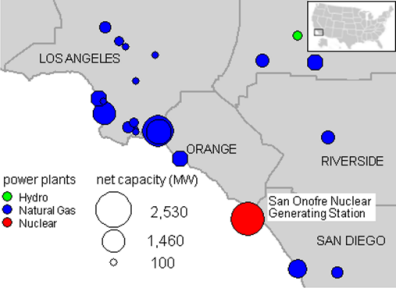
San Onofre Nuclear Outage Contributes to Southern California’s Changing Generation Profile


The January 2012 outage at the San Onofre Nuclear Generating Station (SONGS), located just north of San Diego, changed the California electricity market. SONGS Units 2 and 3 provided the market with a consistent source of baseload electricity since the units began operating in 1983 and 1984 (Unit 1, which began operating in 1967, permanently shut down in 1992). The loss of SONGS is a significant contributor to changes in the California electricity generating profile over the past year.

The SONGS facility is composed of two pressurized water nuclear reactors that together have a rated net summer capacity of 2,150 megawatts (electric). Nuclear power plants such as SONGS are important sources of baseload electricity because of their high output capability and low variable operating costs. SONGS played an important role in the electricity generation profile of the region as a result of its high output and location in the electric demand center of Southern California. Between 2002 and 2011, SONGS generated an average of 16,218,635 megawatt hours of electricity each year. This generation represented 18% of the total electricity generation in the Southern California Edison and San Diego Gas and Electric California ISO zones during this period. The units operated at full capacity during the summer, when demand was highest; output was lowest when either of the units underwent a refueling outage. Both units went offline this January and remain shut down, creating challenges for the Southern California electric grid.


Electricity demand between 2011 and 2012 remained essentially unchanged, leaving California utilities to deliver the same amount of electricity to customers without one of the largest in-state suppliers. In addition to the loss of generation by SONGS, in-state hydroelectric power generation was lower through July of this year. Increases in generation at natural gas-fired power plants in the state offset the reduced nuclear and hydro generation. Natural gas generation was up through July 2012 by 24% when compared to the same period of 2011.

Lower natural gas prices, in general, have moderated the increase in operating costs caused by using natural gas instead of nuclear generation in California so far in 2012. Average on-peak power prices in Southern California in 2012 so far are lower than in 2011, despite increased natural gas demand. The average on-peak wholesale price of electricity in Southern California through July 2012 was $30/MWh, down from $37/MWh during the same period in 2011. On the other hand, the average off-peak wholesale power price during this same period in 2012 was $21/MWh, up slightly from last year's price of $19/MWh. This was due to natural gas replacing nuclear power as the marginal fuel in Southern California during off-peak hours. The variable operating costs of nuclear power are very low, and it is often the marginal fuel during periods of low demand.

The reduction of available in-state supply resulted in California importing more electricity. Electricity imports through July 2012 were approximately 90 percent higher than in the first half of 2011. California historically imported significant amounts of electricity, since its wholesale power markets in the region are relatively open and generation from outside the state is often less expensive. Some power plants located in adjacent states are partially owned by California utility companies, and special agreements exist for exporting power to California. For instance, 18% of the Palo Verde Nuclear Power Plant, located in Tonopah, Arizona, is owned by California-based utilities.  (DOE-EIA)

Jamie Williams Replaces Bill Meadows at Wilderness Society


President Jamie Williams joined The Wilderness Society in 2012. Jamie leads The Wilderness Society in its mission to inspire Americans to care for our wild places.  He succeeded Bill Meadows, who led the organization for decades.

Before coming to The Wilderness Society, Jamie led The Nature Conservancy’s work to protect large landscapes in North America. There he focused on helping Conservancy programs and key partners protect large landscapes through innovative, private and public finance. He also spearheaded critical efforts to secure conservation funding in Congress, among many other accomplishments.

Previously, Jamie also served as the Conservancy’s Northern Rockies Initiative Director (2007–2010) and Montana State Director (1998–2007), where he focused on protecting the Northern Rockies’ largest, most intact landscapes through strong community-based programs, public-private partnerships, and ambitious capital campaigns.

Jamie started working for The Nature Conservancy in 1992 as its NW Colorado Program Manager (1992-1997) where he spearheaded a community-based conservation effort to conserve the Yampa River.
Jamie holds an M.E.S. from the Yale School of Forestry and Environmental Studies (class of ’89) and a B.A. from Yale University (class of ’85).

Jamie came to conservation as a western river guide and wilderness instructor for the National Outdoor Leadership School (NOLS). (Wilderness Society, The Hill, 3/5/2012)

Fiscal Cliff: President Obama's Plan

President Obama plans to open talks using his most recent budget proposal, which sought to raise taxes on corporations and the wealthy by $1.6 trillion over the next decade. That’s double the sum that House Speaker John Boehner (R-Ohio) offered Obama during secret debt negotiations in 2011.

Boehner suggested that negotiations resume on terms discussed in 2011, when he offered to raise $800 billion over the next decade through a rewrite of the tax code.Senate Minority Leader Mitch McConnell (R-Ky.) endorsed that general idea Tuesday but warned Obama not to overplay his hand, noting that the president’s $1.6 trillion tax request failed to receive a single vote in Congress in the spring.

Obama’s 2013 budget sought to reduce borrowing over the next 10 years by about $4 trillion, counting $1.1 trillion in agency cuts already in force. In addition to raising taxes, Obama proposed to slice $340 billion from health-care programs and to count about $1 trillion in savings from ending the wars in Iraq and Afghanistan.His budget request did not include reductions to health and retirement benefits, but Obama did consider such changes in his 2011 talks with Boehner, including raising the Medicare eligibility age from 65 to 67 and applying a stingier measure of inflation to Social Security.  (Wash Post, 11/13/2012)

Tuesday, November 13, 2012

President Obama Must Keep Lisa P. Jackson

PRESIDENT'S CORNER

By Norris McDonald

Lisa P. Jackson is the best administrator in the history of the U.S. Environmental Protection Agency.  President Obama must keep her in that post to assure environmental protection in the United States.  Not only is she equipped to synthesize the myriad environmental regulations into a cohesive green agenda, she does it with a pleasant disposition that even her opponents appreciate.

I sincerely hope that Administrator Jackson wants to continue as EPA chief.  It was a very tough four years and I watched as she held her ground in testifying before very hostile Congressional committees.  Administrator Jackson also traveled the country and the world as the nation's top environmental cop.

You know she was effective because both industry and environmentalists complained that she was either doing too much or not enough.  That strikes me as bringing a balanced approach to environmental protection.

Administrator Jackson successfully navigated a labyrinth of complex environmental regulations from clean air and water to toxic chemicals and children's health.  There was the Clean Air Mercury Rule, Cross State Air Pollution Rule,  new greenhouse gas regulations, new ozone rules, natural gas fracturing analyses, Renewable Fuel Standard Program, vehicle emissions regulations, underground injection regulations, fly ash containment pond regulations, utility water management regulations (cooling water intake structures), ground level ozone standard, New Source Performance Standards, among other important regulations.  These rules could prevent a wide range of serious health effects, including premature deaths, heart attacks and strokes, as well as acute bronchitis and aggravated asthma among the vulnerable, including children and the elderly.

Industry has initiated litigation to block the implementation of many of these regulations.  Environmentalists have complained that Administrator Jackson has not been aggressive enough in implementing these and other regulations.  Again, I think she must be doing something right if the opposite poles are complaining about implementation.

President Obama, please keep Lisa Jackson.  Administrator Jackson, the country needs you.  I understand the sacrifice this places on you and your family and I deeply appreciate your service.  I respectfully request that you give us four more years.

Monday, November 12, 2012

USA Could Be World Oil Production Leader By 2020

According to the International Energy Agency, a shale-oil boom will thrust the U.S. ahead of Saudi Arabia as the world's largest oil producer by 2020. In its annual World Energy Outlook, the IEA, which advises industrialized nations on their energy policies, said the global energy map "is being redrawn by the resurgence in oil and gas production in the United States."

The assessment contrasts with last year when it envisioned Russia and Saudi Arabia vying for the top position.  The report says North America could become a net oil exporter around 2030.

This shift will be driven primarily by the faster-than-expected development of hydrocarbon resources locked in shale and other tight rock formations that have just started to be unlocked by a new combination of two technologies: hydraulic fracturing and horizontal drilling.

The IEA's projections show U.S. oil production peaking in 2020 at 11.1 million barrels a day, up from 8.1 million barrels a day in 2011. Within a decade, the IEA forecasts that U.S. oil imports will drop by more than half to just four million barrels a day, from 10 million barrels a day currently. Much of this decline will be because of higher domestic production, but efforts to improve energy efficiency in the transport sector will also prove significant, the IEA said.

The IEA warned that the emergence of shale gas as a game changer in global energy has a downside risk, in that it will contribute to increased competition for water resources needed for energy projects.
Shale oil and gas are extracted by pumping water, sand and chemicals into the ground at high pressure to crack rocks open, a process known as hydraulic fracturing, or "fracking."
But the intensive use of water, "will increasingly impose additional costs," and could "threaten the viability of projects" for shale oil and gas, and also biofuels, the agency said. (WSJ, 11/12/2012)

Friday, November 09, 2012

California GHG Auction Poses Test For EPA Policy

California will hold its first GHG allowance auction Nov. 14 amidst legal challenges, industry warnings and a host of other hurdles that will test whether the state's landmark cap-and-trade program. The California GHG cap-and-trade allowance program provides a model for how EPA and other policymakers could address GHG emissions in the future.

President Obama signaled in his Nov. 7 acceptance speech that he hopes to use his second term to continue his efforts to address climate change but did not provide any specifics on how he hoped to address this. While EPA is currently working to craft a GHG performance standard for new power plants, the agency has resisted calls to develop a rule governing existing facilities or to create a cap-and-trade program using its existing authority.
California's cap-and-trade program is expected to be face lawsuits following the auction. The Pacific Legal Foundation (PLF), which advocates for property rights and limited government, is one organization working on multiple lawsuits against the program. A source says lawsuits will likely be filed after the Nov. 14 auction to ensure they are “ripe.” Among PLF's likely challenges are federal claims that the regulations violate the Constitution's commerce clause or state claims that regulators never received authorization from the California Legislature to hold GHG allowance auctions, amounting to an illegal tax on businesses, according to the source.  (Inside EPA, 11/9/2012)
 

Will EPA Accelerate Power Sector Rulemakings?

Will EPA now issue several high-profile utility sector rules that the administration was seen as delaying until after the presidential election?  EPA is likely to swiftly issue the final version of its proposed New Source Performance Standard setting first-time greenhouse gas (GHG) limits on power plants; a revised particulate matter ambient air limit that could ultimately prompt states to impose stricter pollution controls on coal-fired power plants; and a Tier III fuel and vehicle rule expected to require further cuts in the sulfur content of fuel.
Sen. James Inhofe (R-OK), stepping down as the environment committee's ranking member due to Senate GOP term limits, accused EPA of intentionally delaying rules until after the election so the Obama administration can skirt accusations that it is seeking to shutter fossil fuel production and associated economic pain before voters went to the polls. (Inside EPA)
 

EPA Update on Hydraulic Fracturing & Drinking Water

In today’s Federal Register , EPA announced it is accepting information through April 30, 2013, including data, studies, scientific analyses and other pertinent scientific information related to the potential impacts of hydraulic fracturing on drinking water resources.
This information will help to ensure EPA is current on evolving hydraulic fracturing practices and technologies as well as inform current and future research and ensure a robust record of scientific information
Consistent with the Agency’s commitment to using the highest quality information in its scientific assessments, EPA prefers that people submit information that has been peer reviewed. EPA will consider all submissions, but will give preference to peer reviewed data and literature sources. 
There are several ways to submit information to the docket for this request. Be sure to include the docket identification number Docket ID No. EPA-HQ-ORD-2010-0674 on every submission.
For more information about EPA dockets.
For more information about EPA's hydraulic fracturing study

Wind Week, Nov 12 - Nov 16

Wind energy tax credit proponents will be lobbying Congress hard when they return to Capitol Hill on November 12.  In fact, proponents are designating it as 'Wind Week.'  Wind-energy companies get 2.2 cents for every kilowatt-hour produced, taking as much as much as one-third off the costs in some areas.  This tax credit, which fuels wind’s growth, expires at the end of this year unless Congress votes to extend it.

The Center supports extension of the wind energy tax credit.

The Senate Finance Committee in August approved a one-year extension of the credit, which carries an estimated cost of $12 billion over the next decade. But the committee bill, which extends a series of expiring tax incentives, did not yet make it to the Senate floor. The House has not acted on the credit.

The industry will shed 37,000 jobs if the credit expires, according to a study by the consulting firm Navigant that was commissioned by the American Wind Energy Association (AWEA).  Fearing the loss of a subsidy that helps them compete with cheaper natural gas, some wind companies including a U.S. unit of Siemens AG (SIE) are already cutting jobs, adding urgency to a lobbying push in Washington. Since July, about 2,000 jobs have been shed by wind developers and suppliers, according to IHS Emerging Energy Research, a unit of IHS Inc. (IHS), based in Englewood, Colorado.

While wind is still a relatively small slice of the overall energy mix, about 2.3 percent of the electricity generated in 2011, it’s growing at a fast clip. Wind accounts for about 35 percent of the new generation capacity added in the past five years, second only to natural gas, according to the American Wind Energy Association, a Washington-based lobbying group. (The Hill, 11/8/2012, Bloomberg Business, 10/7/2012, DOE-EIA)