Monday, January 09, 2012

Mining Ban Near Grand Canyon Extended By Dept of Interior

The Interior Department is moving forward with a plan to ban new mining claims on 1 million acres near the Grand Canyon, which is known to contain high-grade uranium ore. Interior Secretary Ken Salazar is expected to finalize a 20-year ban on new mining claims on public land surrounding the Grand Canyon at an event Monday in Washington.

The Center supports the ban because of the threat to the Colorado River. The Colorado River, which runs through the Grand Canyon, is the source of drinking water for 26 million Americans.

The mining industry and some Republican members of Congress called the ban detrimental to Arizona’s economy and the nation’s energy independence. Rep. Jeff Flake (RAriz.) and other GOP lawmakers are backing legislation to prevent Salazar from moving forward with the 20-year ban.

The ban would not affect more than 3,000 mining claims already staked in the area near the Grand Canyon. The Bush administration had opened up the land to new mining claims. Salazar reversed the Bush policy in 2009 and called for a two-year moratorium on new mining claims around the canyon. He followed up with a six-month extension last year.  (AP, Wash Post, 1/9/2012)

Saturday, January 07, 2012

Beijing To Use PM 2.5 Air Quality Monitoring Level

Beijing will be the first Chinese city to publicize hourly air quality data based on the so-called PM2.5 standard, which measures particles smaller than 2.5 microns that cause the most serious health problems because they get deep inside the lungs. Chinese authorities now publish data that measure larger air particles of up to 10 microns in diameter. The decision represents one of the most significant examples yet of Chinese authorities yielding to public pressure exerted principally over the Internet via microblogs, which are similar to Twitter and have become hugely popular over the last few years.

The Beijing Municipal Environmental Protection Bureau said late Thursday that it would start PM2.5 readings every hour on its website by the start of the Lunar New Year on Jan. 23, and in real time by the end of 2012. The national government had previously said PM2.5 readings were only for internal use and did not have to be made public until 2016.

Beijing is ranked as one of the world's most polluted cities by the World Health Organization and is regularly shrouded in choking smog that grounds flights, forces parents to keep children indoors, and causes widespread respiratory problems. Beijing was the fifth worst with average annual levels of 121 micrograms per cubic meter of air, compared with a global average of 71 and a recommended level of 20.

The most polluted city in the U.S. based on PM10 was Bakersfield, Calif., with an average of 38 micrograms, according to the WHO report. (WSJ, 1/7/2012)

BP, Halliburton & Transocean Contest Federal Spill Charges

BP, Halliburton and Transocean Ltd are contesting charges that were issued by U.S. regulators in response to the explosion at the Deepwater Horizon drilling rig in 2010 and the ensuing oil spill. The Interior Department last year issued citations saying all the firms violated federal rules, leading to the worst offshore spill in U.S. history.

Charges were expected for BP, but the "incidents of noncompliance" given to Halliburton and Transocean surprised the oil industry. Contractors hired by a well's owner typically escape liability in such situations.

The citations will likely serve as the foundation for future fines from U.S. officials. Their significance, however, lies in the fact that they could be used in lawsuits that seek to assign blame for the oil spill.  The appeals will be reviewed by a panel of administrative judges known as the Interior Board of Land Appeals. (WSJ, 1/6/2012)

Friday, January 06, 2012

EPA Releases 2010 Toxics Release Inventory National Analysis

The U.S. Environmental Protection Agency (EPA) is releasing its annual national analysis of the Toxics Release Inventory (TRI), providing all Americans with vital information about their communities. The TRI program publishes information on toxic chemical disposals and other releases into the air, land and water, as well as information on waste management and pollution prevention activities in neighborhoods across the country. Total releases including disposals for the latest reporting year, 2010, are higher than the previous two years but lower than 2007 and prior year totals. Many of the releases from TRI facilities are regulated under various EPA programs and requirements designed to limit human and environmental harm.

Citizens have a right to know what toxic chemicals are being released into their communities. Over the past 25 years, the TRI program has helped citizens, emergency planners, public health officials, and others protect human health and the environment by providing them with toxic chemical release and other waste management data they need to make decisions that affect the safety and welfare of their communities.

The 2010 TRI data show that 3.93 billion pounds of toxic chemicals were released into the environment nationwide, a 16 percent increase from 2009. The increase is mainly due to changes in the metal mining sector, which typically involves large facilities handling large volumes of material. In this sector, even a small change in the chemical composition of the ore being mined -- which EPA understands is one of the reasons for the increase in total reported releases -- may lead to big changes in the amount of toxic chemicals reported nationally. Several other sectors also reported increases in toxic releases in 2010, including the chemical and primary metals industries.

Total air releases decreased 6 percent since 2009, continuing a trend seen over the past several years. Releases into surface water increased 9 percent and releases into land increased 28 percent since 2009, again due primarily to the metal mining sector.

EPA has improved this year’s TRI national analysis report by adding new information on facility efforts to reduce pollution and by considering whether economic factors could have affected the TRI data. With this report and EPA’s Web-based TRI tools, citizens can access information about the toxic chemical releases into the air, water, and land that occur locally. Finally, EPA’s first mobile application for accessing TRI data, myRTK, is now available in Spanish, as are expanded Spanish translations of national analysis documents and Web pages.

TRI data is submitted annually to EPA and states by multiple industry sectors including manufacturing, metal mining, electric utilities, and commercial hazardous waste facilities. Facilities must report their toxic chemical releases to EPA under the federal Emergency Planning and Community Right-to-Know Act (EPCRA) by July 1st of each year. The Pollution Prevention Act of 1990 also requires information on waste management activities related to TRI chemicals. (EPA)

More on the 2010 TRI analysis and TRI Web-based tools

More on myRTK

3rd Merger Attempt For Duke Energy & Progress Energy

Duke Energy and Progress Energy are submitting a new proposal for their corporate merger this month as the North Carolina power companies make a third attempt to appease federal monopoly concerns.  According to Progress CEO Bill Johnson, who would run the combined Duke Energy out of Charlotte,  the challenge will be to preserve the $650 million in savings promised to regulators in the Carolinas while also selling off a sizable chunk of electricity into wholesale markets to appease federal regulators. Part of the modeling process is: What would you sell and at what price, and who would buy it?

Federal regulators have not questioned the merits of the proposed merger, which would create the nation's largest electric utility. Duke and Progress believe the efficiencies achieved through the merger would make it easier to pay for building new power plants, comply with costly environmental regulations and upgrade the aging power grid.

Executives at Duke and Progress had expected to have the merger completed in December, but they ran into snags when the Federal Energy Regulatory Commission (FERC) twice rejected their proposals. The federal commission said the companies must address concerns that the combined Duke would become so large it could manipulate wholesale electricity prices.  FERC said they could sell off wholesale power, sell off stakes in their power plants or build more transmission lines. (Winston-Salem Journal, 1/5/2012)

Wednesday, January 04, 2012

National Radon Action Month

EPA Recognizes Nat'l Radon Action Month: Test for Radon Gas to Protect Health
 
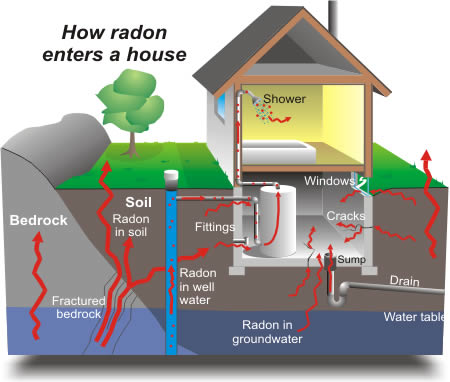
The U.S. Environmental Protection Agency (EPA) is encouraging Americans this January, as part of National Radon Action Month, to take simple and affordable steps to test their homes for harmful levels of radon gas. Radon, a colorless odorless gas, is the leading cause of lung cancer among non-smokers. Radon can seep into a home from underground and if left to accumulate, high levels of radon can cause lung cancer. Improving indoor air quality by increasing awareness of environmental health risks, such as radon gas, supports healthier homes and communities.

Approximately 21,000 people die from radon related lung cancer each year in the United States, yet elevated levels of this health hazard can be prevented through these simple steps:

EPA and the U.S. Surgeon General recommend that all homes, both with and without basements, be tested for radon. Affordable Do-It-Yourself radon test kits are available at home improvement and hardware stores and online or a qualified radon tester can be hired.

EPA recommends taking action to fix radon levels above 4 Picocuries per Liter (pCi/L). Addressing high radon levels often costs the same as other minor home repairs.

By testing and fixing for elevated levels of radon in your home, you can help prevent lung cancer while creating a healthier home and community.
Radon is a natural, radioactive gas that comes from the breakdown of uranium in soil, rock and water. It can enter homes through cracks in the foundation or other openings such as holes or pipes. In addition to testing for radon, there now are

In 2011, EPA announced the Federal Radon Action Plan, along with General Services Administration and the Departments of Agriculture; Defense; Energy; Health and Human Services; Housing and Urban Development; Interior; and Veterans Affairs. This action plan will demonstrate the importance of radon risk reduction, address finance and incentive issues to drive testing and mitigation, and build demand for services from industry professionals.

More information on how to Test, Fix, Save a Life, obtain a text kit, or contact your state radon office: 
or call 1-800-SOS-RADON

More information on the Federal Radon Action Plan

Solar Energy Industries Association Merges with Solar Alliance

The Solar Energy Industries Association (SEIA), which represents 1,100 solar companies around the country has merged with the Solar Alliance in order to focus more on state-level policy issues. The focus on state-level policy will allow SEIA to speak in energy markets across the country and communicate that solar is cost competitive in all 50 states. As part of the merger, SEIA is establishing a department for state affairs, which will include staff from the Solar Alliance.

The Solar Alliance, which counts about three-dozen solar companies as members, works with state officials and policymakers to advocate for solar energy. The merger comes at a time when the solar industry faces a number of challenges, including an uncertain regulatory environment and competition from countries such as China, which has invested billions in renewable energy. (The Hill, 1/2/2012)

Tuesday, January 03, 2012

American Water Infrastructure Funding, Repair & Replacement

At a Senate hearing last month, it was estimated that, on average, 25 percent of drinking water leaks from water system pipes before reaching the faucet. The same committee was told it will take $335 billion to resurrect water systems and $300 billion to fix sewer systems.

About $9.4 billion more per year is needed for water and sewer work between now and 2020, according to a study released last month by the American Society of Civil Engineers. Without that, many Americans should prepare for regular disruption of water service and a jump in contamination caused by sewage bacteria, the study said.

Nationwide, an estimated 1.7 trillion gallons of water leaks from pipes each year before it can be put to use. About 900 billion gallons of raw sewage flows into waterways.

The District of Columbia's water system servers as a good example of the needs in other cities:
The average D.C. water pipe is 77 years old with many being installed in the 19th century. Sewers are even older. Most should have been replaced decades ago. Emergency crews rush from site to site to tackle an average of 450 breaks a year. Raw sewage flows into the Potomac, the Anacostia and Rock Creek whenever it rains hard — hundreds of times a year — an annual flush of about 3 billion gallons, according to D.C. Water. Firefighters are equipped with computerized cue sheets to tell them which of the 9,157 hydrants in the District have enough water pressure to put out a fire.

The average water and sewer bill has gone up about 50 percent in just four years, to $65 a month for single-family homes. Unless there is federal regulatory relief, it may climb to $100 a month by the end of the decade. The decrepit system has 1,300 miles of water pipe and 1,800 miles of sewers. The water pipes are being replaced at an average of 11 miles a year. At that rate, replacing them all will take more than 100 years.
 (Wash Post, 1/2/2012)

Monday, January 02, 2012

Center Special Projects Chairman Builds Water Wells in Senegal

Doc Sloan Works Water Resources in Africa

Dr. Sloan started a fresh drinking water campaign in Senegal more than 20 years ago that has led to the location and construction of 158 wells in Africa. Doc worked to elevate the capabilities to include state-of-the-art, real time water quality monitoring with passive filtering techniques that can be utilized without the need for large power requirements, complicated maintenance or technical skills that are frequently not available in locations where the capability is needed most.

Dr. Sloan Inspects Fresh Water Well in Senegal

Dr. Sloan works with many organizations to help fund these programs. There are numerous studies on the topic, but it is generally accepted worldwide that the provision of clean, fresh drinking water to the general population could have profound and lasting benefits of good health by virtue of the significant reduction in the transmission of infectious disease.

Doc Sloan and his son Dr. Erik Sloan inspect fishing fleet in Africa
 as part of a Sustainable Resource Revenue opportunity for local communties

Dr. Sloan can provide further information about the programs and donations can be made directly to the Center for these critical efforts at DocSloan@cfece.org  or contact us at cfece@msn.com , or by phone at the main office at 443-569-5102.

[More]

DC Water Breaks Ground on $2.6 Billion Clean Rivers Project

Largest Construction Project in DC Since Building of Metro

Anacostia River projects overview and tunnel alignment.

The District of Columbia Water and Sewer Authority (DC Water) broke ground in October 2011 on its largest construction project ever, and the District’s largest since Metro was built. The $2.6 billion Clean Rivers Project aims to nearly eliminate combined sewer overflows to the Anacostia and Potomac rivers and Rock Creek, also improving the health of the Chesapeake Bay.


Massive machinery like this will be used to tunnel along, and under, the Anacostia River.

As in many older cities, about one-third of the District has a combined sewer system. A combined sewer overflow (or CSO) occurs during heavy rain when the mixture of sewage and stormwater cannot fit in the sewer pipes and overflows to the nearest water body. CSOs direct about 2.5 billion gallons of combined sewage into the Anacostia and Potomac rivers and Rock Creek in an average year. CSOs contain bacteria and trash that can be harmful to the environment.


The 23-foot diameter tunnels that will store combined sewer overflows will be similar to this one.

The Clean Rivers Project consists of massive underground tunnels to store the combined sewage during rain events, releasing it to the Blue Plains Advanced Wastewater Treatment Plant after the storms subside.


Blue Plains Advanced Wastewater Treatment Plant is the largest advanced wastewater treatment plant in the world.

The first tunnel system, and the largest, will serve the Anacostia River. The first part of that system, named the Blue Plains Tunnel, is 23 feet in diameter and runs more than 100 feet deep. It will extend from Blue Plains in Southwest DC, roughly along the east bank of the Potomac, crossing under the Anacostia and extending along the west bank to about RFK Stadium.


DC Water, Officials Break Ground on $2.6 Billion Clean Rivers Project

Since the early 1900s, only sewer systems with separate pipes (for sewage and stormwater) have been installed in the District. The Clean Rivers Project is the result of a 2005 federal consent decree. DC Water is beginning discussions with the parties on reopening the agreement. The goal would be to explore green-development technologies that could reduce or eliminate future pieces of the project, create jobs, green the District and reduce rate increases for customers. (DC Water)

Natural Gas At Lowest Price In A Decade: Below $3


U.S. natural gas prices fell to their lowest point in more than two years ($2.989 per million British thermal units-BTUs), as new drilling techniques unlocked vast new stores of natural gas from shale formations and other so-called unconventional reservoirs. Unusually mild temperatures across much of the U.S. have also reduced demand for gas to heat homes and offices. Natural gas for February delivery settled Friday at the lowest closing price for the commodity since September 2009. It closed below $3 in the winter for the first time in nearly a decade.

The sub-$3 levels for gas prices in the winter really point to the incredible amount of nonconventional gas that has come onto the market the last two years. Production levels, a mild winter and the gas in storage have combined to crush natural gas prices this month.
 
Natural gas traded as high as $13 per million British thermal units in July 2008. But in recent years, domestic production boomed, with horizontal drilling techniques and hydraulic fracturing, or "fracking," helping producers unleash a flood of gas from shale formations in Pennsylvania, Arkansas and elsewhere.

Natural gas production in the lower 48 states hit a record 71.3 billion cubic feet a day in October, according to the U.S. Department of Energy.

Cheap gas hurts energy company profits. Chesapeake Energy Corporation is the second-largest U.S. producer of natural gas after Exxon Mobil Corporation.

The Environmental Protection Agency recently ordered power plants to cut emissions of pollutants by 2016. Gas producers envision plants ditching coal for cleaner-burning gas. If the U.S. is going to make a very large move on its greenhouse gas reductions, natural gas will be a big part of that. (WSJ, 12/31/2011)

Department of the Interior Accelerating Solar Projects

The U.S. Department of the Interior says it has now pushed through 27 renewable-energy projects totaling 6,500 megawatts since 2009, compared with about 1,800 megawatts in all prior years, the result of more staff working on a fast-tracked permitting process. As Interior has devoted more resources to clean energy, the oil and gas industry has accused it of slow-walking drilling permits and not opening enough federal lands and waters for exploration.

Energy projects must get federal permits if they are built on public land or if their transmission lines pass through a federal right of way. Most wind projects aren't located on public land, but some big U.S. solar and geothermal power plants are being built on public lands in the West.

Before 2010, the U.S. had never approved a utility-scale solar farm on public land. Interior has now approved 16 solar projects totaling about 5,600 megawatts. It is projected that the department would surpass the goal of permitting 10,000 megawatts of renewable energy on public land next year, three years ahead of a schedule Congress laid out in 2005. (WSJ, 1/2/2012)

Venezuela To Pay Exxon Mobil $908 Million Instead of $7 Billion


An international arbitration panel awarded U.S. oil major Exxon Mobil Corp. about $908 million in a verdict over oil assets nationalized by Venezuelan President Hugo Chavez in 2007. The payout is substantially lower than the $7 billion that Exxon was seeking in restitution. Venezuelan state oil company Petroleos de Venezuela SA (PdVSA) got off lightly, to put it mildly.  Both parties are still awaiting a decision on the suit filed by Exxon's local subsidiary, Mobil Cerro Negro Ltd., against Venezuela in front of the World Bank's International Centre for Settlement of Investment Disputes, or ICSID, where the Chavez administration is facing around 20 pending cases. With billions in potential payouts looming, the number of cases has been the source of constant concern for holders of Venezuelan sovereign bonds.

Hugo Chavez
The verdict comes four years after Exxon, the world's largest publicly traded oil company, left Venezuela in a spat with the country's government, which decreed that the state oil monopoly would have the majority stake in joint ventures with foreign partners. By law, PdVSA now holds at least 60% of all oil projects.

Exxon has said that it invested around $750 million into the Cerro Negro facility. The company reduced its claim to $7 billion from an initial claim of $12 billion.

PdVSA posted a net profit of $4 billion during the first six months of 2011. The Venezuelan oil monopoly has faced declining oil production and cash flow problems in recent years as Chavez diverts large portions of revenue toward social projects, which critics say has resulted in insufficient investments into maintenance. (WSJ, 1/2/2012)

Saturday, December 31, 2011

Court Delays Enforcement of EPA Cross State Air Pollution Rule

A federal appeals court in Washington ruled Friday that the U.S. Environmental Protection Agency must delay enforcement of a regulation aimed at reducing power plant pollution in 27 states. The rule was to go into effect Monday, January 1, 2012, but the court granted a delay sought by more than a dozen electric power companies, municipal power plant operators and states.

The EPA, in a statement, said it was confident that the rule would ultimately be upheld on its merits. But the agency said it was “disappointing” the regulation’s health benefits would be delayed, even if temporarily.

Republicans in Congress had unsuccessfully attempted to block the rule through legislation, saying it would shutter some older, coal-fired power plants and kill jobs. While the Republican-controlled House passed legislation to block the rules, the Senate — with the help of six Republicans — rejected an attempt to stay the regulation.

And theWhite House had threatened to veto it. The rule, finalized by the Environmental Protection Agency in July, replaces a 2005 Bush administration proposal that was rejected by a federal court.  In the first two years, the EPA estimates that the regulation and some other steps would have slashed sulfur dioxide emissions by 73 percent from 2005 levels and nitrogen oxides bymore than half.

Sulfur dioxide and nitrogen oxide pollution from power plant smokestacks can be carried long distances by the wind and weather. As they drift, the pollutants react with other substances in the atmosphere to form smog and soot, which have been linked to various illnesses.

Six states — Texas, Nebraska, Florida, Kansas, Louisiana and Ohio — had asked the court for the delay. All would have had to reduce pollution from their power plants under the regulation. They were joined by local power plant operators and power generating companies, including Entergy, Luminant Generation and GenOn Energy. (Wash Post, 12/31/2011)

Friday, December 30, 2011

Federal Judge Puts Hold On Portion of California CO2 Reg


Federal Judge Lawrence J. O'Neill, of the U.S. District Court for the Eastern District of California in Fresno, rejected the state's greenhouse-gas emissions regulations, finding that California's effort to control fuel imports infringed on Congress's constitutional authority over interstate commerce. It is a victory for refiners and ethanol producers because the ruling says the regulations would have discriminated against crude oil and ethanol imported into the state. The ruling means that refiners and ethanol producers won't have to buy credits when importing oil and ethanol into California, as the regulations would have required in certain cases.

The decision puts on hold a major portion of California's effort to cut greenhouse-gas emissions, at a time when the most-populous state's stance has taken on extra importance nationwide because of a stalemate in Washington over greenhouse-gas legislation.

Refiners and ethanol producers filed a lawsuit over the issue two years ago, arguing the rules penalize suppliers that use crude oil or ethanol from outside the state and would lead to higher costs for consumers.
Judge O'Neill hasn't issued a final decision on the case, but on Thursday he barred California from enforcing the rules while the lawsuit continues.

In setting out the rules, the California Air Resources Board calculated a "carbon intensity" score for different types of fuel, favoring biofuels over carbon-heavy crude, and also assigning imported fuels a higher "carbon intensity" score. To comply with the rules, companies could in some cases be forced to buy credits for fuel scoring high on the carbon intensity scale.

California said the rules on importing were justified because suppliers burn fuel and emit carbon when they transport fuels into the state.

The California Air Resources Board, which put the rules in place in 2010, said it would appeal the ruling and ask the court to "stay its preliminary injunction order in the shortest time possible."

The low-carbon rules on transportation fuels were approved by the California Air Resources Board as part of a sweeping initiative to limit greenhouse-gas emissions, signed in 2006 by then-Gov. Arnold Schwarzenegger. The Republican governor had allied himself with Democratic lawmakers in Sacramento in seeking to make California a world leader in the fight against carbon emissions.

Under the legislation, the state aims to cut its total emissions by 174 million metric tons by 2020, with most of the reduction intended to come from a cap-and-trade program on carbon credits. About 15 million metric tons, or 9% of the total, would come from the low-carbon fuel requirements such as mandating more use of ethanol and biodiesel in vehicles.

The rules have come under broad attack, legally and politically. A ballot measure in 2010 known as Proposition 23 would have kept provisions of the legislation from going into effect until California's unemployment rate dropped by more than half. That measure was defeated by voters, but Judge O'Neill's order adds new uncertainty. (WSJ, 12/30/2011)

EPA Finalizes 2012 Renewable Fuel Standards

The U.S. Environmental Protection Agency (EPA) today finalized the 2012 percentage standards for four fuel categories that are part of the agency’s Renewable Fuel Standard program (RFS2). EPA continues to support greater use of renewable fuels within the transportation sector every year through the RFS2 program, which encourages innovation, strengthens American energy security, and decreases greenhouse
gas pollution.

The Energy Independence and Security Act of 2007 (EISA) established the RFS2 program and the annual renewable fuel volume targets, which steadily increase to an overall level of 36 billion gallons in 2022. To achieve these volumes, EPA calculates a percentage-based standard for the following year. Based on the standard, each refiner and importer determines the minimum volume of renewable fuel that it must ensure is
used in its transportation fuel.

The final 2012 overall volumes and standards are:

Biomass-based diesel (1.0 billion gallons; 0.91 percent)

Advanced biofuels (2.0 billion gallons; 1.21 percent)

Cellulosic biofuels (8.65 million gallons; 0.006 percent)

Total renewable fuels (15.2 billion gallons; 9.23 percent)

Last spring EPA had proposed a volume requirement of 1.28 billion gallons for biomass-based diesel for 2013. EISA specifies a one billion gallon minimum volume requirement for that category for 2013 and beyond, but enables EPA to increase the volume requirement after consideration of a variety of environmental, market, and energy-related factors. EPA is continuing to evaluate the many comments from stakeholders on the proposed biomass based diesel volume for 2013 and will take final action next year.

Overall, EPA’s RFS2 program encourages greater use of renewable fuels, including advanced biofuels. For 2012, the program is implementing EISA’s requirement to blend more than 1.25 billion gallons of renewable fuels over the amount mandated for 2011. (EPA)

More information on the standards and regulations

More information on renewable fuels

Thursday, December 29, 2011

Oklahoma based Chesapeake Energy Corporation will sell $865 million worth of Pennsylvania pipelines to a spun-off subsidiary as part of the oil and gas explorer's broader push to trim debt and close a projected funding gap. Chesapeake formed Chesapeake Midstream, a master limited partnership, or MLP, with private investment fund Global Infrastructure Partners. Shares were sold publicly last year with Chesapeake retaining about a 35% stake. Chesapeake Midstream Partners LP will gain a 47% interest in about 200 miles of pipelines and other gas-gathering assets in Pennsylvania's Marcellus Shale formation.

Chesapeake, the second largest natural gas producer in the U.S., has become the oil patch's predominant deal maker, relying increasingly on asset sales and partnerships to fund drilling and acquisitions of new production fields. The company says it plans to raise $7 billion in 2012 through joint ventures in oil and gas fields, divesting its stakes in oil producer Chaparral Energy Inc. and oilfield service company FTS International Inc., and selling public shares of its own oilfield service company. By comparison, it expects operating cash flow to amount to $6 billion next year.
 
Wednesday's deal is Chesapeake's second with its spin-off. A year ago it sold its network of Louisiana pipelines for $500 million. Acquiring the Pennsylvania assets, which handle more than a billion cubic feet of gas per day, will make Chesapeake Midstream the largest gathering and processing master limited partnership as measured by throughput volume. (WSJ, 12/29/2011)

Monday, December 26, 2011

James Connaughton Gets It Right With Cap & Trade

James Connaughton
Former White House Council On Environmental Quality (CEQ) Chairman James Connaughton is remaining true to the cap and trade philosophy that was developed by his former boss's father.  Republicans and Democrats have switched sides on emissions trading, but Jim is sticking with an approach that the Center agrees is the best way to mitigate emissions.

Connaughton states:
The more market-based approach [cap-and-trade regulatory system] creates opportunities to optimize your pollution control of both [smog-forming compounds] and air toxics. Performance-based [regulations] set the target, usually based on benefit/cost, and then let the private sector sort out the most cost-effective way to get there. And there’s no better example of that than the acid rain trading program. Its main purpose was to deal with the acidification associated with power plant emissions. And no program has been more successful at lower costs, with lower bureaucracy, with virtually no litigation.

If you have a really effective and stringent market-based approach to air pollution, you’re going to get rid of a lot of your air toxics. Now, are you still left with peaks and valleys from one region to another? Yes. But are the peaks and valleys a lot smaller than they were before you did the market-based regulation? Absolutely. The “hot spot” becomes a less and less applicable concept as we get dramatic pollution reductions. You’re always going to have an unequal distribution of emissions of some sort, but pollution is so low now that, relatively speaking, the highs are just not that far away from the lows. Before, there used to be big differences.
(More-The Center for Public Integrity Interview, 12/22/2011))

China Coal Company Buys Into Australia Coal Mining

Yanzhou Coal Mining Company will become the largest standalone coal miner on the Australian stock exchange after Gloucester Coal Ltd. announced that its largest shareholder, Noble Group Ltd. will accept a $2.2 billion reverse takeover. Gloucester’s directors urged shareholders to accept the offer, which is conditional on the successful completion of due diligence and an independent expert’s report finding that the offer is fair and reasonable. Singapore’s Noble Group owns 64.5% of Gloucester, and confirmed in a statement that it intends to accept the offer in the absence of a superior proposal. Singapore-listed Noble Group said that it expects book a gain of about $200 million from its divestment.

Gloucester said the merged entity will be 23% owned by its shareholders and 77% by Yanzhou, which will contribute about $2.7 billion of debt immediately after the deal is completed.

Diversified mining houses BHP Billiton Ltd. and Rio Tinto Ltd. are the biggest coal miners listed in Australia, the world’s biggest exporter of coal.

Rio Tintoand partner Mitsubishi Corp. recently bought the remaining shares they didn’t hold in Coal & Allied Industries Ltd. in a deal that valued the target at A$10.8 billion.

U.S. coal miner Peabody Energy Corp. in November gained control of Macarthur Coal Ltd. with a A$4.9 billion bid, and Whitehaven Coal Ltd. this month agreed to buy smaller Aston Resources Ltd. for almost A$2.3 billion.

By buying foreign assets outright, China is filling projected supply gaps as well as reducing its exposure to fluctuations in coal prices. (WSJ, 12/23/2011)

Thursday, December 22, 2011

E.U. Emissions Trading System Takes Effect January 1, 2012


The Court of Justice of the European Union in Luxembourg ruled in a lawsuit brought by the Air Transport Association of America, American Airlines and United Continental that aviation can be included in the E.U.'s emissions trading system (ETS). The decision cannot be appealed. The European Court of Justice earlier ruled that the EU could, from next year, include all carriers in a carbon trading system targeting polluters as part of the EU's efforts against climate change. The court said the plan "infringes neither the principles of customary international law at issue nor the Open Skies Agreement" covering transatlantic flights.

The US Department of Transportation said it opposed a court ruling which told US airlines to get ready to obey emissions rules in the same way EU companies do. US and Canadian carriers argued the decision was discriminatory and amounted to a backdoor tax. US Secretary of State Hillary Clinton had warned of reprisals ahead of the ruling.

Airlines landing or taking off in Europe will have to join the ETS on Jan. 1, 2012, getting 85 percent of their emissions certificates for free and buying the rest at auction. Even flights conducted by the U.S. Navy will be included.

U.S. air carriers said they would "comply under protest" when the law takes effect but would also press their argument in British court and in international forums.

Environmental groups welcomed the ruling as a necessary nudge for the U.S.

The aviation sector's burden in the ETS for 2012 is expected to be close to €500 million, based on current price forecasts for 2012, when the sector will face a shortfall of around 60 million tons. The cost rises to €9 billion total by the end of 2020.

The CO2 emissions of aircraft operators will be capped at 97 percent of their average 2004-2006 levels next year and 95 percent from 2013 forward. Airlines that do not use all their allowances can sell the excess, while those that are short will have to buy more. Airlines will need to start counting fuel consumption and emissions in 2012, and bills are expected to go out in early 2013, unless they can stop this measure.

Airlines initially would only be required to pay for 15% of the carbon they emit and would be allocated free allowances to cover the other 85%.  Depending on decisions by airlines on how much to pass on to customers, the European commission has calculated that costs per passenger could rise between €2 and €12, much less than the €100 per allowance penalty it would impose on airlines that do not comply.

Several countries including Canada, the U.S., China and Russia have opposed these rules, and the airlines are hoping the fight moves to the political realm where countries can negotiate new rules through the Montreal-based International Civil Aviation Organization. (AFP, E&E Publishing, 12/21/2011, The Guardian, 12/21/2011)

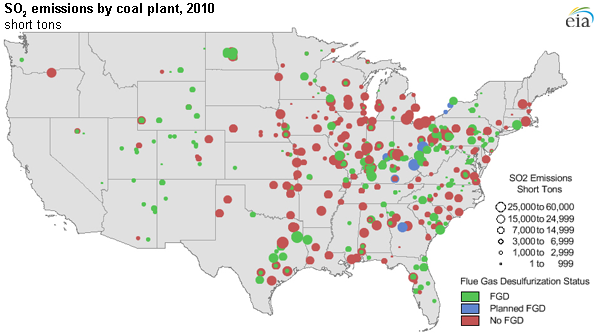
Coal Plants Without Scrubbers Account for a Majority of U.S. SO2 Emissions

Source: U.S. Energy Information Administration, based on Form EIA-860,
EPA Continuous Emissions Monitoring System, Ventyx Energy Velocity.
Note: Circles denotes plants with capacity greater than 25 megawatts.
 Red circles are unscrubbed coal plants, green circles indicate coal plants
 with scrubbers, and blue circles indicate coal plants that plan to add scrubbers.

Coal-fired electric power plants make up the largest source of national sulfur dioxide (SO2) emissions. The Cross-State Air Pollution Rule (CSAPR) calls for a 53% reduction in SO2 emissions from the electric power sector by 2014. To meet this goal, plant owners can implement one of or a combination of three main strategies: use lower sulfur coal in their boilers, retire plants without emissions controls, or install emissions control equipment—primarily flue gas desulfurization (FGD) scrubbers. Plants with FGD equipment generated 58% of the total electricity generated from coal in 2010, while producing only 27% of total SO2 emissions.

SO2 is formed during the combustion of coal. The amount of SO2 produced depends on the sulfur content of the coal burned in a boiler. FGD scrubbers remove the SO2 from a boiler's post-combustion exhaust (flue gas) by passing it through an alkaline solution. This process is also effective in removing acid gases, such as hydrochloric acid. Acid gases are expected to be regulated under EPA's Air Toxics Rule.

Source: U.S. Energy Information Administration,
based on EPA CEMS 2010 data. Note: Graph includes generation
 and emissions from plants with capacity greater than 25 megawatts.

FGD scrubber SO2 removal rates vary based on characteristics such as the specific equipment type, age, and the sulfur content of the coal. New systems have the potential for removal efficiencies of up to 98% according to EPA estimates.

The sulfur content of coal varies by rank. Generally, bituminous coal and lignite coal have higher sulfur content than subbituminous coal, but this can vary by region. Bituminous coal is concentrated in the eastern half of the U.S, while subbituminous coal can be found in the west. Lignite production is concentrated in Texas, Louisiana, and North Dakota.

Subbituminous coal has the lowest sulfur content of the three main coal types, so plants that burn subbituminous coals have been less likely to add scrubbers. Of the plants without scrubbers, the ones burning subbituminous coal generated 69% of the electricity while only emitting 48% of the associated emissions in 2010 (see chart). Even though lignite-burning plants accounted for 16% of SO2 emissions from scrubbed plants in 2010, they generated only 8% of the electricity from scrubbed plants. (DOE-EIA)

Mercury Utility MACT Rule Closes Old Plants & Creates Jobs

PRESIDENT'S CORNER

By Norris McDonald

President George W. Bush issued the first mercury rules, but they were shot down in court.  Now the Obama administration has issued mercury regulations (including other contanimants) that will probably close the oldest, dirtiest coal-fired power plants.  Some utilities claim this will lead to job losses, but EPA Administrator Lisa P. Jackson counters that scrubber installations will create more jobs than will be lost via plant closure.  I guess we will just have to wait and see.  One thing is sure, scrubbers are now as large and complicated as the power plants they serve.  They can cost just about as much as the power plants too.  So signficant jobs should be created by their installation. 

According to EPA:
It will cost about $9.6 billion annually to implement but will provide substantially more in health benefits each year. The EPA estimates the new regulation’s safeguards — which are slated to fully take effect in three years will prevent as many as 11,000 premature deaths a year by 2016 .

The EPA said some 60% of the 1,400 affected coal- and oil-fired generating units already complied with the rule. Many power companies, including Exelon Corp. and Calpine Corp., support the rules because they rely less on coal-burning generation.

Jackson estimated that only 4.7 gigawatts of the nation’s 1,000 gigawattsof electricity capacity,or less than one-half of 1 percent of the nation’s plants, would have to shut down as a result of the new standards.
Of course, critics complain that some of the health stats have been aggregated with other air laws and claim the numbers are inflated.  Yet one thing is clear, mercury is a neurotoxin that can harm the nervous system.

As usual, the litigation has begun, but this rule should withstand lawsuits.  The entire air regulation area frustrates me because it includes, in my opinion, a merry-go-round of legislation, regulation, litigation and it all starts over again.  However, our standards for visible air pollution are stricter than EPA's standards: if you can see the air, it is not healthy to breathe.  So therer would be many more nonattainment days for criteria pollutants than are designated under the EPA system.

We applaud EPA's rule and believe the utility sector will comply to the maximum extent possible.

Justice Department Clears Exelon / Constellation Merger

The Justice Department on Wednesday gave antitrust clearance to the merger of Exelon Corp. and Constellation Energy Group Inc. but said the companies must divest three electricity-generating plants in Maryland in order to proceed with the deal. The department said the transaction as originally proposed would have lessened competition for wholesale electricity and increased prices for consumers in the Mid-Atlantic region. The companies agreed to sell the plants as part of a proposed settlement that was filed in a Washington federal court.

The stock-for-stock transaction, announced in April, has been valued at nearly $8 billion.

The companies still need the approval of the Maryland and New York public-service commissions, as well as the Federal Energy Regulatory Commission and the Nuclear Regulatory Commission.

Constellation Chairman and Chief Executive Mayo Shattuck and Exelon President and Chief Operating Officer Christopher Crane will proceed with the merger proposal in 2012. (WSJ, 12/22/2011)

Maryland Public Service Commission Fines Pepco $1 Million

The Maryland Public Service Commission (PSC) has fined the Potomac Electric Power Company (PEPCO) $1 million for tree-trimming failures that have led to dramatically higher outage durations.  The PSC has also threatened to disallow future rate increases unless it improved its performance.  And just when we were impressed with PEPCO's tree trimming action.  They must have know this was coming because they have been out tree trimming like crazy in Prince George's County, Maryland. 

Although each day of outages costs businesses and consumers tens of millions of dollars, we have felt that PEPCO has done a pretty good job of restoring power.  We have to admit that they have fallen down a bit on the tree trimming though.  Appears they are trying to make up for it now.  But do not forget that the legislator and regulators REALLY BURNED PEPCO WITH BOTCHED DEREGULATION. The order said that tree-trimming failures led to dramatically higher outage durations and frequencies in 2010.

The commission order said:

“Pepco’s history of inconsistent and sometimes contradictory tree trimming practices between 1999 and 2010 imposed more costs and outages on customers than otherwise would have been the case had the company adhered to one coherent strategy. Pepco’s reliability problems were amplified by the utility’s refusal to increase the frequency of its tree trimming from once every four years to every two years. Those lapses contributed to poor performance in national reliability studies and increased the power system’s vulnerability to storms "
The commission also concluded that Pepco failed to conduct periodic inspections of its distribution lines and did not conduct after-storm inspections or patrols. Interestingly, PEPCO is replacing distribution lines along with the more aggressive tree trimming. The commission was especially critical of Pepco’s inability to accurately estimate how long it would take to restore service after major storms.

The order noted that Pepco had already initiated a five-year, $300 million program to improve reliability and planned to pass the cost along along to consumers. The commission cautioned that if the program did not reduce outages, the utility might have to pay those costs itself.

A Washington Post analysis found that the average Pepco customer experienced 70 percent more outages than customers of other big-city utilities and that the lights on average stayed out more than twice as long.  Accoring to The Post, Pepco’s reliability began declining five years ago, but company officials failed to immediately mobilize to counteract the decline. (Wash Post, 12/22/2011)

Tuesday, December 20, 2011

National Academy of Sciences Report on Virginia Uranium

The National Academy of Sciences (NAS) and National Academy of Engineering have completed a 22-month review of the proposed Virginia Uranium proposal to mine element in that state.  The 302-page report says uranium could be mined, but the company would have to protect workers, the public and the environment in Virginia. The report said that “steep hurdles” need to be surmounted before Virginia’s longtime ban on uranium mining could be lifted.

Virginia has a decades old ban on uranium mining and many in Richmond expected the study to provide conclusions supportive of lawmakers seeking to lift the ban.  Instead struck more of a cautionary tone.

The state’s Coal and Energy Commission, which ordered the study, will review the findings and recommend to the General Assembly in the next few weeks whether Virginia should lift the ban. The study did not recommend whether the site should be mined. Critics argue that the study is tainted because the company, Virginia Uranium, paid the $1.42 million cost for the report.  This sort of arrangement is not unusual for such reports and is often the case in the preparation of environmental impact statements.

It is being reported that Virginia Uranium has aggressively lobbied lawmakersand has spoken to 100 of 140 legislators and flew more than a dozen of them to France and Canada to visit uranium mines. It is also being reported that Virginia Uranium has donated more than $150,000 to candidates in Virginia and retained five of Richmond’s most influential lobbying and public relations firms.

The 20-member Coal and Energy Commission asked the National Academy of Sciences in 2008 to conduct the study, despite objections from the General Assembly. Several studies have been released.

Thirty-two governmental organizations in Virginia and North Carolina have passed resolutions to keep the ban.

Uranium would be mined underground. (Wash Post, 12/20/2011)

The NAS Report

"Uranium Mining in Virginia: Scientific, Technical, Environmental, Human Health and Safety, and Regulatory Aspects of Uranium Mining and Processing in Virginia (2011)"

Report in Brief

A range of health and environmental issues and related risks are important considerations as Virginia deliberates on whether to rescind its almost 30-year moratorium on mining uranium. Although there are internationally accepted best practices to mitigate most of these risks, there are still steep hurdles to be surmounted before mining and processing could take place within a regulatory setting that appropriately protects workers, the public, and the environment.

Key Findings

• Of the sites in Virginia explored so far, only the Coles Hill uranium deposit appears to have the potential to be economically viable. Extensive site-specific tests would be required to determine the most appropriate mining and processing methods for each uranium deposit. Geological exploration carried out to date indicates that underground mining or open-pit mining are the probable methods of extraction for uranium deposits in Virginia.

• Protracted exposure of workers in uranium mining and processing facilities to radon decay products generally would be expected to represent the greatest radiation-related health risk. Exposure to radon is associated with lung cancer, a link that has been most clearly established in uranium miners exposed to radon. Cigarette smoking increases the risk.

• Other potential health risks for mine workers apply to any type of hard rock mining or other large-scale industrial or construction activity. The inhalation of silica dust and diesel exhaust, to which miners in general can be exposed, increases the risk of lung cancer and silicosis.

• Off-site releases of radionuclides could present some risk of radiation exposure to the general public, depending on how the release occurred and the density of the nearby population.

• Uranium tailings, the solid or semi-solid waste left after processing, present potential sources of radioactive contamination for thousands of years. Modern tailings management facilities are designed to prevent the release of radioactive contaminants for at least 200 years, but longer-term monitoring results from modern tailings facilities are not yet available.

• Virginia is susceptible to extreme natural events, including heavy precipitation and earthquakes, and any uranium mining and/or processing facility would need to take the possibility of such events into consideration during planning.

• Three over-arching best practices should be guiding principles if uranium mining were to be permitted: the need to plan at the outset of the project for the complete life cycle of mining, processing, and reclamation; the need to engage and retain qualified experts familiar with internationally accepted best practices for all aspects of a project; and the need to encourage meaningful and timely public participation throughout the life cycle of a project, beginning at the earliest stages.

• At a more specific level, there are numerous internationally accepted best practices that would contribute to operational and regulatory planning for uranium mining in Virginia. These cover the health, environmental, and regulatory impacts of uranium mining.


Additional Studies:

TECHNICAL REPORT ON THE COLES HILL URANIUM PROPERTY PITTSYLVANIA COUNTY, VIRGINIA, 2007


Proposed Coles Hill Virginia Uranium Mine and Mill: An Assessment of Possible Socioeconomic Impacts, RTI International, December 2011.

Origin of Uranium Mineralization at Coles Hill Virginia (USA) and its Natural Attenuation within an Oxidizing Rock-Soil-Ground Water System, 2001. 

Monday, December 19, 2011

Fracking Creates Lucractive Market For Gas Liquids

U.S. shale-oil and natural-gas boom opens another lucrative market—gas liquids used to make plastics

The hydraulic fracturing (fracking) method used to unlock vast amounts of crude and natural gas from previously unproductive shale formations across the U.S. is also are reaping large stores of ethane, propane and butane, known as natural-gas liquids. This is resuscitating the U.S. petrochemical industry, which just a few years ago was being strangled by the high costs of the raw materials.

Methane is the main component of natural gas, usually accounting for 70%–90% of the total volume produced. If gas contains more than 95% methane, it is sometimes termed dry or lean gas, and it will produce few, if any, liquids when brought to the surface. Gas containing less than 95% methane and more than 5% of heavier hydrocarbon molecules (ethane, propane, and butane) is sometimes called rich gas or wet gas. This gas usually produces hydrocarbon liquids during production.

Natural gas liquids include propane, butane, pentane, hexane and heptane, but not methane and ethane, since these hydrocarbons need refrigeration to be liquefied. The term is commonly abbreviated as NGL.

Processing ethane into chemicals is 50% cheaper than using crude oil-derived naptha and its availability has made U.S. petrochemical companies the envy of overseas competitors. It also brings the prospect of lower prices for auto parts, Styrofoam and other products.

The boom has turned into a potential profit center for oil-and-gas producers, as well as for the pipeline companies that transport the fuel. Demand for ethane grew to about 933,000 barrels a day during the first half of 2011, up from 812,000 barrels a day in 2009, according to Bentek Energy. But like the other fuels extracted from remote shale deposits, the biggest problem is how to get it to facilities that can process it.

A dearth of pipelines created a bottleneck that drove the price that petrochemical companies pay for ethane to 95 cents per gallon in the third quarter, from 60 cents at the start of the year, according to Dow Chemical Company.  But even with that price spike, chemical companies prefer ethane over other chemicals.  Ethane is still by far the preferred feed here in the United States and is much more cost-competitive than all of its equivalents.

To free up the flow of natural-gas liquids, about 12,000 miles of pipeline needs to be built by 2035, costing $14.5 billion, according to data from the Interstate Natural Gas Association of America, a trade association. Until those pipelines are built, higher production will make the market volatile as short-term fixes such as rail transport are used.

Some pipeline operators are working to expand their reach into oil- and gas-producing shale formations. Enterprise Products Partners LP is spending $7 billion on projects. That includes a 280,000 barrel-a-day pipeline joint venture with Anadarko Petroleum Corp. and Enbridge Energy Partners LP and a wholly owned 125,000-barrel-a-day pipeline, both of which will transport natural-gas liquids from the shale formations in the Northeast and mid-continent areas to the U.S. Gulf Coast, where the bulk of the petrochemical companies are located. DCP Midstream Partners LLC is also expanding its natural-gas liquids business, building two pipelines with a combined capacity of 350,000 barrels a day from the mid-continent and Texas to the Gulf Coast. (WSJ, 12/19/2011, NatgasInfo, Schlumberger)

Asplundh Tree Expert Company

Since 1928 the Asplundh Tree Expert Company has been dedicated to safe, efficient and innovative line clearance services to the utility industry. Reliable, uninterrupted power is an important service provided by the world's electrical utilities and Asplundh has the expertise to help keep the power flowing. Diversification over the years has opened up vegetation management services to other specialized markets such as railroads, pipelines, municipalities and departments of transportation.

Their Mission Statement

At Asplundh, their mission is to be the recognized world leader in providing professional, safe, cost-effective and environmentally sustainable vegetation management and other utility-related services.

Who They Are and What They Do

A family-owned and operated corporation headquartered near Philadelphia, Pennsylvania, Asplundh has grown to employ over 26,000 service professionals throughout the U.S., Canada, New Zealand and Australia.

As a full-service utility contractor Asplundh performs tree pruning and removals, right-of-way clearing and maintenance, vegetation management with herbicides and emergency storm work and logistical support. Asplundh is the parent company of UtiliCon Solutions, Ltd. whose subsidiaries provide overhead and underground line construction, meter reading and installation, infrared inspection, utility pole maintenance, and street lighting/traffic signal services. (Asplundh)

[Note:  PEPCO has contracted with Asplundh for tree trimming services in the Washington, DC region.]